Manufacturing
Wraps up in 12 Minutes
How to Create Demand for a New Product in B2B Manufacturing

Published On October 7, 2026
Wraps up in 12 Minutes
Published On October 7, 2026
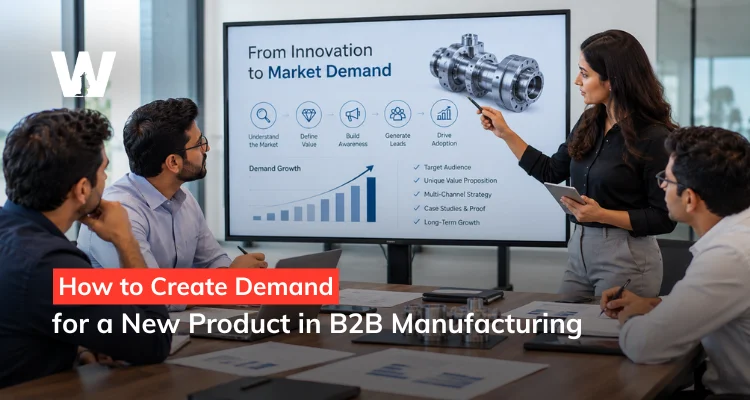
Manufacturers can spend months, sometimes years, developing a new product. Engineering teams refine the design, production teams solve manufacturing challenges, management approves the investment, prototypes are tested and the final product is eventually ready for the market. Then marketing enters the picture and everyone expects enquiries to start arriving.
The problem is that developing a good product and creating market demand for it are two completely different challenges. A technically superior product does not automatically create buyer interest, particularly in B2B manufacturing where purchasing decisions are considered, technical and often involve multiple stakeholders.
This becomes even more difficult when the product introduces a new technology, solves a problem differently or belongs to a category buyers are not actively searching for. In those situations, simply creating a product page, publishing a launch announcement and running Google Ads may not generate meaningful demand because the market has not yet learned why it needs the product.
Successful manufacturing demand generation therefore needs to begin before the buyer starts searching for the product itself. Manufacturers need to create awareness around the problem, educate the market about its commercial impact, introduce a better way of solving it and build enough evidence for buyers to consider changing how they currently operate.
That requires a different approach to launching industrial products.
Manufacturing companies are naturally product focused. When significant engineering effort has gone into developing something better, it is reasonable to believe the improvements will attract buyers. The new machine may operate faster, consume less energy, produce tighter tolerances or require less maintenance than existing alternatives.
The challenge is that customers do not experience those improvements until they understand why they matter.
Imagine an industrial equipment manufacturer developing a new separation system that can recover significantly more valuable material from a waste stream. Internally, the team may be excited about its magnetic configuration, belt design, rotor technology or throughput capacity. Those specifications matter to technical buyers, but they may not be what initially creates demand.
The potential customer may instead be concerned about rising material losses, low recovery rates, contamination, labour requirements or the amount of valuable non ferrous metal being lost during processing. Their starting point is the business or operational problem, not necessarily the manufacturer's new technology.
If marketing begins by repeatedly announcing the new machine, it assumes the buyer already understands the problem, knows the solution category and is actively searching for a new supplier.
For a genuinely new product, that assumption can be expensive.
One of the most important distinctions in B2B manufacturing marketing is the difference between creating demand and capturing demand.
Demand capture focuses on buyers who already recognise their problem and are actively looking for a solution. They might search Google for “industrial filter press pump manufacturer,” “precision machining supplier,” “eddy current separator manufacturer” or another established product category. SEO, Google Ads, product pages, comparison pages and RFQ campaigns can be highly effective because demand already exists.
Demand creation operates earlier. The buyer may be experiencing a problem but has not yet decided to purchase a new product or may not even know that a different solution exists. Marketing therefore needs to help the buyer recognise the cost of the problem, understand the available alternatives and see why solving it should become a priority.
This distinction matters because many manufacturers invest almost entirely in demand capture. They optimise product pages, bid on existing keywords, attend exhibitions and contact companies already known to purchase the category. These activities can work well, but they largely compete for demand that already exists.
When launching an innovative product, manufacturers may need to create new demand before they can capture it.

That shift from selling the product to educating the market should influence the entire launch strategy.
Before developing a campaign, manufacturers should clearly define the problem their new product solves and how significant that problem is for the customer.
Suppose a manufacturer develops an advanced Eddy Current Separator that improves the recovery of aluminium and other non ferrous metals from mixed waste. The company could immediately build its marketing around the machine itself, focusing on specifications, rotor speed, belt width, capacity and construction.
Those details will eventually matter, but they may not create the initial demand.
The stronger marketing opportunity may exist around questions such as why valuable aluminium is being lost during sorting, how recycling facilities can improve non ferrous metal recovery, how much revenue is lost through inefficient separation and how operators can improve recovery without significantly increasing labour costs.
These questions connect directly with problems that plant managers and business owners already understand.
Once the market understands the commercial problem, the manufacturer can introduce the technology that solves it. The conversation moves naturally from problem awareness to solution awareness and finally to product consideration.
This is a fundamental principle of demand generation for manufacturers: market the problem before expecting the market to care about the product.
Another mistake manufacturers make when launching new products is defining the audience too broadly. “Automotive companies,” “recycling businesses” or “pharmaceutical manufacturers” may describe industries, but they do not identify the people involved in making the purchase decision.
Complex B2B products are rarely purchased by one individual. An engineer may evaluate whether the technology works. A plant manager may care about throughput and operational reliability. Procurement may focus on pricing, supplier capability and commercial terms. Finance may evaluate return on investment, while senior management may want to understand whether the investment improves productivity or creates a competitive advantage.
The same product therefore needs different messages for different stakeholders.
For an engineer, the strongest message might concern technical performance. For operations, it might be reduced downtime. For finance, it could be payback period. For management, it may be increased capacity or lower production costs.
This is why a manufacturing demand generation strategy should define not only the Ideal Customer Profile (ICP) but also the buying committee within that customer. Current B2B launch guidance similarly emphasises multi-channel buyer journeys rather than treating a launch as a single announcement.
When the buying committee is understood, marketing becomes much more precise.
When buyers are not searching for a new product, manufacturers need to create an information environment around the problem it solves.
SEO can play an important role here, but keyword research needs to extend beyond product keywords. Instead of only targeting searches for the machine or component, manufacturers should research questions around operational problems, applications, alternatives, costs, performance and purchasing decisions.
Returning to our separation equipment example, the content strategy could address topics such as improving metal recovery rates, reducing valuable material loss, increasing recycling plant profitability, comparing separation technologies, understanding the economics of material recovery and identifying the causes of poor separation performance.
The objective is not simply to generate blog traffic. Each topic should move potential buyers closer to understanding the commercial problem and the available solution.
Over time, this creates a content ecosystem around the problem rather than a website containing only product pages.
New industrial products often require more education than established products because buyers need to understand not only what the product does, but also why they should change what they are currently doing.
This is where technical content becomes particularly important. Manufacturers can use engineering articles, application guides, webinars, videos, comparison content, technical FAQs and demonstrations to explain the problem and the technology behind the solution.
A technical article might explain why certain materials are difficult to separate. A video could show the difference in recovery rates between two approaches. A webinar could demonstrate how operators can calculate the financial impact of material losses. A comparison guide could explain where different separation technologies are most effective.
The goal is to help buyers become more informed.
When a manufacturer consistently provides useful information before asking for an enquiry, it can begin building authority around the category itself. Instead of appearing only when someone is ready to request a quotation, the company becomes part of the buyer's education process.
Manufacturing buyers are naturally sceptical of performance claims. A statement such as “20% higher efficiency” may attract attention, but buyers will immediately want to know how the figure was calculated, under what conditions the product was tested and whether similar results can be achieved within their operation.
Proof therefore needs to be built into the demand generation strategy from the beginning.
Pilot projects can be particularly valuable for new industrial products. An early customer willing to test the technology can provide operational data, feedback, photographs, videos and eventually a case study. Product launch frameworks similarly recognise early pilot customers as valuable because they generate real usage data and proof before a full scale marketing push.
Instead of simply claiming that the product performs better, manufacturers can demonstrate the improvement. Before and after performance data, application videos, ROI calculations, customer testimonials, technical test results and documented case studies can all reduce perceived purchasing risk.
For complex manufacturing products, proof often creates more demand than promotion.
A manufacturer introducing a new solution has an opportunity to become an educator within the market.
Instead of restricting communication to product announcements, founders, engineers and technical leaders can discuss the broader changes happening within the industry. They can explain emerging operational challenges, regulatory changes, new technologies, inefficiencies in traditional processes and how the market may evolve over the next several years.
This type of thought leadership is particularly useful when the company is effectively introducing buyers to a new way of solving an existing problem.
If the manufacturer can shape how the market thinks about the problem, it becomes much easier to establish the company's solution as part of the answer.
Thought leadership can be distributed through LinkedIn, trade publications, technical articles, webinars, podcasts, industry panels, newsletters and the company's own website. The objective should not be for executives to repeatedly promote the product. Their role is to help the market understand why change is necessary.
When a product is unfamiliar, buyers need reassurance that the technology is credible. This is where Digital PR can play an important role in manufacturing demand generation.
Coverage in relevant engineering publications, trade media, industry associations and technical platforms can introduce the innovation to audiences beyond the manufacturer's existing network. Expert commentary from the company's engineers can also help establish authority around the technical problem the product addresses.
The emphasis should be on relevance rather than simply chasing large publications. For a specialised manufacturing product, coverage in a respected trade publication read by engineers and plant managers may be significantly more valuable than a mention in a large general business publication.
Original research can make this strategy even stronger. A manufacturer could analyse industry data, production trends, operational inefficiencies or technical challenges and publish the findings as an industry report. The research gives publications something useful to discuss while simultaneously positioning the company around the problem its product solves.
This is also where Digital PR, SEO and Generative Engine Optimization can begin supporting each other. Relevant third party mentions can expand the wider information environment around the company and its expertise rather than leaving all authority confined to the manufacturer's own website.
Paid advertising can accelerate a manufacturing product launch, but different channels need to perform different jobs.
If meaningful search volume already exists around the product category, Google Search can be highly effective for capturing active demand. However, a genuinely new product may have little or no direct search demand of its own. Manufacturing paid media guidance recognises this problem and recommends phased approaches that build awareness before focusing heavily on conversion.
In that situation, manufacturers can target the problems and established categories surrounding the innovation rather than relying only on the product name. LinkedIn can help reach specific job functions and industries, while video can demonstrate the product in operation. Retargeting can then keep the company visible to buyers who have interacted with technical content, videos or product pages.
Paid media should therefore reflect the buyer's level of awareness. Asking someone who has never heard of the technology to immediately “Request a Quote” is very different from retargeting an engineer who has already watched a technical demonstration and downloaded a specification sheet.
A new manufacturing product should not have a single launch date from a marketing perspective.
The market should begin hearing about the problem before the product is officially launched. This creates an opportunity to educate potential buyers, gather feedback and build anticipation before the commercial announcement.
The launch itself can then introduce the solution through product demonstrations, technical content, customer or pilot evidence, media coverage, email communication and sales outreach. After launch, marketing should continue building proof, answering buyer questions and distributing content based on what the market is actually responding to.
This matters because B2B buying rarely happens immediately after an announcement. Current B2B product launch guidance similarly treats launches as integrated campaigns that build awareness, explain value and generate demand across multiple touchpoints rather than as one-day events.
Manufacturers should therefore think in terms of launch momentum, not launch day.
Trade exhibitions remain extremely important across many manufacturing sectors, but companies often treat them as three or four day events rather than multi-week demand generation opportunities.
Before the exhibition, manufacturers can identify relevant accounts, announce demonstrations, publish educational content around the problem and schedule meetings with high value prospects. Paid campaigns and email outreach can target people likely to attend, while sales teams can prioritise accounts they want to meet.
During the exhibition, the objective should go beyond collecting business cards. Product demonstrations can become video content, technical questions can become future articles, customer conversations can provide market intelligence and interviews with engineers can create thought leadership material.
After the event, every meaningful interaction should enter a structured follow up process. Visitors who saw the product demonstration may receive technical documentation, case studies or ROI information. Other prospects can enter retargeting and email campaigns based on their interests.
One exhibition can therefore create months of content, remarketing audiences, sales conversations and market insights when it is treated as a campaign rather than an isolated event.
Marketing can create awareness and interest, but manufacturing sales teams still need to convert that interest into commercial conversations.
This is particularly important with new products because salespeople may be explaining a solution the buyer has never purchased before. A standard product brochure is unlikely to answer every objection.
Sales enablement should therefore be developed alongside the marketing campaign. Technical presentations, competitor comparisons, ROI calculators, case studies, application guides, FAQs, objection handling documents, demonstration videos and specification sheets can help sales teams explain both the problem and the product more effectively.
Sales feedback should also flow back into marketing. If prospects repeatedly ask the same technical question, that question should become content. If buyers consistently raise the same objection, marketing should address it before the sales conversation. If one application generates stronger interest than expected, the campaign can shift more resources toward that segment.
Demand generation becomes much more effective when marketing and sales operate as one feedback system.
Manufacturing marketing should ultimately be measured against commercial outcomes.
Website traffic, impressions, video views and engagement can help indicate whether awareness is increasing, particularly during the early stages of demand creation. However, they should not become the final definition of success.
As the campaign develops, manufacturers should monitor indicators such as branded search growth, engagement from target accounts, technical document downloads, sample requests, demonstration requests, RFQs, distributor enquiries, qualified opportunities and pipeline value.
The measurement model should also recognise that demand creation and demand capture operate on different timelines. A technical article read today may influence an RFQ several months later. A prospect who sees a machine at an exhibition may return through Google after discussing the investment internally.
This is why manufacturing marketing attribution is rarely as simple as identifying the last click before an enquiry.
The more useful question is: Are more of the right companies becoming aware of the problem, engaging with our expertise and moving toward a commercial conversation?
For manufacturers preparing to introduce a new product, the first 90 days should focus on building the market systematically rather than immediately maximising lead volume.
During the first 30 days, the priority should be market clarity. Define the Ideal Customer Profile, buying committee, core problem, positioning, commercial value proposition and competitive alternatives. Research existing search demand, understand how buyers currently solve the problem and build the foundational product, technical and educational content required for the campaign.
Days 31 to 60 should focus more heavily on demand creation. Begin publishing thought leadership, educational SEO content, technical videos and expert insights. Introduce Digital PR, trade publication outreach, LinkedIn distribution, email campaigns and targeted awareness advertising. The objective during this stage is to make the problem and solution increasingly visible among the right audience.
Days 61 to 90 can increase the emphasis on demand capture and conversion. Search advertising, retargeting, product demonstrations, case studies, webinars, RFQ campaigns, account based outreach and structured sales follow up can convert the awareness generated during the earlier phases into meaningful commercial conversations.
This sequence is not rigid. Manufacturers entering an established category may already have substantial demand available to capture and should not ignore it while building awareness. The important principle is to understand how much demand already exists and how much demand still needs to be created before deciding where to invest.
Launching a new manufacturing product is not simply a marketing communications exercise. It is a market development challenge.
Manufacturers often invest heavily in engineering, production capacity and product development but expect the market to understand the innovation almost immediately after launch. When enquiries do not arrive quickly enough, the conclusion is often that marketing is not working. In reality, the market may simply need more education before meaningful demand can exist.
At Wolfable, we believe manufacturing demand generation should begin with the customer's problem rather than the manufacturer's product. The objective is to understand what is changing in the buyer's business, make the commercial impact of the problem visible, educate the market about better ways of solving it and then introduce the product with enough evidence to make the change credible.
SEO, paid media, thought leadership, Digital PR, exhibitions, technical content and sales outreach all have a role to play, but they should not operate as disconnected activities. They should work together to move the market from problem awareness to solution awareness, product consideration and eventually commercial action.
For manufacturers introducing genuinely new products, this distinction becomes critical. You cannot rely entirely on capturing search demand that has not yet developed.
Sometimes, before you can capture the demand, you have to create it.