Manufacturing
Wraps up in 5 Minutes
How to Build a Go to Market Strategy for a New Manufacturing Product

Published On October 1, 2026
Wraps up in 5 Minutes
Published On October 1, 2026
Developing a new manufacturing product can take months or even years. Engineering teams work through design challenges, prototypes are tested, production processes are established, suppliers are finalised and significant capital may be committed before the product is commercially ready.
Yet one critical question is often addressed much later: How exactly are we going to take this product to market?
A new product does not become commercially successful simply because it performs well. The manufacturer still needs to identify the customers most likely to buy it, understand why they would switch from their current solution, establish the right positioning and pricing, determine how the product will reach the market and give sales teams enough evidence to convert interest into orders.
That is the role of a go to market strategy.
For manufacturing companies, a go to market strategy is particularly important because industrial buying rarely follows a simple path from advertisement to purchase. Products may require technical evaluation, samples, demonstrations, certifications, plant visits, distributor involvement, commercial negotiation and approval from several stakeholders before an order is placed.
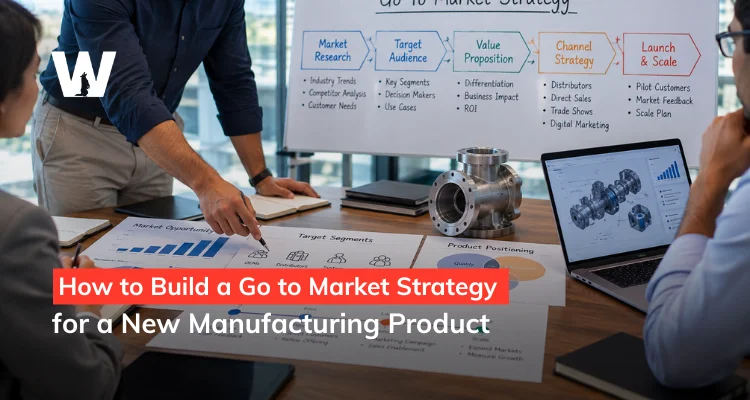
A strong manufacturing GTM strategy therefore needs to connect market opportunity, customer need, positioning, pricing, sales channels, marketing, technical proof and sales execution into one commercial plan.
A go to market strategy defines how a manufacturer will introduce a product to the right market and turn that opportunity into revenue. It determines which customers should be targeted first, what problem the product solves for them, how it should be positioned against existing alternatives, what price the market can support, how customers will buy it and which sales and marketing activities will create the initial pipeline.
It is important to distinguish a GTM strategy from a marketing plan. Marketing is one part of going to market, but it does not answer every commercial question. A company can have an excellent website, run advertising campaigns, attend exhibitions and publish content while still struggling because the underlying market, positioning, pricing or channel decisions are wrong.
The strongest GTM strategies therefore make choices before campaigns begin. They define not only what the business will do, but also which markets, applications and channels it will deliberately not prioritise during the initial launch.
This focus is particularly important in manufacturing because a new product may technically serve dozens of industries. Trying to market it to all of them at the same time can dilute the positioning, complicate sales conversations and spread the marketing budget too thinly.
Before deciding how to promote a new product, manufacturers need to validate whether the market opportunity is commercially meaningful.
Internal enthusiasm can sometimes create false confidence. Engineers may believe the product is technically superior, management may see an attractive market opportunity and existing customers may provide encouraging feedback. None of these automatically proves that enough customers will pay for the product at a price that supports the business case.
Market validation should therefore examine the size of the opportunity, existing alternatives, competitive intensity, customer dissatisfaction, switching barriers, expected pricing, buying frequency and the urgency of the problem being solved.
Most importantly, validation should include conversations with actual potential buyers.
If a manufacturer has developed a new industrial pump, for example, the team should understand why plants currently choose competing pumps, what causes them to replace equipment, which performance problems matter most, what certifications are required, how purchasing decisions are made and what would justify switching suppliers.
The objective is not simply to confirm that companies use pumps. It is to establish whether there is a specific market segment where the new product has a sufficiently strong reason to win.
A GTM strategy built on assumptions can produce a highly organised launch into the wrong market.
One of the most important GTM decisions is deciding where not to launch.
A new manufacturing product may have applications across automotive, recycling, pharmaceuticals, chemicals, food processing, mining and other industries. The natural temptation is to present every possible application because doing so appears to increase the size of the opportunity.
Commercially, the opposite can happen.
If the website says the product is suitable for ten industries and fifteen applications, potential buyers may struggle to understand where the manufacturer has genuine expertise. Sales teams also have to manage numerous value propositions, competitors and technical requirements at the same time.
A better approach is often to identify a beachhead market: the segment where the product has the strongest combination of customer pain, competitive advantage, commercial value and realistic accessibility. Current GTM frameworks similarly emphasise starting with a focused segment rather than trying to address the entire available market at launch.
Winning one application creates references, case studies, customer feedback and market credibility. Those assets can make expansion into the next segment considerably easier.
Manufacturing segmentation should usually go deeper than industry categories.
Imagine a manufacturer launching a new high performance industrial filtration system. Saying the target customer is the “chemical industry” is not enough. Two chemical plants can have completely different filtration requirements depending on their processes, materials, production volumes, regulatory environment and existing equipment.
A more useful Ideal Customer Profile might define the target according to plant size, process type, operating environment, existing technology, production challenge, geographic market and potential economic impact of the problem.
Application based segmentation is particularly powerful in manufacturing because industrial products are purchased to perform specific jobs. The more precisely the manufacturer understands that job, the easier it becomes to build meaningful positioning.
The question therefore changes from “Which industries can use our product?” to “In which applications does our product create enough value that customers have a compelling reason to change?”
That is a much stronger foundation for a GTM strategy.
Even when the target company is clear, manufacturers still need to identify who participates in the purchase decision.
Industrial buying commonly involves several stakeholders. Engineers may evaluate technical suitability, plant managers may focus on productivity and reliability, procurement may compare suppliers and commercial terms, finance may assess return on investment and senior management may evaluate the broader strategic value of the purchase.
Each stakeholder sees the same product differently.
A new machine that reduces energy consumption, for example, can be positioned around technical performance for engineering, operating cost for finance, reliability for plant management and payback period for senior leadership.
A strong GTM strategy maps these stakeholders before the launch and defines what each needs to believe before the purchase can progress.
This affects much more than advertising. It determines what information belongs on the website, which sales materials need to be created, what data should be included in technical documentation and which objections the sales team should be prepared to address.
Manufacturers often begin positioning with product features because features are tangible and easy to communicate.
The machine is faster. The component has tighter tolerances. The pump consumes less power. The system requires less maintenance.
Those advantages matter, but they become compelling only when connected to a customer problem.
A strong positioning strategy should therefore begin with the operational or commercial problem the product solves. If a machine improves throughput, what does additional throughput mean financially? If a component lasts longer, what is the cost of premature failure? If a filtration system reduces downtime, how much production is currently being lost?
The strongest value propositions connect three elements:
Customer problem → Product advantage → Commercial outcome
Instead of:
“Our new system offers advanced separation technology.”
the market should understand:
“Recover more valuable material from the same waste stream without increasing labour requirements.”
The technology provides credibility. The outcome creates interest.
Competitive analysis in manufacturing often begins by comparing specifications against similar products.
That is necessary, but another competitor is frequently more important: doing nothing.
Customers may already have machinery installed, supplier relationships established and processes built around the existing solution. Even if a new product is technically better, switching introduces risk, training requirements, approval processes and potentially production disruption.
The GTM strategy therefore needs to answer two questions.
First, why is this product better than competing products?
Second, why should the customer change anything at all?
The second question can be harder.
Manufacturers need to quantify the cost of maintaining the status quo wherever possible. Lost production, excessive energy consumption, high maintenance costs, scrap, material loss, labour requirements or quality problems can create a commercial reason to change.
Without that reason, technical superiority alone may not be enough.
Pricing a new manufacturing product should not be treated as a final calculation performed after the rest of the GTM strategy is complete.
Price influences positioning, distributor economics, customer expectations and the sales process. A premium product needs enough differentiation and evidence to justify its premium. A product sold through distributors needs enough margin to motivate the channel. A capital equipment purchase may require a strong ROI story because customers evaluate it against other investment priorities.
Manufacturers should therefore consider the total commercial model rather than only manufacturing cost plus margin.
This includes list pricing, distributor or representative margins, volume discounts, installation costs, service contracts, warranties, payment terms, minimum order quantities and any recurring aftermarket revenue.
Current industrial GTM guidance also highlights an important channel reality: pricing needs to work for both the manufacturer and the partners expected to sell the product. If the channel cannot make sufficient margin, the product may technically be available through distributors while receiving very little active selling attention.
Pricing should ultimately reflect both customer value and the economics required to bring the product successfully to market.
Manufacturers have several potential routes to market: direct sales, distributors, dealers, manufacturers' representatives, ecommerce in certain categories or a hybrid combination.
There is no universally correct channel.
The right approach depends on product complexity, deal value, geography, customer concentration, installation requirements, after sales service and how buyers already purchase within the category.
A technically complex capital machine may require direct engineering and sales involvement because customers need demonstrations, application assessment and commercial consultation. A standardised industrial component sold across multiple geographic markets may benefit more from distributors with established customer relationships.
A hybrid model is also common. The manufacturer may sell directly to strategic accounts while distributors serve smaller customers or specific territories.
The important point is to design the channel intentionally.
Simply appointing distributors does not create a route to market. Partners need clear positioning, commercial incentives, training, technical documentation, sales tools and reasons to prioritise the new product alongside everything else they already sell.
Before selecting marketing channels, manufacturers need to understand how much demand already exists.
If buyers already search for the product category, the GTM strategy can place greater emphasis on demand capture. SEO, Google Search campaigns, product pages, directories and distributor visibility can help the manufacturer appear when buyers are actively evaluating suppliers.
A genuinely innovative product presents a different challenge. Buyers may experience the problem but have little awareness of the new solution. Search volume around the product itself may therefore be limited.
In that situation, the manufacturer needs demand creation.
Educational content, thought leadership, technical webinars, Digital PR, trade publications, LinkedIn, industry research, exhibitions and video demonstrations can help buyers understand the problem and discover a new approach to solving it.
This distinction is critical because marketing cannot efficiently capture demand that does not yet exist.
A strong manufacturing GTM strategy therefore asks early: Are we entering an established category or creating a new way of solving the problem?
The answer changes the entire marketing mix.
The website often becomes the first place potential buyers go after hearing about a new manufacturing product.
It needs to do much more than display specifications.
A strong product experience should explain the problem, application, product differentiation, technical capabilities, commercial benefits and evidence supporting the claims. Buyers should be able to find technical documentation, certifications, videos, FAQs, case studies and clear routes to speak with sales or request more information.
SEO research should also happen before the website structure is finalised. Understanding how buyers search for the problem, technology, application and product category can influence page architecture and content strategy.
For innovative products, manufacturers should not rely exclusively on product keywords. Content around problems, applications, alternatives, comparisons and purchasing questions can capture buyers earlier in the research journey.
The objective is to build a digital environment capable of supporting the entire GTM motion rather than adding a product page to the website a few days before launch.
One of the strongest assets in a manufacturing GTM strategy is evidence.
Buyers want to know whether the product works in environments similar to theirs. This makes pilot installations, beta customers, technical testing and early reference customers particularly valuable.
A successful pilot can generate performance data, photographs, demonstration videos, customer feedback and eventually a case study. These assets give both marketing and sales something much stronger than product claims.
If the new product reduces energy consumption, document the reduction. If it improves throughput, measure the improvement. If it reduces downtime, establish the baseline and compare results after implementation.
This creates a simple principle for manufacturing GTM:
Prove first. Scale second.
Scaling advertising before establishing credible proof can generate awareness without enough confidence to convert it into revenue.
A manufacturer can execute an excellent marketing campaign and still underperform if the sales team is not prepared for the new product.
Before launch, salespeople should understand the Ideal Customer Profile, target applications, value proposition, competitive positioning, pricing structure and common objections. They should also understand when the product is not a good fit.
Sales enablement materials should support those conversations. Depending on the product, this might include technical presentations, application guides, comparison sheets, ROI calculators, case studies, demonstration videos, FAQs and objection handling documents.
For distributor led launches, the same preparation becomes even more important. A distributor representative carrying dozens of product lines is unlikely to study a complicated technical launch without clear training and simple tools.
The objective is not merely to make the product available to sales.
It is to make the product sellable.
For many industrial sectors, trade exhibitions remain an important route to market. They allow manufacturers to demonstrate products, meet distributors, gather customer feedback and speak directly with technical buyers.
However, the exhibition itself should not become the entire launch strategy.
A better approach begins several weeks before the event. Target accounts can be identified, meetings scheduled, educational content distributed and product demonstrations promoted. Paid campaigns and email outreach can support the event while sales teams prioritise the companies they want to meet.
During the exhibition, questions from prospects provide valuable market intelligence. Which features attract attention? Which objections appear repeatedly? Which applications generate unexpected interest? Which competitors are buyers comparing?
After the exhibition, this information should feed back into the GTM strategy. Follow up campaigns, sales outreach, remarketing, technical content and product positioning can all be refined using what the market revealed.
The exhibition then becomes a market validation and pipeline event, not simply a booth and product launch.
A manufacturing GTM strategy becomes easier to manage when the launch is phased.
The first phase should focus on validation and preparation. The manufacturer confirms the priority market, target application, buying committee, positioning, pricing, route to market and early proof.
The second phase builds market readiness. The website, product content, sales enablement materials, distributor training, technical documentation and initial demand generation campaigns are prepared.
The third phase is the commercial launch. PR, email, search campaigns, LinkedIn, exhibitions, distributor activity, direct sales and account outreach can work together rather than appearing as disconnected marketing activities.
The fourth phase is optimisation. The manufacturer reviews which industries, applications, messages, channels and accounts are generating the strongest commercial signals and reallocates resources accordingly.
This phased approach reduces the temptation to scale before the business has learned what the market actually responds to.The first 90 days after launch should not be judged only by total revenue.
For many industrial products, sales cycles are simply too long for revenue to provide immediate feedback. Manufacturers therefore need earlier indicators of whether the GTM strategy is gaining traction.
During the initial period, the business should monitor which target accounts engage with the product, which applications generate enquiries, which content attracts technical buyers, which sales objections occur repeatedly and which channels produce meaningful conversations.
Qualified enquiries, demonstrations, sample requests, technical meetings, RFQs, distributor opportunities and pipeline value can provide much more useful signals than website traffic alone.
The objective is to identify patterns.
Perhaps the product was initially positioned for three industries but 70% of serious enquiries come from one application. Perhaps buyers consistently respond to reduced maintenance rather than increased productivity. Perhaps distributors struggle to explain the product while direct sales conversations convert well.
These signals should change the strategy.
A GTM plan should provide direction, but it should not prevent the company from learning.
Manufacturers should resist the temptation to increase marketing spend simply because the product has officially launched.
Scaling makes more sense once several elements are working together: the right customer segment is becoming clear, the positioning resonates, sales can explain the value proposition, early proof exists, pricing is accepted and at least one acquisition channel is producing meaningful opportunities.
At that point, marketing investment can increase with greater confidence.
The company can expand SEO, paid search, account based campaigns, trade media, distributor programs, exhibitions or geographic coverage based on evidence rather than assumptions.
Once the first market is working, the manufacturer can also evaluate adjacent applications or industries.
This creates a more disciplined expansion model:
Validate → Prove → Repeat → Scale
rather than:
Launch → Spend → Hope.
A strong GTM measurement framework should connect marketing activity with commercial progress.
Awareness metrics such as impressions, website traffic, video engagement and branded searches can be useful during the early stages. They help determine whether the market is beginning to notice the product.
Engagement metrics can then show whether the right buyers are becoming interested. Technical downloads, repeat website visits, target account engagement, webinar participation, product video views and distributor enquiries can indicate movement toward consideration.
Commercial metrics become increasingly important as the launch progresses. Demonstrations, sample requests, RFQs, qualified opportunities, average deal value, sales cycle length, distributor activation, pipeline value, win rate and revenue provide a clearer view of GTM performance.
Manufacturers should avoid judging the entire strategy using a single marketing metric.
A successful GTM system should ultimately answer a more important question:
Are we creating a repeatable path from the right market to profitable revenue?
A useful way to think about manufacturing go to market strategy is through eight connected decisions.
Market: Where is the strongest commercial opportunity?
Customer: Which companies and applications should we target first?
Buying Committee: Who influences and approves the purchase?
Problem: What operational or commercial issue makes change necessary?
Positioning: Why should the customer choose this product over alternatives or the status quo?
Commercial Model: What pricing, margins and terms make the product attractive and profitable?
Route to Market: Will the product be sold directly, through distributors or through a hybrid model?
Growth Engine: How will marketing and sales create, capture and convert demand?
These decisions should happen before the manufacturer starts asking which social platforms to use or how much to spend on Google Ads.
Marketing channels are execution decisions.
GTM is the strategy that tells those channels who to reach, what to say and what commercial outcome they need to produce.
A new manufacturing product does not need more marketing activity simply because it is new. It needs clarity about the market it is entering and a coordinated commercial system capable of turning product innovation into customer adoption.
At Wolfable, we believe one of the most important GTM decisions manufacturers can make is choosing where to focus first. A product may technically work across multiple industries and applications, but that does not mean every opportunity should receive equal attention at launch. The strongest initial market should be where customer pain, product differentiation, commercial value and the manufacturer's ability to win come together.
Once that market is clear, positioning, pricing, sales channels, SEO, Digital PR, paid media, exhibitions, content and sales enablement can all work toward the same objective instead of operating as separate activities.
The real purpose of a manufacturing go to market strategy is therefore not simply to launch a product.
It is to create a repeatable path between what you have built, who needs it, why they should change and how that demand ultimately becomes profitable revenue.