Manufacturing
Wraps up in 7 Minutes
How to Market Industrial Products to Engineers, Procurement Teams and Plant Heads

Published On September 16, 2026
Wraps up in 7 Minutes
Published On September 16, 2026
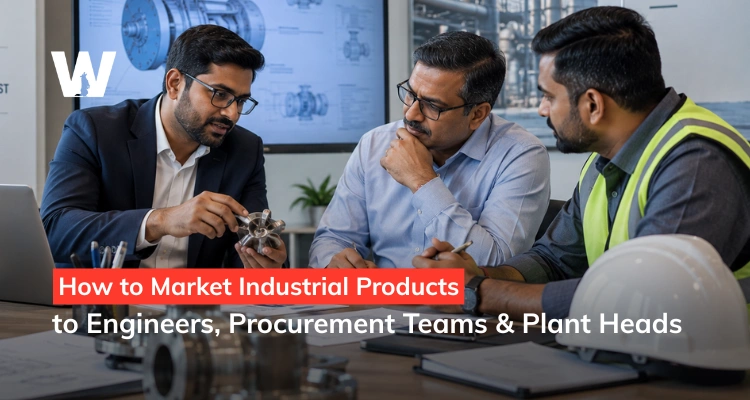
Marketing an industrial product becomes very different when the person making the decision is not the owner of the company.
If you are selling machinery, components, industrial equipment, engineering products, raw materials or technical solutions to larger manufacturing companies, your sales opportunity may need to pass through several people before a purchase order is issued.
An engineer may first evaluate whether your product can technically solve the requirement. A plant or operations leader may want to understand reliability, performance and the effect on production. Procurement may compare suppliers, commercial terms, certifications and delivery capabilities. Finance or senior management may become involved when the investment is significant.
Each person is evaluating the same supplier from a different perspective.
That creates one of the biggest challenges in industrial product marketing: you are not marketing to one buyer. You are building confidence across a buying committee.
A strong industrial marketing strategy therefore needs to do more than generate leads. It needs to make your company easier to discover, evaluate, shortlist and justify internally.
Industrial marketing is often approached from the manufacturer's perspective.
We have better technology. We have 25 years of experience. We have a large manufacturing facility. We have excellent quality. We can offer competitive pricing.
All of those things may be true, but the buyer is evaluating the decision from another perspective:
What happens if we choose the wrong supplier?
For an engineer, a wrong specification could create a technical problem. For a plant head, unreliable equipment could mean downtime. For procurement, an unreliable supplier could create delivery or compliance issues. For senior management, a poor capital equipment decision could affect productivity and return on investment.
This is why industrial marketing needs to reduce uncertainty throughout the buying process.
Your marketing should provide enough technical information, evidence, credibility and commercial clarity for each stakeholder to become more confident in considering your company.
One of the biggest mistakes in B2B manufacturing marketing is creating one message for everyone.
An engineer, procurement manager and plant head may all influence the purchase, but they are not looking for the same information.
Your website, content, sales material, search strategy and campaigns should recognise those differences.
Engineers are often involved early in the industrial buying process, particularly when a product needs to meet a specific technical requirement or become part of a larger system.
They are less interested in broad marketing statements and more interested in understanding exactly what the product does.
An engineer may want to evaluate dimensions, materials, operating conditions, tolerances, standards, compatibility, performance characteristics, drawings, installation requirements and application suitability.
This has a major implication for marketing.
A product page that says:
“Our innovative solutions deliver world class performance and exceptional reliability.”
does very little to help an engineer make a decision.
A page that clearly explains specifications, operating parameters, available materials, standards, applications, technical drawings and performance data is far more useful.
For technical buyers, information itself becomes part of your marketing.
Once technical suitability has been established, procurement may evaluate the supplier from a broader commercial and organisational perspective.
They may want to know whether your company can meet volume requirements, maintain quality, deliver consistently, comply with required certifications and offer appropriate commercial terms.
They may also compare multiple suppliers simultaneously.
This means procurement focused marketing should make supplier evaluation easy. Certifications, manufacturing capacity, quality systems, export experience, locations served, lead times where appropriate, company credentials and clear contact information should not be difficult to find.
A procurement manager should be able to visit your website and quickly understand whether your company deserves to move onto the shortlist.
Plant and operations teams often think in terms of performance.
Their questions may be different again.
Will the equipment reduce downtime? Will it improve throughput? How difficult is maintenance? Can spare parts be sourced easily? How quickly can support be provided? Will the product integrate with the existing process? What happens under actual operating conditions?
Marketing to plant heads therefore needs to connect technical capability with operational outcomes.
Case studies become particularly powerful here because they show what happened in a real operating environment rather than simply explaining what a product is designed to do.
Imagine a company manufacturing an industrial pump.
The product itself does not change, but the value proposition changes depending on who is evaluating it.
An engineer might care about flow rate, pressure, materials of construction and compatibility with the application.
A maintenance manager might care about serviceability, spare availability and expected maintenance requirements.
A plant head might care about reliability, process continuity and downtime.
Procurement might care about supplier credentials, pricing, delivery capability and commercial terms.
Senior management might care about total cost of ownership, productivity and return on investment.
If your entire website and sales collateral use one generic message, you are forcing every stakeholder to translate that message into their own priorities.
Good industrial marketing does that work for them.
Industrial purchases rarely move directly from advertisement to enquiry to order.
A buyer may recognise a problem, research possible solutions, define technical requirements, identify potential suppliers, compare alternatives, create a shortlist, seek internal approval and only then begin detailed commercial discussions.
Marketing should support that progression.
At this point, the buyer may not be searching for your product at all.
They may be searching for a problem.
For example:
“How to reduce pump failure in chemical processing”
“How to remove non ferrous metals from recycling material”
“How to reduce boiler fuel consumption”
“Why is our filter press cycle taking longer?”
This is where educational and problem-led content can introduce your expertise before the buyer has decided exactly what solution they need.
Once the buyer understands the problem, searches become more solution-oriented.
They may compare technologies, equipment types, materials or approaches.
Content such as comparison articles, selection guides, technical videos, FAQs and application guides becomes valuable here.
Your goal is not necessarily to sell immediately. It is to help the buyer understand the decision.
Now the questions become more specific.
Will your product meet the requirement?
This is where detailed product pages, specifications, drawings, brochures, application information, certifications and technical documentation become essential.
For industrial manufacturers, this stage is one reason website depth matters so much.
At this stage, you are no longer competing only on the product.
You are competing as a supplier.
Buyers may evaluate your manufacturing capabilities, quality systems, infrastructure, customers, certifications, geographical reach, service capability and track record.
This is where a strong company profile, capability pages, case studies, facility information and proof become important.
Even when your contact likes the product, they may need to convince other people internally.
This is frequently overlooked in industrial marketing.
Your engineer may need information for procurement. Procurement may need documentation for vendor approval. The plant head may need to justify the operational benefit. Management may need a commercial case.
The easier you make it for your internal champion to explain and defend the decision, the easier it becomes for the opportunity to progress.
For larger B2B purchases, the website plays a much more important role than simply generating enquiries.
It is part of supplier evaluation.
When an engineer or procurement professional searches your company after hearing about you through a salesperson, exhibition, distributor, LinkedIn post or recommendation, what do they find?
A website filled with generic claims?
Or a useful technical resource that demonstrates exactly what you manufacture and where you are capable?
A strong industrial website should make several types of information easy to access:
For larger industrial companies, your website is not simply a lead generation tool. It is part of your vendor qualification infrastructure.
Industrial SEO should reflect the language buyers use at different stages of evaluation.
A procurement professional may search for:
industrial valve manufacturer in India
while an engineer may search:
316 stainless steel valve for corrosive chemical application
A plant engineer may instead search:
how to reduce valve failure in high temperature application
All three could eventually become part of the same opportunity.
This is why an industrial SEO strategy should not consist of one list of product keywords.
Manufacturers should build search visibility around several layers of intent: product and supplier searches, technical specifications, applications, industries, problems, comparisons and questions.
The lower-volume technical searches can be particularly valuable because specificity often signals that the buyer already understands the requirement.
Don't dismiss a keyword simply because only a small number of people search for it.
In industrial marketing, the better question is:
Who is making that search, and what could that opportunity be worth?
If engineers are part of your buying audience, content needs to become more useful and less promotional.
Technical buyers do not need another article telling them your company is committed to innovation.
They need information that helps them make a decision.
Useful formats can include selection guides, comparison articles, technical FAQs, specification tables, engineering drawings, application guides, troubleshooting content, calculation tools, installation information and videos explaining how a product works.
For example, instead of publishing:
“5 Reasons Our Industrial Pumps Are the Best”
consider:
“How to Select a Pump for Filter Press Applications”
Instead of:
“Why Choose Our Stainless Steel Products?”
consider:
“304 vs 316 Stainless Steel: Which Grade Should You Specify for Your Application?”
The second approach creates value before asking for the enquiry.
It also gives search engines and AI-powered discovery platforms substantially more information about the areas in which your company has expertise.
Engineers and procurement professionals often need different assets.
Your technical library might contain product data, specifications and application guidance. Your procurement information should make it easy to evaluate your company as a supplier.
That could include certifications, manufacturing capabilities, quality processes, production capacity, export markets, vendor registration information, industries served, compliance documentation and company credentials.
Consider creating a dedicated Supplier Capabilities or Why Partner With Us section if enterprise buyers are an important market.
The objective is simple:
When procurement begins evaluating your company, they should not need to chase your sales team for basic information.
Case studies are particularly valuable in industrial marketing because they can speak to several members of the buying committee simultaneously.
A strong industrial case study should explain the customer's situation, the technical challenge, the solution selected, why it was selected, how implementation worked and what changed afterwards.
Where commercially and technically appropriate, include measurable evidence.
An engineer sees technical validity.
A plant head sees operational performance.
Procurement sees evidence that you have delivered successfully before.
Management sees business impact.
One piece of content can therefore reduce uncertainty across multiple stakeholders.
LinkedIn is useful for industrial marketing, but the strategy should extend beyond publishing on the company page.
If you are targeting enterprise manufacturers, identify the roles that influence your sale.
Your audience may include engineering leaders, plant heads, procurement professionals, operations directors, project managers and senior management.
Content can then be built around their priorities.
Technical leaders can publish engineering insights. Founders and directors can discuss industry changes and manufacturing strategy. Sales teams can share application knowledge. Company pages can demonstrate capabilities, projects, exhibitions and proof.
Paid LinkedIn campaigns can also be useful where the target market is narrow enough to justify targeting specific industries, job functions, seniorities or companies.
The goal is not simply to accumulate followers.
It is to create familiarity among the people who may eventually participate in a buying decision.
For industrial products with existing search demand, Google Ads can provide access to buyers actively looking for a solution or supplier.
But broad campaigns can generate large amounts of irrelevant traffic.
A better industrial PPC strategy usually prioritises specific product, supplier, application and technical searches and sends each visitor to a page closely aligned with that requirement.
A search for a specific industrial valve should not land on a generic homepage containing 15 product categories.
The closer the message, keyword and landing page are to the buyer's requirement, the easier it becomes for them to continue evaluating your company.
And when leads arrive, measure quality rather than volume.
One technically qualified RFQ from a large manufacturing company may be worth more than dozens of generic form submissions.
Not every industrial buyer who visits your website is ready to contact you.
That does not mean the visit had no value.
Someone may review a product page today, return to a technical article next week, download a brochure later and only contact the company when an internal project receives approval.
Remarketing, email nurturing and consistent LinkedIn visibility can help your company remain familiar during that process.
This is particularly important for capital equipment and high-value industrial purchases where buying cycles may stretch over several months.
Marketing should therefore be designed around the reality of the sales cycle rather than expecting every visitor to convert immediately.
Industrial marketing and sales should not operate as separate functions.
Your sales team probably already knows the objections and questions that repeatedly appear during technical and commercial discussions.
Marketing should capture that knowledge.
If prospects repeatedly ask about a particular application, create a page about it.
If engineers frequently request the same technical explanation, turn it into a guide or video.
If procurement repeatedly asks for certifications and capabilities, make them easier to access.
If the sales team frequently loses against a particular alternative, create a fair technical comparison.
The best industrial content often comes from questions the sales team has already answered dozens of times.
Marketing's job is to answer those questions before the next prospect has to ask.
Industrial research is also beginning to extend beyond traditional search engines.
An engineer can ask an AI platform to explain the difference between two technologies. A procurement professional can research supplier selection criteria. A project team can use AI to understand specifications or identify possible approaches before beginning formal supplier discovery.
For manufacturers, this increases the importance of publishing clear, specific and technically credible information.
If your website only says that you are a “leading manufacturer of innovative, high quality solutions”, there is very little substance for either a buyer or an AI system to understand.
Instead, document what you manufacture, which applications you support, materials and specifications, industries served, technical capabilities, certifications and the questions customers regularly ask.
Clear question-based content is particularly useful.
Which valve material is suitable for corrosive applications?
How do I select the right pump capacity?
What information is required before requesting an RFQ?
What certifications should procurement check when evaluating a supplier?
Answer the question directly first, then provide the technical depth underneath.
That structure works well for human readers while also making individual passages easier for search and AI systems to interpret.
If your target customer is a large manufacturing company, judging marketing only by the number of leads can be misleading.
Marketing may influence an account well before an RFQ is created.
A better measurement framework can include target account visits, engagement from relevant companies, technical content consumption, RFQs, qualified opportunities, specification opportunities, procurement conversations, quotation value and pipeline influenced.
You can then connect marketing data with CRM and sales information to understand which activities are contributing to commercially meaningful opportunities.
For enterprise industrial marketing, one right account progressing through the buying committee can matter more than 100 unqualified leads.
When selling to large manufacturing organisations, marketing cannot stop once someone discovers your company.
An engineer needs to believe the product will work.
A plant head needs to believe it will perform.
Procurement needs to believe your company can deliver.
Management may need to believe the investment makes commercial sense.
Your job is to make it easier for all of them to reach those conclusions.
That requires a different approach from generic B2B lead generation. Your website, SEO, technical content, case studies, paid campaigns and sales material should work together to move an account from discovery through evaluation and towards supplier selection.
At Wolfable, we help manufacturing and industrial businesses build marketing strategies around how their actual buyers research, evaluate and purchase.
If you manufacture industrial products and want to reach more engineers, procurement teams, plant leaders and enterprise buyers, we can help identify where your current digital presence is supporting the buying process and where opportunities are being missed.