Digital Marketing
Wraps up in 5 Minutes
Digital Marketing for Accountants in 2026: Complete Guide to SEO, PPC, Social Media & Client Acquisition

Published On June 17, 2026
Wraps up in 5 Minutes
Published On June 17, 2026
Referrals still matter, but they are no longer enough to keep an accounting firm growing steadily. A business owner may hear your name from a client, then check your website, search your reviews, compare you with two other firms, and ask an AI tool what to look for before booking a call.
That is why digital marketing for accountants in 2026 has to work like a system. SEO brings high-intent searches. PPC creates faster visibility. Social media builds trust before the sales conversation. Content and email keep the relationship warm until the prospect is ready.
We have seen accounting firms struggle when they treat each channel separately. The website says one thing, the ads say another, and LinkedIn posts feel disconnected from the services the firm wants to sell. Growth starts to change when every channel points toward the same client acquisition goal.
This guide shows what accounting firms should prioritize, what to avoid, and how SEO, PPC, social media, content, reviews, and conversion tracking work together to create a more predictable pipeline.
Digital marketing matters because prospects now validate accounting firms before they speak to them. Even referral-led firms need a digital presence that proves credibility, explains services clearly, and makes it easy for the right clients to book a consultation.
Referrals still create trust, but they do not create a predictable growth system by themselves. A stronger digital setup helps accounting firms get found earlier, explain their value faster, and convert the right prospects with less friction.
The shift is deeper than search alone. HubSpot’s 2026 SEO trend analysis shows that search behavior now spans Google, AI Overviews and answer engines. A prospect may discover your firm through Google, LinkedIn, ChatGPT, a review profile, or a shared article.
For accountants, this creates one practical requirement: your message must stay consistent everywhere. A prospect should understand the same specialty, value, and next step whether they find you through Google, LinkedIn, paid ads, reviews, or referral.
A simple way to think about it:
An accounting firm should build its website, positioning, analytics, and local search foundation before investing heavily in paid campaigns. PPC can accelerate demand, but it should not be used to compensate for unclear messaging, thin service pages, or a contact form that fails to qualify for leads.
The best build order is simple: define the client you want, create high-converting service pages, strengthen local SEO, publish helpful content, set up tracking, then add PPC and social distribution. That sequence protects the budget and creates a pipeline that compounds over time.
Google explains that SEO is about helping search engines understand your content and helping users decide whether to visit your site. For accounting firms, that means clear service architecture, useful pages, credible expertise, and technical accessibility.
A firm that wants construction businesses should not rely on one generic “accounting services” page. It needs pages that speak to construction bookkeeping, contractor tax planning, payroll, cash flow, and job costing. That is how SEO becomes client acquisition, not just traffic.
The best channels for accountants are SEO, local SEO, PPC, LinkedIn, content marketing, email, and review management. Each channel has a different job, so the goal is not to choose one winner. The goal is to connect them around the same client acquisition path.
| Clinic Stage | Monthly Budget | Google Ads Split | Meta Ads Split | Expected CPL | Notes |
|---|---|---|---|---|---|
| Solo practitioner or clinic just launching | $1,000 - $2,000 | 60% | 40% | $75 - $150 | Prioritize Google for intent capture; use Meta for brand awareness |
| Established single-location clinic | $2,000 - $5,000 | 50% | 50% | $50 - $100 | Balanced split works once brand awareness is building locally |
| Multi-treatment or competitive urban market | $5,000 - $10,000 | 40% | 60% | $50 - $80 | Meta scales better at higher budgets; Google remains the high-intent anchor |
| Multi-location or high-ticket surgical practice | $10,000 - $30,000+ | 40% | 60% | $100 - $200 | Higher CPL is acceptable given LTV of $6,000 - $20,000+ for surgical procedures |
Note: Timelines depend on market competitiveness, website condition, offer clarity, and how consistently the firm executes each channel.
Bottom Line: SEO should anchor the long-term system, PPC should accelerate priority services, and LinkedIn plus email should build trust before and after the first inquiry.
Accountants should use SEO to rank for service, location, and niche-intent searches. Local SEO helps nearby prospects find the firm, while content and service pages help Google, AI tools, and human readers understand what the firm does best.
Start with service architecture. A strong accounting website usually needs dedicated pages for tax planning, bookkeeping, payroll, CFO advisory, audit support, business formation, and industry-specific services. Each page should answer real questions, explain who the service fits, and include a clear consultation path.
Local SEO then adds the trust layer. Google says local results are mainly based on relevance, distance and prominence, and that more reviews and positive ratings can help local ranking. For accounting firms, the Google Business Profile cannot be an afterthought.
The 2026 layer is AEO and GEO. When a founder asks an AI tool which accountant fits an e-commerce business, the firms with structured service pages, FAQs, clear definitions, and credible thought leadership have a stronger chance of being surfaced. That is why SEO strategy now needs to support both search engines and answer engines.
PPC fits best when an accounting firm needs faster visibility for high-value services, urgent seasonal demand, or a specific niche. It should point to focused landing pages, not a generic homepage, and it should be judged by qualified consultations rather than clicks.
Google Ads can work well for terms such as “tax accountant for small business,” “bookkeeping services near me,” “CPA for startups,” or “payroll service for contractors.” The mistake is bidding on broad keywords before the firm knows which client type is profitable.
Google’s own ROI guidance says advertisers should measure conversions and costs per conversion before judging performance. For accounting firms, that means tracking form submissions, calls, booked consultations, qualified leads, and signed clients.
Ad copy also has to match the landing page. Google’s Search ad guidance recommends clear calls to action and messaging that reflects the service being offered. For accountants, that means a startup tax ad should land on a startup accounting page, not a general services page.
At Wolfable, our performance marketing approach starts with the conversion path first. Ads should amplify a strong offer, not expose a weak one.
Accountants should use social media to demonstrate judgment, not to copy lifestyle-brand content. The strongest content explains financial decisions, clarifies tax changes, shares practical business insights, and shows the human expertise behind the firm.
LinkedIn is usually the most practical starting point for accounting firms because it reaches business owners, finance leaders, founders, and referral partners. But the content has to move beyond firm announcements. Prospects care more about your point of view than your award posts.
A strong social plan includes short founder-led videos, tax deadline explainers, “mistake to avoid” posts, anonymous client scenario breakdowns, and industry-specific tips. The goal is to make a prospect think, “This firm understands businesses like mine.”
Compliance cannot be skipped. The IRS 2026 Dirty Dozen warning includes misleading tax advice on social media, so accounting firms should add disclaimers, avoid personalized advice in public posts, and review sensitive content before publishing.
This is where a structured social media marketing workflow helps. It gives the firm consistency without turning every partner into a full-time content creator.
Accounting firms should publish content that answers buyer questions, not only seasonal reminders. Tax deadline posts may create visibility, but client acquisition content explains services, clarifies fit, compares options, and helps prospects decide whether to contact the firm.
The strongest topics sit where expertise and buying intent overlap: “when should a startup hire a CPA,” “bookkeeping vs CFO advisory,” “how to choose an accountant for construction,” “tax planning for S corp owners,” and “common payroll mistakes for growing teams.”
A good content marketing system also repurposes one strong idea into multiple assets. A blog can become a LinkedIn carousel, short video, email newsletter, sales follow-up, and FAQ block. That is how content moves from publishing activity to pipeline support.
We recommend keeping the tactical details high-level in public content. Educate prospects enough to trust your expertise, but do not turn every article into a do-it-yourself checklist that removes the need for professional advice.
Reviews, email, and CRM follow-up convert interest into clients by removing hesitation. Reviews build trust at the comparison stage; email keeps the firm present after the first visit, and CRM follow-up prevents qualified leads from disappearing after one missed call.
For accounting firms, reviews often matter most when two firms look similar on paper. A detailed review from a business owner about responsiveness, clarity, and proactive advice can do more than a generic service description.
Email should not be a monthly dump of tax news. Segment the list by clients, prospects, referral partners, and service interest. A payroll prospect should not receive the same nurture sequence as an advisory lead or a year-end tax client.
CRM follow-up is where many firms leak revenue. If a prospect fills out a form and hears back two days later, the best opportunity may already be gone. A simple lead routing and follow-up system can protect the money already spent on SEO, ads, and content.
The biggest mistakes happen when firms copy generic marketing advice without adapting it to accounting. Professional services marketing needs trust, specialization, compliance, and measurement. Without those, traffic grows, but client acquisition stays flat.
| Common Mistake | Why It Hurts | Better Move |
|---|---|---|
| Running ads before fixing the website | PPC sends paid traffic into a weak conversion path. | Build service-specific landing pages and tracking before scaling spend. |
| Using only broad service pages | “Accounting services” pages rarely match niche search intent. | Create service, location, and industry pages for profitable client segments. |
| Posting generic social content | Firm news and vague tax tips do not build authority with business owners. | Use POV-led posts, short videos, and business-specific scenarios. |
| Ignoring review management | Prospects compare trust signals before contacting a firm. | Request reviews consistently and respond professionally. |
| Tracking clicks instead of clients | Traffic can look strong while revenue stays weak. | Measure qualified consultations, signed clients, and acquisition cost. |
| Skipping compliance review | Public tax advice can create risk and damage trust. | Use disclaimers and review sensitive topics before publishing. |
Note: These mistakes are common when accounting firms treat marketing as isolated activity instead of a connected revenue system.
Bottom Line: The best accounting firm marketing strategy is not louder. It is clearer, better structured, easier to measure, and more aligned to the clients the firm wants most.
Accounting marketing works best when strategy, website, SEO, PPC, content, social media, and follow-up are built together. That is the kind of system we build at Wolfable.
Our team brings strategists, designers, SEO specialists, content writers, performance marketers, web developers, video creators, and AI-focused specialists under one roof. That matters because accounting firms rarely need one isolated tactic. They need a connected growth engine.
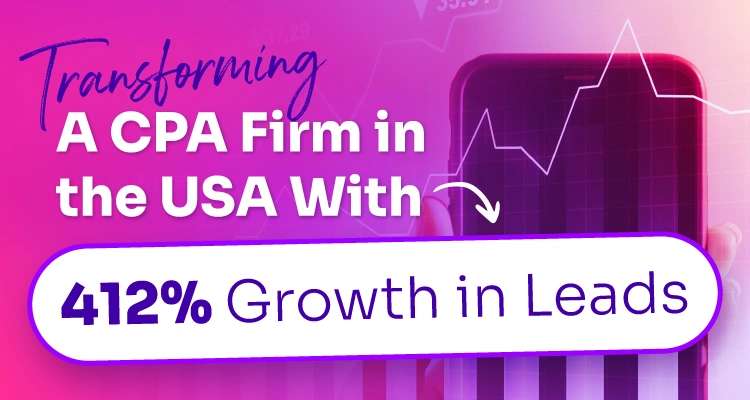
We have also worked with regulated and trust-heavy businesses where authority matters as much as visibility. For a US accounting and advisory firm, our integrated website, SEO, AEO, content, paid, email, and social work helped drive 412% growth in organic leads and 623% organic traffic growth.
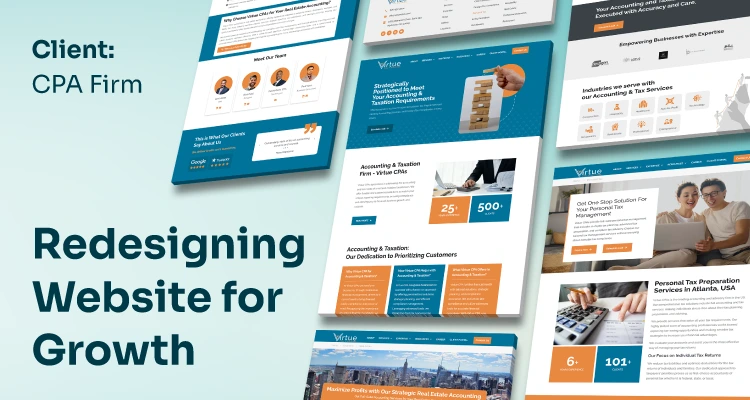
You can see this same in our CPA firm website redesign case study, where clearer navigation, stronger service-page structure, mobile responsiveness, and conversion-focused CTAs helped turn a professional website into a stronger client acquisition asset.
That kind of result does not come from publishing more posts or buying more clicks. It comes from understanding the buyer, structuring the website around intent, building trust signals, and measuring the full path from first visit to signed client.
Digital marketing for accountants in 2026 is not about chasing every new channel. It is about building a system that helps the right prospects find you, trust you, contact you, and become profitable for long-term clients.
Start with positioning and your website. Build SEO and local visibility around the services and client types you want most. Add PPC when the conversion path is ready. Use LinkedIn and content to make expertise visible. Use reviews, email, CRM, and reporting to convert interest into revenue.
If your firm is ready to turn scattered marketing into a connected acquisition system, talk to Wolfable and let our team help you build the next stage of growth.