Branding Strategy
Wraps up in 14 Minutes
How Cosmetic Practitioners Can Build a Strong Personal Brand Online

Published On May 1, 2026
Wraps up in 14 Minutes
Published On May 1, 2026
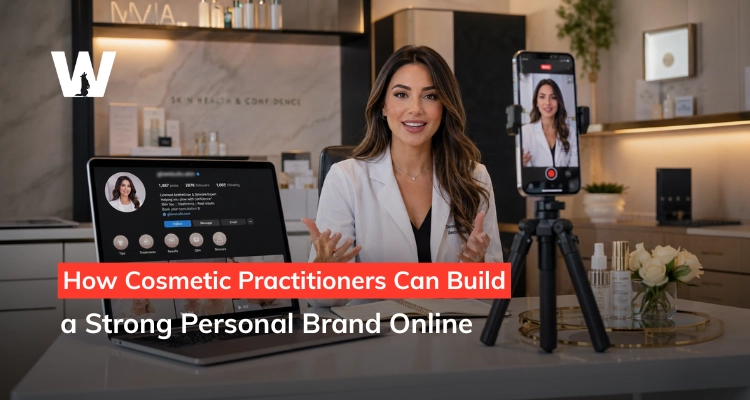
Patients today do not just pick a clinic - they pick a person. Before anyone books a consultation, they have already scrolled through your social media, read your Google reviews, and formed an opinion about whether they trust you. In aesthetic medicine, that trust gap is everything.
The competition in cosmetic practice has never been sharper. The global beauty and personal care market is valued at $698.38 billion in 2026, and patient expectations are rising alongside it. New clinics open every month; new practitioners graduate every season, and most of them struggle for visibility online. The ones pulling ahead are not always the most technically skilled - they are the ones patients feel they already know.
A strong personal brand changes how patients find you, evaluate you, and decide to book you. It is the difference between being one of fifty practitioners with a price list and being the practitioner whose name gets searched, recommended, and remembered. In 2026, building that brand online is not as complicated as most practitioners fear.
This guide breaks down exactly how cosmetic practitioners can build a credible, discoverable personal brand - without sacrificing clinical time or technical focus. We have helped aesthetic clinics across India, the UK, and Canada do this from scratch, and the principles hold regardless of your specialty or scale.
A cosmetic practitioner's personal brand is the sum of everything a potential patient sees, hears, and feels about you before they walk through the door. It is your Instagram presence, your Google search results, your website bio, your LinkedIn articles, and every review ever left about your work.
According to a 2026 physician branding study, 94% of patients use online reviews to evaluate practitioners before making a booking decision. Meanwhile, 44% of patients value advice from health professionals they follow online, with 98% reporting that they trust those insights. The patient journey begins online - and a practitioner without a clear digital presence is, for all practical purposes, invisible to that patient.
We've seen this pattern repeat itself across every aesthetic clinic we've worked with. Practitioners with a defined online identity consistently outperform those relying solely on word-of-mouth. The referral channel has not disappeared - but it now has a digital checkpoint before a patient picks up the phone.
The urgency is not about ego or vanity. When patients trust you before they meet you, consultation conversion rates are higher, treatment compliance improves, and long-term patient retention strengthens meaningfully.
The easiest way to understand a practitioner's personal branding is to compare what patient experience looks like with it versus without it. Personal brands built around consistent storytelling see 22% higher loyalty from their audience - and for a cosmetic practice, loyalty translates directly into lifetime patient value and referrals.
| Common Problem | Impact on Conversions | Fix |
|---|---|---|
| Uncompressed images | Increases load time by 2-4 seconds | Compress all images to under 200kb before uploading |
| Video autoplay on page load | Delays interaction and drains mobile data | Use a thumbnail with a play button and load the video only after user click |
| CTA below the fold on mobile | Patients leave before seeing the CTA | Add a sticky CTA bar at the bottom of the mobile screen |
| Non-click-to-call phone number | Mobile friction reduces incoming calls | Wrap the phone number inside a tel: href link |
| Too many form fields | Can lead to an 81% form abandonment rate | Limit forms to 5 fields: name, phone, email, treatment, and preferred time |
| No SSL certificate | Browser security warnings instantly reduce trust | Ensure https:// is active on all landing page URLs |
Source: Aggregated from physician branding research and our client’s data across aesthetic clinic accounts, 2026.
Bottom Line: A practitioner brand is built on specificity and consistency - not on posting the most content.
The fastest way to build a personal brand is to narrow your focus before you go public. Cosmetic medicine covers an enormous spectrum - from injectables to skin health, from non-surgical body contouring to thread lifting. Trying to be the authority on all of it results in being the authority on none of it.
Start with two questions: What treatments do you perform best, and which patient outcomes do you find most clinically rewarding? Overlap is your brand territory. A practitioner known for natural-looking lip augmentation in a specific city will build an audience faster than a generalist posting about every cosmetic treatment available.
Your niche informs your tone, your visual aesthetic, your content topics, and the kind of patients you attract. In our experience working with aesthetic clinic founders, practitioners who commit to a niche within the first sixty days of building their brand see significantly more organic traction than those who start broad and attempt to narrow later.
This does not mean turning away patients outside your specialty. It means leading with your strongest clinical identity - and letting that identity attract the right audience. Specificity is not a limitation; it is a magnet.
Your website is not just a brochure. It is your most important personal brand asset and your best long-term source of high-intent patient inquiries. The key difference between a practitioner website that generates leads and one that sits idle comes down to three things: content depth, technical SEO, and trust signals.
Content depth means having dedicated pages for each treatment you offer, written to answer the exact questions patients type into Google - "how long does filler last," "what to expect after Botox," "is laser skin resurfacing safe for darker skin types." Each of those pages is a patient-acquisition asset that works around the clock.
Technical SEO means your site loads quickly on mobile, uses proper schema markup, and structures headings so both Google and AI answer engines can extract information cleanly. According to Docuhealth's 2026 patient discovery research, patients increasingly use AI-assisted search to evaluate practitioners - and structured, credible content is what those tools surface preferentially.
Trust signals mean professional photography, credentials displayed prominently, real patient testimonials, and clear clinical governance information. Practitioners we have worked with who added structured credential pages and clinical bio sections saw immediate improvements in consultation-to-booking conversion rates.
Building this kind of website requires an SEO strategy tailored to the aesthetics space - generic web templates do not perform in a market this specific.
Choosing platforms randomly wastes time. Every platform has a different audience, content format, and conversion behaviour. For cosmetic practitioners, the goal is to be intentional - owning two or three platforms properly rather than underperforming on five.
Social media now influences approximately 70% of beauty and aesthetic service discovery among active users. But that influence is not evenly distributed across platforms - it concentrates where visual content and expertise intersect.
| Platform | Best Content Type | Primary Audience | Key Brand Benefit | Time Investment |
|---|---|---|---|---|
| Reels, carousels, Stories | Women 25-45 | Visual discovery and daily engagement with prospective patients | Medium - 3 to 5 posts per week | |
| YouTube | Long-form procedure and education videos | Research-stage patients | Authority building and strong SEO signal for treatment terms | High - 1 to 2 quality videos per month |
| Articles, clinical case insights, opinions | Referral network - GPs, dermatologists, media | Professional credibility and referral relationship building | Low - 2 to 4 posts per week | |
| TikTok | Short educational clips and myth-busting | Patients under 35 | Rapid brand awareness and algorithm-driven discovery | Medium - daily posting preferred |
| Google Business Profile | Reviews, posts, Q and A responses | Local-intent patients searching for clinics near them | Map Pack visibility and local search dominance | Low - weekly review responses and posts |
Note: Time for investment estimates are indicative. Results depend on content quality, consistency, and audience targeting rather than posting volume alone.
Bottom Line: Start with Instagram and Google Business Profile as your core two. Add YouTube when you have the capacity for consistent, high-quality video production.
Instagram remains the primary discovery channel for cosmetic treatments, particularly for visual procedures like fillers, skin rejuvenation, and body contouring. For practitioners, the most effective content mix runs roughly 40% educational, 30% patient results (with consent), 20% behind-the-scenes, and 10% direct calls to action. Leading with education builds the trust that makes the promotional 10% actually convert.
YouTube is where practitioner authority is built over time. A ten-minute video explaining the science behind a treatment, the realistic outcomes a patient can expect, or the recovery process for a procedure builds a level of trust that a short Reel cannot. Across our aesthetic clinic work, YouTube channel growth is slower than Instagram - but the enquiry quality from YouTube visitors is substantially higher. These are patients who have done their research and are close to booking.
Most cosmetic practitioners dismiss LinkedIn as irrelevant to patient acquisition. That is a missed opportunity. LinkedIn is where referral relationships are built with GPs, dermatologists, plastic surgeons, and wellness practitioners who can send you patients regularly. A practitioner with published LinkedIn articles is also better positioned for media coverage, speaking invitations, and the kind of professional credibility that patients notice.
Follower count is a vanity metric for cosmetic practitioners. What actually converts browsers into booked patients is the quality and consistency of educational content - content that positions you as a clinical expert, not merely a service provider with an aesthetic feed. count is a vanity metric for cosmetic practitioners. What actually converts browsers into booked patients is the quality and consistency of educational content - content that positions you as a clinical expert, not merely a service provider with an aesthetic feed.
The most effective formats for practitioner authority content are short-form video that explains individual treatments or debunks persistent myths, long-form blog posts that serve as patient guides indexed by Google, and case-based storytelling that walks through your clinical thinking - from diagnosis to treatment plan to outcome - without identifying the patient.
A well-executed content marketing strategy for aesthetic clinics creates compounding returns. A well-written article about "the difference between Russian lip technique and classic lip filler" will attract patients searching exactly that phrase for months or years after publication. That is fundamentally different from the lifespan of a paid ad.
One principle worth anchoring to: consistency matters more than volume. Publishing two strong, genuinely useful pieces per month outperforms daily posting of low-depth content. Google's search quality standards in 2026 place enormous weight on demonstrable expertise and original, consistent publishing - this directly affects how your practitioner content ranks.
Social proof is not an afterthought to your personal brand - it is one of its load-bearing pillars. Reviews, testimonials, and documented patient outcomes serve two parallel purposes: they influence the decision-making of prospective patients, and they send credibility signals to search engines ranking your practice.
A systematic approach to reviews means prompting patients to leave Google reviews as part of your post-treatment follow-up sequence - not as a one-off ask, but as a standard clinical process. Practitioners who collect reviews consistently rank significantly higher in local search results and appear more prominently in the Google Map Pack for treatment-specific and location-based searches.
Case studies are the next level. Documenting a patient's full journey - the consultation, the treatment plan, the results at four weeks and twelve weeks - gives prospective patients the kind of detailed, trust-building narrative that no ad can replicate. Authenticity matters more than production quality at this stage. A genuine, well-documented outcome is worth more than a polished promotional piece.
Patient-facing behind-the-scenes content - the treatment room preparation, the aftercare process, the practitioner's pre-treatment checklist - also forms a powerful layer of social proof. It answers the unspoken questions every nervous prospective patient is sitting with before they reach out.
Building a personal brand online is not a one-afternoon project. It is a system - and like any clinical system, it delivers results when it is properly designed, consistently maintained, and measured against real outcomes.
At Wolfable, we have spent years building digital brands for aesthetic and healthcare practices across India, the UK, the USA, and Canada. Our in-house specialists - strategists, content writers, SEO experts, video creators, and designers - work under one roof to ensure every element of a practitioner's brand is consistent, credible, and conversion-ready.
We have seen firsthand what a structured brand-building investment delivers. An aesthetic clinic we supported through our aesthetic clinic digital marketing programme saw a 127% increase in Google Business Profile views and a 104% increase in direct website clicks from search - within the first few months of a focused, integrated strategy. These are not isolated wins; they are the compounding result of treating practitioner branding as a system, not a series of disconnected posts.
We also understand the specific constraints of healthcare marketing - what can be shown, how results must be framed, and how to build authority without running afoul of medical advertising guidelines. That context matters enormously for practitioners who want to grow without compliance risk.
Building a strong personal brand online is not about becoming an influencer. It is about being findable, credible, and trustworthy at every stage of a potential patient's search journey - from the first Google query to the decision to book a consultation.
The practitioners winning in 2026 own a defined niche, maintain a credible website, show up consistently on the right platforms, publish content that demonstrates genuine expertise, and treat patient social proof as a professional asset rather than a marketing afterthought. None of these steps require a studio or a full-time content team on day one. They require a clear identity and a commitment to showing up consistently.
If your personal brand needs a sharper direction - or you are building from scratch and want a proven system behind you - our team at Wolfable works with cosmetic and aesthetic practitioners every day to build the kind of online presence that fills appointment books and builds the patient relationships that last.
Explore these Wolfable resources to build on what you have learned here: