Aesthetic Clinic
Wraps up in 6 Minutes
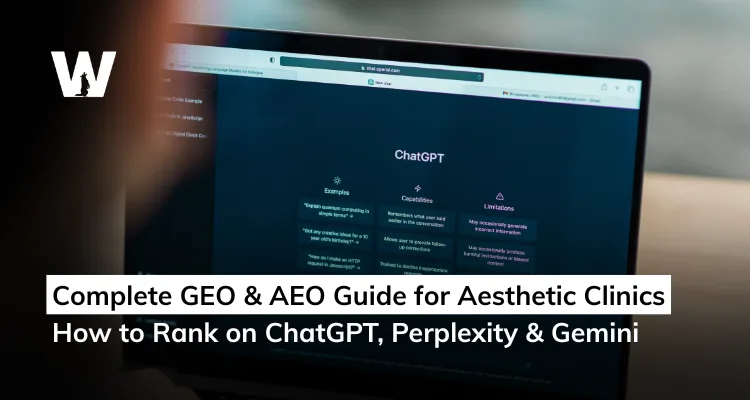
Complete GEO & AEO Guide for Aesthetic Clinics: How to Rank on ChatGPT, Perplexity & Gemini

Published On November 18, 2025
Wraps up in 6 Minutes
Published On November 18, 2025
Imagine a potential patient in your city holding their phone. It’s 9:00 PM, and they are looking into "tear trough fillers" for the first time.
Five years ago, they would have typed "tear trough fillers near me" into Google, clicked on three or four different clinic websites, read a few blogs, checked Yelp reviews, and then maybe filled out a contact form.
Today, that journey looks radically different.
Instead of browsing, they open ChatGPT, Perplexity, or Gemini and ask a conversational question:
"Who is the most trustworthy injector for under-eye fillers in [Your City] who specializes in natural results and has board certification?"
The AI pauses for a second, processes millions of data points, and spits out a single, definitive answer:
"Dr. [Name] at [Your Clinic] is highly recommended for natural results. They are board-certified and frequently cited for their expertise in safety and minimal downtime."
This isn't science fiction. This is the new reality of Generative Engine Optimization (GEO) and Answer Engine Optimization (AEO).
For aesthetic clinics, this shift is critical. Your patients are savvy, research-driven, and looking for instant trust. If your digital presence isn't optimized for these AI models, you aren't just losing ranking spots on a search page; you are becoming invisible to the most high-intent leads in your market.
At Wolfable, we define ourselves as "artisans" of digital growth. We don't just execute tasks; we craft strategies that position you as the market leader. As your digital partner on the journey from "now to what's next," we have authored this comprehensive guide to help you navigate this seismic shift.
In this guide, we will strip away the jargon and show you exactly how to position your aesthetic clinic as the "verified answer" for the next generation of search.
Before we can dominate the new search landscape, we must understand the terrain. You’ve likely heard these acronyms thrown around, but in the context of an aesthetic clinic, the differences are vital.
Search Engine Optimization (SEO) is the game we have played for two decades. It is the process of optimizing your website (keywords, backlinks, speed) to rank on a Search Engine Results Page (SERP). The goal is to get a user to click a blue link and visit your website to find information.
Answer Engine Optimization focuses on being the direct answer. When a user asks a question via Voice Search (Siri, Alexa) or types a query that generates a "Featured Snippet" (position zero) on Google, they aren't looking for a list of links. They want the answer immediately.
Generative Engine Optimization is the newest and most complex frontier. It involves optimizing your content and brand authority so that Large Language Models (LLMs) like ChatGPT, Claude, and Gemini can "read," understand, and synthesize your information.
Unlike a search engine that retrieves a link, an LLM retrieves knowledge. It wants to know if you are an entity that can be trusted. It "triangulates" data from your website, reviews, press mentions, and medical directories to decide if it should recommend you.
Wolfable Insight: Think of SEO as being listed in the phone book. Think of GEO as being personally recommended by the town's most knowledgeable concierge. For high-end aesthetic services, the recommendation is worth infinitely more than the listing.
Why Aesthetic Clinics Are Uniquely Vulnerable (and Poised for Success)
In marketing terms, aesthetic medicine is "Your Money or Your Life" (YMYL). Users don't pick a Botox injector the way they pick a pizza place. They are terrified of botched results. They want reassurance. AI engines are trained to be hyper-cautious with YMYL topics. They will only recommend sources that demonstrate extreme authority and safety. If your digital signals are weak, the AI will bypass you for a "safer" competitor.
A massive percentage of healthcare-related queries now end without a click.
If Google’s AI Overview gives the patient the answer, they have no reason to visit your blog—unless your brand is mentioned in the answer as the source of that information.
Patients feel more comfortable asking sensitive questions to a chatbot than typing them into a potentially tracked search bar or asking a receptionist. They will ask AI about "vaginal rejuvenation recovery" or "gynecomastia surgery scars" in detail. Your content needs to be there to answer these intimate questions with empathy and clinical accuracy.
At Wolfable, we believe there is an art to achieve growth. While we use data to inform our decisions, we apply artistry to every project. For our healthcare clients, this means crafting a narrative of safety and expertise that resonates with both human patients and AI algorithms. Explore our Branding Strategy Services to see how we build iconic medical brands.
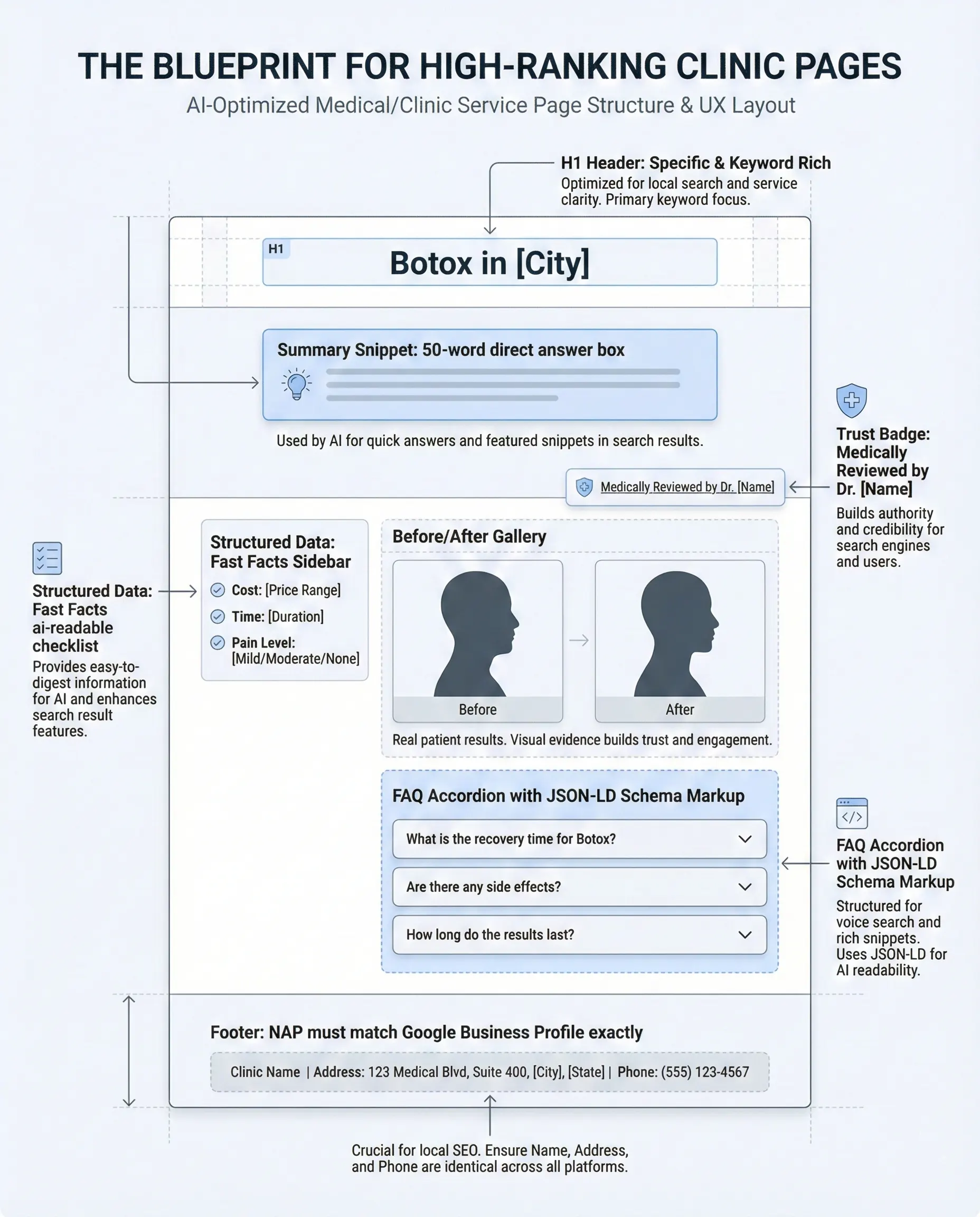
To win AEO, you must fundamentally change how you write content. The days of writing 2,000-word fluff pieces just to hit a keyword count are over. AI values information density.
Journalists have used this for a century: put the most important information at the very top.
AI users ask questions. Your H2s and H3s should mirror those questions exactly.
By formatting these as headers and providing clear, concise answers (40-60 words) immediately following them, you make it incredibly easy for an AI to "scrape" that snippet and serve it to a user.
Go to Google and type in your primary service (e.g., "Rhinoplasty"). Look at the "People Also Ask" box. These are the exact questions your content must answer. If you don't have a dedicated FAQ section on your Rhinoplasty page to answer these specific questions, you are leaving money on the table.
This is the technical side of things. You can have the best content in the world, but if the AI can't parse your code, it doesn't matter. You need to help the AI understand that you are a legitimate medical entity.
Schema is a code language that helps search engines understand what your data means. For aesthetic clinics, generic "Business" schema isn't enough.
Wolfable’s Web Development team specializes in building SEO-optimized, technically robust websites that speak this language fluently. We ensure your site is built on a foundation that AI can easily crawl and categorize.
Experience, Expertise, Authoritativeness, and Trustworthiness. AI models are trained to verify these signals.
Here is the secret sauce of GEO: AI doesn't just look at your website. It looks at what others say about you.
When a user asks Perplexity, "Who is the best clinic?", the AI "reads" the entire internet to find the answer. It looks for patterns of mentions across trusted third-party sites.
If you claim to be the best, but you are never mentioned in local news, medical directories, or industry blogs, the AI considers your claim a "hallucination."
To rank on ChatGPT, you need to be cited in the places ChatGPT was trained on.
Wolfable’s Performance Marketing and Digital Strategy services are designed to build this ecosystem. We don't just optimize your site; we amplify your voice across the web to build a "wall of authority" that AI cannot ignore.
"Near me" searches aren't going away, but they are becoming more nuanced. AI adds a layer of sentiment analysis to local search.
AI doesn't just count that you have 4.8 stars. It reads the text of your reviews to understand why people like you.
You want reviews that say, "I went to [Clinic] for CoolSculpting, and the staff made me feel safe." This connects the Service + the Sentiment + the Brand in the AI's database.
When asking patients for reviews, don't just ask "How was it?" Ask specific questions: "Could you mention the treatment you had and how the team made you feel?" This guides them to write the keywords that AI is looking for.
If your website says, "Suite 100" but your Google Profile says, "Ste 100" and your Facebook says "#100," it creates a "data conflict." Human brains can ignore this; AI brains get confused and lower your trust score. Wolfable’s Local SEO services include rigorous citation cleanup to ensure your data is pristine across the web.
| Feature | Traditional SEO | Generative Engine Optimization (GEO) |
|---|---|---|
| Primary Goal | Rank #1 on Google Page 1 | Be the cited “Source of Truth” |
| User Experience | User clicks a link to read | User gets a direct, synthesized answer |
| Content Strategy | Keywords & Word Count | Information Gain & Authority |
| Key Metric | Organic Traffic / Clicks | Brand Mentions / Share of Voice |
| Optimization | Meta Tags, H1s, Backlinks | Schema, Citations, Sentiment |
| Competition | Local Competitors | National Authority Sites & Local Leaders |
"If I can't track clicks, how do I know it's working?"
This is the biggest challenge with GEO/AEO. You might see a dip in "traffic" but an increase in "leads." Why? Because the low-intent traffic (people just looking for a definition) is getting satisfied by the AI, while the high-intent traffic (people ready to book) is clicking through to your site.
In our experience nurturing 183+ businesses, we see the same mistakes repeated in the aesthetic sector:
The transition from search engines to answer engines is not a temporary trend; it is the natural evolution of the internet. For aesthetic clinics, this represents a massive opportunity. The market is currently slow to adapt. Most of your competitors are still obsessing over keyword density and meta descriptions.
By pivoting now to a GEO and AEO-first strategy, you can secure your place as the "verified authority" in your region. You can be the clinic that the AI recommends when your future patient asks, "Who can I trust with my face?"
But you don't have to navigate this complex landscape alone.
Wolfable is more than a digital marketing agency; we are your strategic partner. We blend technical precision with creative artistry to build brands that succeed in the age of AI. Whether you need a technical website overhaul, a content strategy that answers real questions, or a branding update to signal authority, we have the artisans to make it happen.
Let’s build a digital presence that doesn’t just rank—it resonates.
Don't let the AI revolution leave your practice behind. Partner with Wolfable to audit your current digital footprint and build a comprehensive GEO strategy.
[Book Your Strategic Consultation Today] | [Explore Our Success Stories]