AI Marketing Agency
Wraps up in 9 Minutes
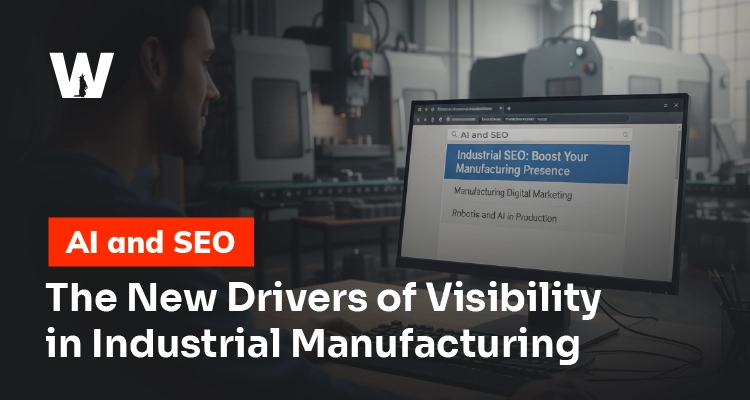
AI and SEO: The New Drivers of Visibility in Industrial Manufacturing

Published On October 24, 2025
Wraps up in 9 Minutes
Published On October 24, 2025
Picture this: Your competitor just landed a $2 million contract. The buyer never called them. Never visited their facility. They found them on Google at 11 PM on a Tuesday.
Welcome to the new reality of industrial manufacturing.
Here's the truth bomb: 93% of B2B buying journeys now start with a search engine. Not a trade show. Not a cold call. A simple Google search.
Yet most manufacturing websites? They're invisible. It's like having a world-class factory hidden behind a locked door with no sign.
At Wolfable, we've helped manufacturing clients flip this script. We're talking 277% increases in organic leads and 611% boosts in website impressions. These aren't flukes. They're the result of combining AI technology with manufacturing-specific SEO strategies.
Think of AI and SEO as your factory's new power couple. AI is the smart automation system. SEO is the distribution network. Together, they work 24/7 to bring qualified buyers to your digital doorstep.
This guide reveals exactly how this works. Whether you make CNC parts, industrial equipment, or specialized components, these strategies will help you dominate your niche.
Let's get started.
Remember when trade shows were the holy grail? You'd spend $50,000 on a booth, shake hundreds of hands, and hope for leads.
Those days are fading fast.
Today's buyers—even for million-dollar equipment—start their research online. Often months before they talk to a sales rep. A 2024 Gartner study dropped this truth: B2B buyers complete 70% of their purchase decision independently through digital research.
They're comparing specs. Reading case studies. Watching demos. All without touching their phone to call you.
Flaw #1: You're interrupting, not helping. Traditional marketing screams "Buy from us!" Modern buyers want education, not sales pitches.
Flaw #2: You're invisible when it counts. Trade shows happen twice a year. Google searches happen 24/7/365. Where are you when buyers are actively looking?
Flaw #3: You can't reach global buyers efficiently. Flying to Germany for a trade show costs thousands. Ranking on Google in Germany? That's scalable.
Here's the reality: Your competitors who've gone digital aren't working harder. They're working smarter. And AI makes it even easier.
Imagine you're looking for a specific bolt in a massive warehouse.
Traditional SEO? You'd walk every aisle with a checklist. It takes hours. Maybe days.
AI-powered SEO? You've got a smart drone that scans everything instantly. It knows exactly where that bolt is, how many you have, and predicts when you'll need to reorder.
That's the difference we're talking about.
Traditional SEO was manual grunt work. Spend weeks researching keywords. Write content. Wait months to see if it works. Then adjust.
AI flips this completely.
Speed multiplies by 10X. AI analyzes your entire website, spots technical issues, and suggests fixes—simultaneously. Tasks that took teams months now take days.
Guessing becomes knowing. Machine learning predicts which keywords will drive conversions, not just traffic. For manufacturers, this means targeting "ISO 9001 certified precision machining services" instead of generic terms.
Content gets smarter. AI understands manufacturing terminology. It knows the difference between a butterfly valve and a ball valve. It speaks your language.
Personalization scales. AI adapts content based on visitor behavior. A first-time visitor sees educational content. A returning visitor sees case studies and ROI calculators.
Think of traditional SEO as a fishing rod. AI-powered SEO? That's sonar technology, automated nets, and real-time migration data—all working together.
The manufacturers dominating search results aren't working harder. They're using AI to work exponentially smarter.
Google just changed the game. Again.
AI Overviews now appear for 15% of all searches—and climbing fast. When someone searches "best CNC machines for aerospace parts," they might see an AI-generated summary pulling from multiple sources.
Your website might be included. Or excluded.
This creates a new challenge: Ranking isn't enough anymore. Your content must be good enough for AI to reference it.
Change #1: Featured snippets are gold. AI prioritizes direct answers. If someone asks "How do I select pumps for chemical applications?" and your content answers this perfectly, you win.
Change #2: Google understands relationships. Google's AI knows your company makes industrial pumps. It knows you're in Ohio. It knows you're ISO certified. When someone searches for exactly that combination, you appear.
Change #3: Expertise matters more than ever. AI evaluates whether your content shows genuine manufacturing knowledge or generic marketing fluff.
Here's a real scenario:
A buyer searches "corrosion-resistant pumps for sulfuric acid." If your website only lists products, you're invisible. But if you've published detailed guides about material science, application specs, and compliance standards—all optimized with AI tools—you become the authority AI recommends.
The winners in AI-powered search are the manufacturers investing in deep, expert-level content.
Walk into any factory. You'll see specialized tools for specialized jobs. You don't use a sledgehammer for precision work.
Same principle applies to AI tools for SEO.
The landscape is massive. Overwhelming, even. But for manufacturing companies with small marketing teams, the right tools make all the difference.
These are your reconnaissance tools. They reveal what buyers actually search for—not what you think they search for.
Tools like SEMrush and Ahrefs use AI to analyze competitor gaps, identify long-tail manufacturing keywords, and predict seasonal demand. For products with 6-12 month sales cycles, this intelligence is gold.
AI writing tools like ChatGPT and Claude can draft blog posts, product descriptions, and technical guides. But here's the catch: They need your expertise.
Use AI for the first draft. Have your engineers review for accuracy. This combo is unstoppable.
These AI tools crawl your website 24/7. They catch broken links, slow pages, and mobile issues before they hurt your rankings. Critical for sites with hundreds of product pages.
AI analytics tools predict ranking opportunities three months ahead. They connect SEO performance to actual business metrics—like quote requests and qualified leads.
Here's what matters: Don't chase every shiny AI tool. Start with one tool per layer. Master it. Then expand.
The manufacturers succeeding with AI aren't using 50 tools. They're using 5-7 tools strategically—and using them well.
Pop quiz: What do buyers want to know about your industrial pump?
If you answered "specifications," you're half right.
They also want to know: How do I select the right one? What certifications do I need? How does it perform in extreme conditions? What's the real-world ROI?
AI-powered search rewards companies that answer ALL these questions. Not just the obvious ones.
Traditional manufacturing content looked like this:
Boring. Unhelpful. Invisible to AI.
Modern manufacturing content looks like this:
See the difference? You're not selling. You're teaching.
Structure your content around actual questions. Here's why:
When a buyer searches "How do I choose a pump for hydrochloric acid," they want a direct answer. If your content provides it—detailed, accurate, helpful—AI systems flag you as the authority.
One Wolfable client restructured their content from product-centric to question-centric. The result? 188% increase in organic leads.
Why? Because they started answering questions buyers were actually asking.
Your website is like your factory floor. If the equipment is broken, production stops. Doesn't matter how good your products are.
Same with technical SEO. Brilliant content won't rank if your technical infrastructure is weak.
Manufacturing sites are heavy. High-res product images. Detailed CAD drawings. Specification PDFs.
All that weight slows you down.
And Google's AI? It prioritizes fast-loading sites. Why? Because slow sites frustrate users. And frustrated users bounce.
Hit these targets, and you're in Google's good books.
Over 60% of industrial buyers now research on mobile during early discovery. Yes, even for heavy machinery.
They're on the factory floor. In a meeting. On a job site. They pull out their phone and search.
If your site doesn't work perfectly on mobile, you've lost them.
Google knows this. That's why mobile-first indexing is standard. Your mobile experience determines rankings for ALL devices.
Virtue CPAs (a Wolfable client) saw a 52% reduction in bounce rate after technical optimization. Visitors stayed longer, engaged more, and became qualified leads.
Technical SEO isn't sexy. But it's the foundation everything else builds on.
Ignore it, and you're building on sand.
Want to sell to Germany? China? Brazil?
Ten years ago, that meant expensive trade shows, international travel, and local sales reps. Barrier to entry? Sky-high.
AI-powered SEO democratizes global competition.
AI translation tools maintain technical accuracy while adapting for regional markets. A pump manufacturer can now efficiently target German, Chinese, and Spanish markets simultaneously.
But here's the trick: It's not just translation. It's localization.
German buyers search differently than American buyers. The terms they use, the information they prioritize, the certifications they care about—all different.
AI reveals these nuances.
Your sales team sleeps. AI doesn't.
AI-powered chatbots answer technical questions at 3 AM Beijing time. Content serves international buyers while your team is offline. Lead forms capture inquiries from every time zone.
Sujal Engineering (a Wolfable client) implemented AI-optimized multilingual content targeting export markets.
The result? 88% increase in international leads.
They didn't hire international sales teams. They didn't fly to a dozen trade shows. They let AI-powered SEO do the heavy lifting.
1. Market-specific keyword research: AI analyzes search volumes and buyer intent across countries. Reveals which markets offer the best opportunities for your products.
2. Regional compliance awareness: AI helps identify country-specific certifications and regulatory requirements to emphasize.
3. Competitor intelligence: Monitor international competitors' digital strategies in real time.
4. Cultural adaptation: AI spots regional preferences in content format, communication style, and trust signals.
For mid-sized manufacturers, competing globally used to be nearly impossible. AI changes that equation completely.
B2B manufacturing sales are complex. Multiple decision-makers. Extensive research. Significant investment. Your SEO strategy must reflect this reality.
Not all traffic is equal.
Someone searching "what is precision machining" is in learning mode. Someone searching for "ISO 9001 certified precision machining services in Ohio" is ready to buy.
AI helps you identify and target high-intent keywords. These drive fewer visitors but more qualified leads.
Comprehensive guides (2,500-5,000 words) perform exceptionally well for manufacturing SEO.
Why? They establish authority. They capture numerous long-tail keywords naturally. They satisfy buyer research needs in one place.
Think about it: Would you rather read ten short articles or one comprehensive guide that answers all your questions?
Buyers prefer comprehensive. So does AI.
Technical buyers want to See products in operation. Understand applications visually. Evaluate capabilities before calling.
Manufacturing companies producing quality video content gain massive competitive advantage.
And here's the bonus: YouTube is the second-largest search engine. Many manufacturing buyers start product research there.
Even for products shipped globally, many buyers prefer suppliers within proximity. Why? Service, support, relationship building.
Optimize for both:
AI tools help balance this dual strategy effectively.
Schema markup is like adding subtitles to your content—but for AI systems.
Implement:
This enables rich results that make your content more prominent in search.
Let's cut through the hype. Here's exactly what changes when you bring AI into your SEO strategy.
| Aspect | Traditional SEO | AI-Powered SEO |
|---|---|---|
| Keyword Research | Manual analysis of keyword tools, competitor review (Days of work) | Predictive intent modeling, semantic analysis, real-time opportunities (Hours of work) |
| Content Creation | 3–4 weeks per comprehensive piece, high labor costs | 5–7 days per piece with AI assistance, expert review for accuracy |
| Technical Optimization | Quarterly manual audits, reactive problem-solving | Continuous AI monitoring, proactive issue detection and alerts |
| Competitor Analysis | Monthly manual competitive reviews | Real-time AI-powered intelligence, instant competitive alerts |
| Personalization | Generic content for all visitors | Dynamic content adaptation by industry, stage, and behavior |
| International Expansion | Expensive localization projects, 6–12 month rollout | Scalable AI translation with regional optimization, 2–3 month rollout |
| Performance Tracking | Monthly reports looking backward | Real-time dashboards with predictive trend analysis |
| ROI Timeline | 8–12 months to see significant results | 4–6 months with AI acceleration |
| Cost Structure | High ongoing labor costs | Lower labor costs, moderate tool investment |
| Scalability | Linear (more work = more time/cost) | Exponential (same effort reaches more markets) |
Generic digital marketing agencies understand retail SEO. E-commerce optimization. Consumer psychology.
But manufacturing marketing? That's a different beast entirely.
Here's the risk: An AI tool trained on consumer content will miss the nuanced terminology manufacturing buyers use.
It might optimize for "cheap industrial pumps" when your ideal buyer searches "ANSI-compliant chemical processing pumps with PTFE seals."
See the difference? One attracts bargain hunters. The other attracts serious buyers with real projects and budgets.
1. Technical vocabulary mastery: Understanding the difference between similar sounding but distinct products, certifications, and applications.
2. Long sales cycle optimization: Creating content that supports 3-6 month research processes with multiple decision-makers.
3. Regulatory and compliance integration: Knowing which certifications, standards, and compliance requirements to emphasize for different products and markets.
4. Application-based strategy: Organizing content around use cases and applications—the way manufacturing buyers actually research.
At Wolfable, we've built our reputation specifically on manufacturing marketing.
Our team includes marketers who understand industrial processes—not just digital tactics. We know the difference between a CNC lathe and a CNC mill. We understand why NFPA compliance matters for certain products.
This expertise, combined with cutting-edge AI tools, produces results like the 611% website impression increase we achieved for Jaykrishna Magnetics.
We don't apply generic SEO templates to manufacturing clients. We use AI tools to amplify manufacturing-specific strategies proven to work in industrial sectors.
The bottom line: AI is powerful. But it's a tool, not a strategy. You need both AI capability and manufacturing expertise to win.
Theory is interesting. Results matter.
Here's how AI-powered SEO strategies have transformed visibility for manufacturing companies willing to invest in modern digital marketing.
The Challenge: Jaykrishna Magnetics had an outdated static website, poor search visibility, and zero social presence. They were invisible online despite being a leading manufacturer.
The Challenge: Sujal Engineering struggled with content gaps, low search rankings, and difficulty attracting international buyers for their industrial pumps.
The Challenge: Virtue CPAs had an underperforming website with poor technical performance, obsolete design, and confusing navigation—leading to high bounce rates and minimal leads.
These aren't cherry-picked outliers. They represent typical impact when manufacturing companies embrace AI-enhanced SEO strategies.
The common thread? Each client committed to comprehensive digital transformation—not quick fixes. They invested in quality content, technical excellence, and ongoing optimization.
All accelerated by AI. All guided by manufacturing expertise.
AI excitement sometimes leads to costly mistakes. Let's make sure you avoid them.
AI can draft content quickly. But it lacks deep manufacturing knowledge.
The problem: AI might confuse technical specifications, misunderstand application requirements, or make subtle errors that damage credibility with knowledgeable buyers.
The solution: Use AI for first drafts. Have manufacturing experts review and refine for technical accuracy. This combo gives you speed AND quality.
E-E-A-T stands for Experience, Expertise, Authoritativeness, Trustworthiness.
Google's AI specifically evaluates whether content demonstrates genuine expertise—particularly important for industrial products where incorrect information could have safety implications.
The fix: Include author bios with credentials. Cite technical sources. Showcase certifications. Feature client testimonials and case studies.
Just because an AI tool identifies high-volume keywords doesn't mean they're relevant or profitable.
Example: "manufacturing" might have huge search volume. But "precision CNC machining for medical devices" has lower volume but WAY higher conversion potential.
The lesson: Target intent, not just volume.
AI-generated content won't rank if your website has technical issues preventing crawlers from accessing pages properly.
Foundation first: Fix technical issues. Then layer on great content.
Modern AI algorithms penalize unnatural keyword usage.
The rule: Write for humans first. Optimize for search engines second. If it sounds awkward when read aloud, rewrite it.
Use AI as a powerful tool to amplify human expertise—not replace it. Maintain quality standards while leveraging AI for speed and scale.
The manufacturers winning with AI SEO understand this balance perfectly.
Vanity metrics don't pay the bills. Total traffic? Social media followers? Nice to see. But meaningless for manufacturing companies.
What matters: Qualified lead generation and actual business impact.
Track leads specifically from organic search. But filter by qualification criteria:
Ten qualified leads beat 100 tire-kickers every time.
Monitor rankings for keywords indicating buyer readiness:
These drive business. Generic terms drive traffic.
How long do visitors spend on technical content? Product pages? Specification sheets?
Longer engagement suggests quality traffic genuinely interested in your offerings.
Compare organic search conversion rates to other channels. Quality SEO should produce conversion rates equal to or better than paid search.
For companies pursuing global markets, track organic traffic and lead generation from target countries month-over-month.
Monitor Core Web Vitals, mobile usability, and crawl efficiency. These ensure your technical foundation supports SEO efforts.
The ultimate metric: Connect SEO performance directly to sales pipeline and closed deals. This proves ROI unambiguously.
AI-powered analytics can:
The most sophisticated manufacturers don't just track rankings—they connect SEO directly to revenue growth.
The intersection of AI and SEO continues evolving rapidly. Smart manufacturers can position themselves ahead of competitors by understanding emerging trends.
Industrial buyers increasingly use voice assistants for research.
Instead of typing "chemical resistant industrial pump specifications," they ask: "What pump should I use for hydrochloric acid?"
Optimization shifts toward conversational, question-based content matching natural speech patterns.
Buyers will upload product images or technical diagrams to find suppliers.
"Find manufacturer of this industrial valve type" with an uploaded photo becomes a common search method.
This requires new optimization approaches for visual content, including proper image tagging and schema markup.
Manufacturing websites will dynamically adapt content based on:
All without manual intervention. AI creates personalized experiences automatically.
AI will understand not just what buyers search now, but what they'll need next based on industry trends, seasonal patterns, and market movements.
Imagine your content ranking for searches buyers haven't made yet—because AI predicts they will soon.
1. Zero-click searches: Google increasingly answers questions directly in results. Optimize for featured snippets and AI Overviews to maintain visibility.
2. Multimodal search experiences: Future search combines text, voice, image, and video inputs. Content strategies must adapt to integrated search experiences.
3. AI-generated buying journeys: Advanced AI systems will map optimal content paths for different buyer personas, suggesting sequences that move prospects efficiently from awareness to decision.
4. Augmented reality integration: AR product demonstrations and virtual facility tours become searchable content, creating new SEO opportunities.
5. Blockchain verification: As AI content proliferates, verification systems may prove content authenticity and expertise—particularly important for technical manufacturing information.
The manufacturers thriving tomorrow are those investing in AI-enhanced digital presence today.
The gap between digitally sophisticated manufacturers and traditional laggards will only widen. Which side will you be on?
Let's bring this home.
AI and SEO have fundamentally transformed how industrial manufacturers attract, engage, and convert buyers. Companies leveraging these technologies strategically are capturing market share from competitors still relying on trade shows and cold calls.
But here's the unvarnished truth: AI tools alone don't guarantee success.
You need two things:
1. Cutting-edge AI capabilities
2. Deep industrial expertise
The manufacturing companies achieving dramatic results combine both. They understand the technology AND the unique challenges of B2B manufacturing marketing.
Since 2016, we've focused intensely on manufacturing digital marketing. We've helped industrial companies achieve:
These aren't accidents. They're the result of blending AI-powered efficiency with manufacturing-specific expertise.
We don't apply consumer marketing tactics to industrial companies. We're manufacturing marketing specialists using AI to amplify proven strategies.
Our team understands:
We speak your language. We understand your challenges. We know your buyers.
Whether you're a:
Wolfable's team combines AI innovation with industrial knowledge to deliver measurable business growth.
Not just traffic. Not just rankings. Real business growth: more qualified buyers, better leads, increased revenue.
Ready to transform your manufacturing company's digital visibility?
Get in touch with Wolfable's team today.
Let's discuss how AI-powered SEO can help you:
The future belongs to manufacturers who embrace digital transformation. Will that be you?
How Manufacturers Can Use YouTube to Attract Global Buyers


![Local SEO for Valuation Firms Dominating [City] Business Valuation Searches](https://wolfable.com/wp-content/uploads/2026/03/Local-SEO-for-Valuation-Firms-Dominating-City-Business-Valuation-Searches.webp)