Manufacturing
Wraps up in 14 Minutes
B2B Lead Generation for Precision Component Manufacturers

Published On September 22, 2026
Wraps up in 14 Minutes
Published On September 22, 2026
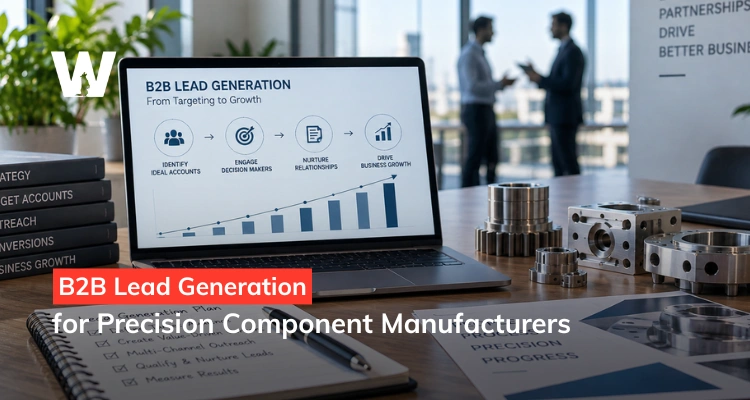
A precision component manufacturer may have advanced CNC machines, experienced engineers, tight tolerance capabilities, robust quality systems and years of experience supplying demanding industries. Yet new business can still depend heavily on existing customers, referrals, exhibitions, distributors and the personal network of the founder or sales team.
There is nothing wrong with these channels. In fact, relationships will always matter in manufacturing. The problem begins when they become the only reliable source of new opportunities.
Today's OEMs, procurement teams, engineers and sourcing professionals can research potential manufacturing partners online before initiating a conversation. They may search for a specific component, machining capability, material, tolerance, certification, industry application or manufacturing location before creating their supplier shortlist.
For precision component manufacturers, this creates an important opportunity. Digital marketing can help transform an unpredictable referral driven approach into a structured system that creates visibility among the right buyers and converts that visibility into qualified RFQs and sales conversations.
This guide explains how B2B lead generation for precision component manufacturers works and how precision engineering companies can use SEO, content, Google Ads, LinkedIn, account based marketing and conversion focused websites to build a more predictable pipeline.
B2B lead generation for precision component manufacturers is the process of identifying, attracting and converting companies that may require your manufacturing capabilities into qualified business opportunities.
Unlike consumer lead generation, the objective is not to generate the highest possible number of leads. A precision manufacturer may need only a small number of highly relevant opportunities if those opportunities represent recurring component requirements, OEM programs or long term supply contracts.
A good lead might be an automotive Tier 1 supplier looking for a precision turned component, a medical device company evaluating a new machining partner, an industrial equipment OEM seeking a supplier for low volume complex parts, or an overseas procurement team looking to diversify its sourcing base.
The quality of the opportunity matters significantly more than the number of form submissions.
That distinction should influence the entire marketing strategy.
Precision manufacturing is not a straightforward transactional purchase.
A potential customer isn't simply asking, “Can you manufacture this component?”
They are trying to determine whether you can manufacture it repeatedly, at the required tolerance, using the right material, within the expected production volume, under an appropriate quality system and at a commercially viable cost.
Depending on the industry and component, a prospective buyer may need to understand your machining capabilities, equipment, tolerances, materials, inspection systems, certifications, production capacity, traceability, secondary processes and experience with similar applications.
Different stakeholders may also evaluate different aspects of your business. A design or manufacturing engineer may focus on manufacturability and technical capability. Quality teams may examine inspection processes and certifications. Procurement may evaluate pricing, capacity, delivery reliability and commercial terms. Senior management may care about supply continuity and the long term stability of the supplier relationship.
This means generic lead generation campaigns rarely work well for precision manufacturers.
Your marketing needs to communicate technical capability and commercial confidence at the same time.
Many successful precision engineering companies have been built through relationships.
A customer recommends the company to another business. A director knows someone in procurement. An exhibition creates a new relationship. An existing customer introduces the manufacturer to another division.
These are valuable channels because trust is already partially established.
However, word of mouth has one fundamental limitation: you cannot control when the next referral happens.
If a precision component manufacturer wants to enter a new industry, expand internationally, reach more OEMs or increase machine utilization, relying exclusively on referrals can make growth unpredictable.
Digital lead generation does not need to replace referrals, exhibitions or sales relationships. Its role is to create an additional acquisition engine that operates alongside them.
The objective is simple: when a relevant buyer is actively searching for the capabilities you already possess, your company should have an opportunity to be discovered and considered.
Understanding search behavior is one of the most important parts of industrial digital marketing.
A procurement manager or engineer may not search for something broad such as:
“Best precision engineering company.”
Their search can be much more specific.
They might search for:
The closer a search gets to a specific capability, material, component, industry or purchasing requirement, the more commercially relevant it can become.
This is why precision manufacturing SEO should not be built around five broad keywords. It should be structured around the different ways buyers describe what your company can manufacture.
A strong manufacturing lead generation strategy can be understood through five connected stages:
Right Market → Right Buyer → Digital Discovery → Technical Qualification → RFQ
Each stage solves a different problem.
First, you need to identify which companies you actually want as customers. Then you need to understand the people involved in supplier selection. Your digital presence must make the company discoverable, while your website and content provide enough evidence for buyers to evaluate your capabilities. Finally, serious prospects need an easy route to submit an RFQ or start a technical conversation.
Let's look at how to build each part of this system.
One of the biggest B2B manufacturing marketing mistakes is defining the target audience as simply “manufacturing companies.”
That is far too broad.
A precision component manufacturer should build its Ideal Customer Profile around the type of work it is commercially and technically best positioned to win.
Start with the industries you want to serve. Depending on your capabilities and certifications, this might include automotive, aerospace, medical devices, industrial equipment, automation, electronics, energy, pumps, valves or other engineering sectors.
Then go deeper.
Consider the geography you want to target, typical component types, materials, tolerance requirements, production quantities, recurring order potential, target company size and the certifications buyers are likely to require.
For example, an ICP could look like:
Automotive and industrial equipment OEMs in the UK and Germany requiring recurring precision turned stainless steel and aluminum components at medium to high production volumes.
That is considerably more useful than saying:
“We want international manufacturing leads.”
The clearer your ICP becomes, the easier it is to build SEO, advertising, content and outbound campaigns around the right opportunities.
The person who discovers your company may not be the person who approves you as a supplier.
In a typical precision manufacturing opportunity, several stakeholders can become involved.
A design engineer may evaluate whether your manufacturing process can achieve the required geometry and tolerance. A manufacturing engineer may investigate production feasibility. A quality manager may assess certifications, inspection capabilities and documentation. Procurement may compare pricing, lead times and commercial terms, while operations or senior leadership may consider production capacity and supply chain risk.
Your marketing therefore needs to answer questions for more than one type of buyer.
Technical pages can address engineers.
Quality and certification content can support supplier qualification.
Case studies can demonstrate experience to decision makers.
Clear capacity and delivery information can help procurement.
The website should work as a digital supplier qualification platform, not simply an online company brochure.
Many precision manufacturing websites begin with statements such as:
“Quality is our priority.”
“We are committed to excellence.”
“We provide world class solutions.”
The problem is that almost every competitor can say exactly the same thing.
Industrial buyers need evidence.
A strong precision manufacturing website should help a prospective customer quickly understand:
The objective is to reduce uncertainty.
A buyer arriving on your website should not need to email your sales team simply to understand whether your company is technically relevant.
Instead of relying on a five page corporate website, build pages around the way buyers research suppliers.
Your website could include dedicated pages for CNC turning, CNC milling, 5 axis machining, Swiss machining or other relevant capabilities.
You can then create material focused pages for stainless steel, aluminum, brass, titanium or engineering plastics where commercially relevant.
Industry pages can address automotive, aerospace, medical, industrial automation or other sectors you genuinely serve.
Certification and quality pages should explain your quality management system, inspection capabilities and relevant certifications rather than displaying certification logos without context.
Finally, a well designed RFQ page should make it easy for qualified prospects to share their requirements.
SEO is one of the strongest long term lead generation opportunities for precision component manufacturers because it allows you to become visible when a potential buyer is already researching a manufacturing requirement.
However, manufacturing SEO needs to be built differently from generic B2B SEO.
Instead of focusing only on high volume keywords, identify searches around:
Capability + Material
For example, “stainless steel CNC turning.”
Capability + Industry
For example, “CNC machining for medical devices.”
Component + Manufacturer
For example, “precision shaft manufacturer.”
Capability + Geography
For example, “precision machining company India.”
Requirement + Supplier
For example, “tight tolerance machining supplier.”
Export/Sourcing Intent
For example, “CNC machining supplier India for USA.”
A keyword with 30 highly relevant searches can sometimes be more commercially useful than a broad term receiving thousands of searches.
The question shouldn't simply be:
How much search volume does this keyword have?
The better question is:
If someone searches this phrase, could they realistically become our customer?
Many manufacturing companies either publish no content or publish generic articles such as “What Is CNC Machining?”
That type of content may attract students, researchers and general visitors without generating meaningful commercial opportunities.
Instead, build content around the technical and commercial questions buyers ask during supplier research.
Examples include:
CNC Turning vs CNC Milling: Which Process Is Right for Your Component?
How Material Selection Affects CNC Machining Tolerances
Design Considerations for Tight Tolerance Machined Components
How to Reduce CNC Machining Costs Without Compromising Component Quality
What to Look for When Choosing a Precision Component Manufacturer
10 Questions to Ask Before Selecting a CNC Machining Supplier
How to Evaluate a Precision Machining Supplier for High Volume Production
What Information Should You Include in a CNC Machining RFQ?
Precision Machined Components for Automotive Applications: What OEM Buyers Should Consider
CNC Machining for Medical Device Components: Quality and Supplier Considerations
Precision Components for Industrial Automation: A Buyer's Guide
How to Source Precision Machined Components From India
What International Buyers Should Look for in an Indian Precision Component Manufacturer
India vs China for Precision Component Sourcing: Key Factors to Consider
This content can generate search visibility while demonstrating that your company understands the concerns behind the drawing, not just the machining operation.
A common manufacturing SEO mistake is putting every capability on one page.
If your company offers CNC milling, CNC turning, Swiss machining, grinding and other specialist processes, each strategically important capability may deserve its own detailed page.
The same principle applies to industries and component categories.
A strong capability page should explain what the process is used for, your relevant equipment, materials, achievable specifications where appropriate, component examples, production capabilities, inspection process and industries served.
It should then provide a relevant conversion opportunity.
Instead of a generic “Contact Us” button, consider calls to action such as:
Request a Manufacturing Quote
Upload Your Drawing for Review
Discuss Your Component Requirement
Request a Capability Review
These CTAs better match the intent of an industrial buyer.
Precision manufacturers should not judge their website primarily by the number of visitors it receives.
The website's most commercially important job is often generating qualified RFQs.
Your RFQ process should therefore collect enough information to help your sales or engineering team understand the opportunity without creating unnecessary friction.
Depending on your business, useful fields can include:
The objective is not simply to generate a form submission.
It is to begin a useful engineering and commercial conversation.
SEO compounds over time, while Google Ads can create visibility much faster for strategically important searches.
Precision component manufacturers can use paid search to target high intent phrases related to specific capabilities, materials, components and geographies.
For example, a company looking to expand in the United States could test searches around precision CNC machining suppliers, custom machined components, CNC turning manufacturers and relevant industry specific requirements.
However, traffic should not automatically be directed to the homepage.
A search for “stainless steel CNC turned components” should ideally lead to a page that demonstrates your stainless steel turning capabilities, relevant equipment, component examples and RFQ process.
That connection between keyword → landing page → technical evidence → RFQ is what makes industrial paid search effective.
Search marketing captures existing demand.
LinkedIn can help you proactively reach the accounts you want to work with.
Start by creating a list of target OEMs, Tier suppliers, engineering companies or other organizations that match your ICP. Within those accounts, identify relevant stakeholders across procurement, sourcing, engineering, supply chain and operations.
Instead of immediately sending a sales message, use content to build familiarity.
Share manufacturing insights, technical problem solving, new capabilities, quality processes, component applications, engineering knowledge and relevant case studies.
For example, rather than posting:
“We are a leading precision component manufacturer.”
show how your team solved a manufacturing challenge involving difficult geometry, material selection, tolerance control, cycle time or quality consistency.
Specific evidence creates credibility.
Generic claims create advertising.
For precision manufacturers, the total number of companies that could become ideal customers may actually be relatively small.
That makes Account Based Marketing particularly relevant.
Instead of marketing to thousands of loosely relevant businesses, identify 50, 100 or 200 companies that represent strong commercial opportunities.
Research their products, manufacturing footprint, sourcing requirements, industries, supplier ecosystem and relevant decision makers.
Then combine LinkedIn, targeted email outreach, technical content, remarketing and direct sales activity around those accounts.
Marketing and sales should work together.
If the sales team wants to enter a particular automotive OEM, marketing can develop supporting industry content, relevant case studies and targeted campaigns rather than operating independently.
For manufacturers in India seeking customers in the United States, UK, Europe or other international markets, digital trust becomes especially important.
An overseas buyer cannot casually visit your factory before every initial conversation.
Your digital presence needs to reduce that distance.
Show the facility.
Show the machines.
Show your quality laboratory.
Explain your inspection process.
Introduce your engineering team.
Provide relevant certifications.
Show examples of the types of components you manufacture without violating customer confidentiality.
Explain your export experience, logistics capability and the markets you already serve where appropriate.
Video can be particularly effective here. A well produced facility walkthrough or manufacturing capability video can sometimes communicate more credibility than several pages of marketing copy.
International lead generation is not only about becoming visible overseas.
It is about making an overseas buyer comfortable enough to put your company on the shortlist.
B2B research is changing.
Buyers increasingly use AI powered search experiences and tools to research suppliers, manufacturing processes, sourcing locations and technical questions.
A procurement professional might ask:
“What should I look for when choosing a precision machining supplier in India?”
An engineer might ask:
“Which manufacturing process is suitable for a tight tolerance stainless steel component?”
This creates another discovery layer alongside traditional Google search.
Precision manufacturers should structure their websites so their capabilities are easy to understand. Clear service pages, detailed industry content, FAQs, structured data, technical expertise, consistent company information and credible third party mentions can all strengthen the digital entity around the business.
SEO remains the foundation. AEO and GEO extend that foundation into AI driven discovery.
One of the strongest forms of B2B manufacturing content is a good case study.
Instead of telling buyers:
“We manufacture complex precision components.”
Show them.
A manufacturing case study can explain the customer's challenge, component requirements, material, tolerance, production challenge, manufacturing approach, inspection process and measurable outcome.
For example:
Challenge: An industrial equipment OEM required a stainless steel component with tight tolerance at recurring production volume.
Approach: The engineering team optimized tooling and machining parameters while introducing in process inspection.
Result: Consistent production quality with reduced cycle time and reliable delivery.
The details will vary according to what can be disclosed, but the principle remains the same.
Proof is stronger than adjectives.
Digital marketing does not mean abandoning exhibitions and trade shows.
Instead, connect the two.
Before an exhibition, identify target accounts and promote relevant content to them. Create event specific landing pages and meeting booking opportunities.
During the exhibition, capture contacts in a structured system rather than collecting business cards that disappear into someone's drawer.
After the event, segment prospects based on industry, requirement and opportunity stage. Follow up with relevant technical information, case studies and sales conversations.
This turns an exhibition from a three day activity into a longer account development campaign.
Not every prospect that discovers your company today will have an immediate RFQ.
They may be evaluating suppliers for a future project, developing a new product, considering a second source or waiting for an existing supplier contract to expire.
This is why precision manufacturing lead generation needs nurturing.
A CRM can help track the account, contacts, source, requirements, quotation history and next action. Email and LinkedIn can keep your company visible through relevant technical content and company updates.
The objective is not to send weekly promotional emails.
It is to remain credible and visible until the sourcing requirement becomes active.
Manufacturing companies should avoid measuring marketing success primarily through impressions, followers or website traffic.
Those numbers can be useful indicators, but they do not tell you whether marketing is creating business.
Start with visibility metrics such as relevant keyword rankings, organic traffic from target markets and engagement with capability pages.
Then measure conversion metrics such as drawing uploads, RFQs, calls, technical enquiries and meetings.
Most importantly, connect marketing with sales outcomes.
Track:
This creates an important feedback loop.
If CNC turning content is consistently generating automotive RFQs from Germany while another service generates traffic but no opportunities, marketing investment can be adjusted accordingly.
A good system doesn't depend on a single channel.
Imagine a procurement manager in Germany searching for a new precision component supplier.
They discover one of your technical articles through Google. From there, they visit your CNC turning capability page and review the materials, equipment and industries you support.
They then visit your quality page to check certifications and inspection capabilities before reviewing a relevant automotive case study.
They leave without contacting you.
Several days later, they see a relevant LinkedIn post or remarketing message from your company. They return to the website, upload a drawing and request a quote.
Your sales team receives the enquiry with information about the source, pages visited and project requirement.
That is not simply SEO.
It is not simply LinkedIn.
And it is not simply a good website.
It is a connected B2B lead generation system.
If your company currently relies primarily on referrals, exhibitions and existing relationships, you do not need to activate every digital channel at once.
During the first 30 days, focus on research and foundation. Define target industries, markets, buyer roles, priority capabilities and commercially relevant keywords. Audit the website and identify where technical information or conversion paths are missing.
During days 31 to 60, strengthen the website around priority capabilities and industries. Build or improve RFQ functionality, technical SEO, analytics and conversion tracking. Begin creating high intent technical content around actual buyer questions.
During days 61 to 90, start expanding demand generation. This could include targeted Google Ads, LinkedIn account based activity, SEO content and structured outbound campaigns for carefully selected target accounts.
The objective of the first 90 days isn't thousands of leads.
It is to establish a system capable of generating and measuring the right opportunities.
One common mistake is assuming that having a website means having a digital marketing strategy. A website that lists capabilities but cannot rank for relevant searches or convert visitors into RFQs is still essentially a digital brochure.
Another mistake is targeting broad audiences. A precision component manufacturer does not need every manufacturing company to know its name. It needs visibility among the companies most likely to require its capabilities.
Manufacturers also frequently communicate capabilities using generic claims rather than technical evidence. Statements such as “high quality,” “world class” and “customer focused” mean little unless they are supported by actual equipment, certifications, tolerances, inspection processes, case studies or manufacturing expertise.
Finally, don't measure success by lead volume alone. Ten irrelevant enquiries can consume more sales time than one serious RFQ from the right OEM.
Word of mouth can build an excellent precision manufacturing company.
But it should not determine how quickly the company can grow.
A modern B2B lead generation strategy gives precision component manufacturers another route to market. SEO helps capture existing demand. Technical content builds authority. Google Ads provides targeted visibility. LinkedIn and ABM help reach priority accounts. Case studies create proof. A strong website helps buyers qualify the company, while a well designed RFQ process converts interest into an opportunity.
The goal isn't to replace relationships with digital marketing.
It is to use digital marketing to create more of the right relationships.
At Wolfable, we work with manufacturing and engineering businesses that often face a similar challenge: strong technical capability, but new business still depends heavily on referrals, exhibitions, existing customers or the sales team's network.
Our approach begins by understanding what you manufacture, which capabilities create the strongest commercial opportunity, which industries you want to penetrate and which geographic markets matter most.
From there, we can build an integrated strategy across manufacturing SEO, technical content, website conversion, Google Ads, LinkedIn, account based campaigns, AEO and GEO, and analytics.
More importantly, we don't believe manufacturing marketing should be judged only by traffic.
The real question is whether your digital presence is helping your business generate more conversations with OEMs, procurement teams, engineers and companies that can actually become customers.
If your precision manufacturing capabilities are stronger than your current digital visibility, that is the gap we can help close.