Manufacturing
Wraps up in 6 Minutes
Manufacturing SEO vs AEO: What Industrial Companies Need to Know

Published On July 8, 2026
Wraps up in 6 Minutes
Published On July 8, 2026
Your sales engineer forwards you a message.
A procurement manager at a target account says they "asked ChatGPT for a shortlist" and your company was not on it.
Three competitors were. Two of them are smaller than you.
That conversation is happening across the industrial sector right now, and it is forcing an uncomfortable question:
If buyers are getting answers instead of links, does traditional search optimization still matter for manufacturers?
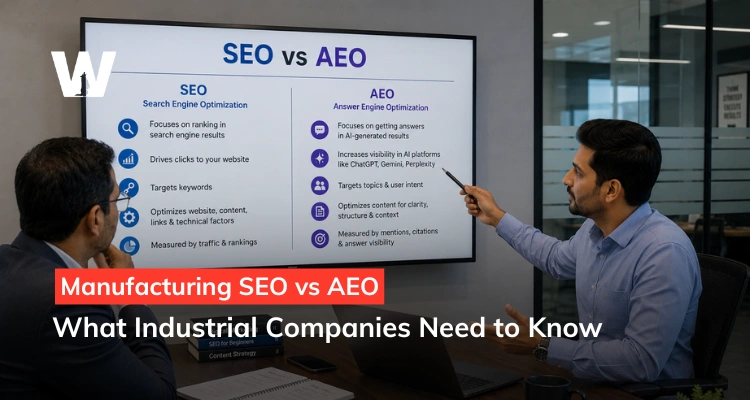
The debate has been framed as manufacturing SEO vs AEO, as though you have to pick a side. You do not. But you do need to understand what each one actually does, because the wrong assumption here costs real RFQs.
Most manufacturers assume AEO is a replacement for SEO. It is closer to the opposite: AEO is what happens when your SEO foundation is good enough for a machine to trust it.
That distinction shapes every budget decision that follows, and it is where a lot of manufacturing marketing programs quietly go wrong.
This guide breaks down what SEO and AEO each do for industrial companies, where they overlap, where they genuinely differ, and how to run one strategy that covers both without doubling your budget.
Manufacturing SEO is the work of making your site findable and rankable when someone searches for what you make.
In practice, that means capability pages, product and part pages, application content, technical resources, and the technical infrastructure underneath all of it.
For industrial companies, SEO has always been narrower and higher value than consumer SEO. Nobody searches "stainless steel bright bars 12mm h9 tolerance" out of curiosity. That query has a buyer behind it, usually with a spec sheet open in another tab.
The traffic volumes are small. A term like "industrial seo" gets a few hundred US searches a month.
But the commercial intent is dense, and one qualified RFQ can be worth more than a year of consumer traffic.
Here is what SEO reliably delivers for manufacturers:
None of that has stopped working. What has changed is where the answer gets delivered.
Answer engine optimization is the practice of structuring your content so that AI systems can extract, trust, and cite it when generating a direct answer.
The visibility is the win, whether or not a click follows.
For manufacturers, this matters because of who is asking. An engineer typing "what material should I specify for a food-grade conveyor in a washdown environment" is not looking for a homepage.
They want a reasoned answer, and the AI will assemble it from whichever sources it can parse and trust.
If your knowledge lives in a downloadable PDF datasheet, a distributor's catalog page, or a sales rep's head, you are not in that answer. A competitor with worse products but clearer web content will be.
This is where answer engine optimization diverges from a pure ranking exercise. You are optimizing for extraction and citation, not just position.
The engines that matter for industrial buyers are Google AI Overviews and AI Mode, ChatGPT, Perplexity, Microsoft Copilot, and Gemini.
They do not all behave the same way, which is a point most articles on this topic skip entirely.
| Factor | Manufacturing SEO | AEO for Manufacturers |
|---|---|---|
| Goal | Rank a page in results | Get cited inside an answer |
| Query type | Specific, keyword-shaped | Conversational, problem-shaped |
| Success metric | Position, clicks, sessions | Citation frequency, share of answers |
| Buyer stage | Knows the spec, comparing suppliers | Defining the problem, building a shortlist |
| Content unit | The page | The paragraph, table, or answer block |
| Winner takes | Traffic | Trust and consideration |
| Timeline | 4 to 9 months for competitive terms | Often faster, but far less stable |
The most important row in that table is the last one. AEO visibility moves.
A model update can change which sources get cited for a query in a single week, while a hard-won organic ranking tends to hold.
Manufacturers with long sales cycles should weight that stability accordingly.
This is the part that changes the budget conversation, and almost nobody covers it.
In its official guidance for site owners, Google Search Central addresses AEO and GEO directly.
Its position is that from Google Search's perspective, optimizing for generative AI search "is optimizing for the search experience, and thus still SEO." Its generative features run on the same core ranking and quality systems that power classic search.
Google goes further and lists things you can ignore for its search products:
That list eliminates a fair amount of the AEO advice currently being sold to manufacturers.
There is an important limit, though. Google's guidance covers Google. ChatGPT, Perplexity, and Copilot are separate systems with their own retrieval behavior, their own crawlers, and their own citation patterns. Treating Google's documentation as universal is its own mistake.
The B2C and SaaS playbooks do not transfer cleanly to a plant floor, and three things explain why.
We see this on almost every audit: the manufacturer has better technical depth than the competitor outranking them, but none of it exists as readable web content.
SEO holds the ground closest to revenue, and the data supports keeping it funded.
Pew Research Center analyzed the browsing behavior of 900 US adults and found that when an AI summary appeared, users clicked a traditional result 8% of the time, compared with 15% when no summary was present.
According to Pew's analysis, only 1% of visits involved clicking a link inside the summary itself.
Read that carefully. Clicks fell, but they did not vanish. And AI summaries appear far less often on narrow technical queries than on broad informational ones, because the model has less consensus material to summarize.
SEO remains the stronger investment for:
That last point is the one manufacturers underrate. Buyers use AI to narrow, then they use search to verify.
If you win the shortlist and lose the verification, you still lose.
AEO earns its budget at the top of the funnel, where you previously had almost no visibility.
Consider the queries a buyer runs before they know what to specify: "how do I reduce cavitation in a centrifugal pump," or "which coating holds up in coastal industrial environments."
Those questions used to route through forums and trade publications. Now they route through AI, and whoever gets cited enters the consideration set first.
The traffic that follows behaves differently, too. Semrush research estimates that AI search visitors convert at roughly 4.4 times the rate of traditional organic visitors, largely because they have already compared options before they arrive.
For manufacturers, the practical AEO priorities are:
If you want the mechanics of that in more depth, our guide on how to rank on ChatGPT covers the retrieval side, and our breakdown of generative engine optimization explains how the two disciplines connect.
Splitting SEO and AEO into competing budget lines is the most common and most expensive mistake we see. Here is the sequence that works.
AI referral traffic is typically around 1% of total sessions for most B2B sites.
If you judge AEO on session volume, you will kill the program before it matures.
Judge it on different questions instead:
A declining session count paired with a stable or rising RFQ count is not a failure.
It usually means the low-intent research traffic moved into AI, and what reaches your site is closer to a buying decision than it used to be.
Manufacturing SEO vs AEO is the wrong frame.
SEO is how machines find and trust your content.
AEO is what that trust earns you when the machine answers instead of listing. One is the foundation, the other is the return on it.
What genuinely changes for industrial companies is the cost of being unreadable.
When your specifications sit in PDFs, and your expertise sits with your sales team, you are invisible to the systems now assembling your buyers' shortlists.
That was survivable when buyers browsed. It is not survivable when they ask.
Wolfable works with more than 120 manufacturers on exactly this problem, translating technical capability into content that ranks in search and gets cited in AI answers.
If you want to know where your site stands today, get in touch, and we will walk through it with you.