Web Development
Wraps up in 8 Minutes
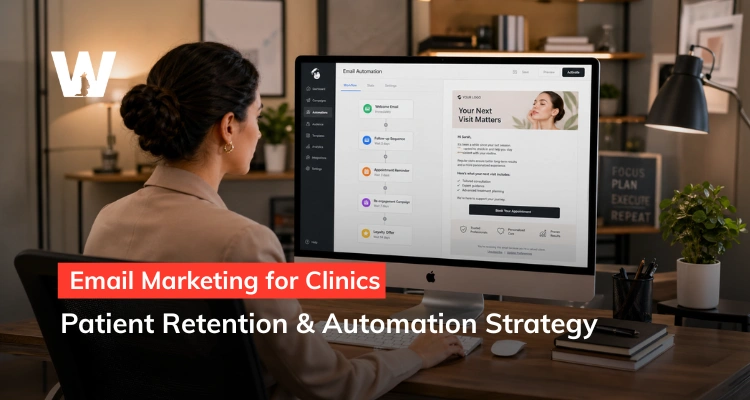
Email Marketing for Clinics: Patient Retention & Automation Strategy

Published On April 22, 2026
Wraps up in 8 Minutes
Published On April 22, 2026
Most clinics lose patients not because of a bad experience - but because of silence. A patient leaves after a great consultation, gets busy with life, and simply forgets to come back. Nobody followed up. Nobody checked in. And six months later, they booked with your competitor.
Email marketing, done well, is the system that closes that gap. It keeps your clinic in the conversation between visits, nudges patients back when the timing is right, and builds the kind of ongoing relationship that turns a one-time booking into years of patient loyalty.
The data makes a compelling case. Healthcare email campaigns achieve open rates of 44.60% - significantly higher than the industry average. And WebFX's 2026 healthcare marketing benchmarks put email ROI at $36 for every $1 spent, one of the highest returns of any marketing channel available to clinics.
The gap between clinics that get those results and those that send the occasional newsletter is not budget. It is a strategy. This guide walks through what that strategy looks like - from automation sequences to segmentation to the metrics that tell you whether it is working.
Social media reaches people who happen to be scrolling. Search reaches people who are actively looking. Email reaches people who already chose you - they gave you their address because they trusted your clinic enough to book.
That is a fundamentally different relationship. And it changes what email can do for a clinic compared to what it does for a generic brand or an e-commerce store.
A patient who has visited once knows your space, knows your team, and had an experience good enough to share their contact details. An email from your clinic lands in an inbox that already has positive associations with your name.
According to Genesys Growth's 2026 email statistics report, healthcare drip campaigns achieve 56.36% view rates - nearly double the cross-industry average. That figure reflects the fact that patients genuinely want to hear from a clinic they trust.
The challenge is building the system that sends the right email at the right moment. That is where most clinics leave their retention ROI on the table.
Automation does not mean cold and robotic. The best clinic email sequences are the ones patients open and think, 'That was well-timed.' Building that impression requires knowing which moments in the patient journey call for a message.
The moment a patient completes their first visit is the highest-engagement window you will ever have with them. Welcome emails achieve an average open rate of 83.63% - and that window closes quickly.
A two to three-email welcome sequence should introduce your clinic's team and values, set expectations for the patient experience, and let the patient know what kind of communications they can expect from you going forward.
This is not the place for a promotional offer. It is the place to make the patient feel that booking with you was the right decision. Warmth and clarity at this stage compound into long-term loyalty.
Following up within 24-48 hours of a treatment is one of the simplest, most effective retention actions a clinic can take. A short email asking how the patient is feeling, sharing aftercare guidance, and inviting any questions does several things at once.
It demonstrates that your clinic cares beyond the consultation room. It pre-empts post-treatment anxiety. And it opens a conversation that often leads to the patient booking their next session.
Keep these short - two to three paragraphs, a clear reply invitation, and one soft link to a relevant treatment FAQ page on your website.
Every clinic has a segment of patients who visited once, had a good experience, and then disappeared. They did not leave angry - they just got busy. A reactivation sequence targets patients who have not booked in 90-180 days, depending on your treatment cycle.
A well-written reactivation email does not guilt-trip or pressure. It acknowledges the gap naturally: "It has been a while since we have seen you, and we wanted to check in." Add a relevant seasonal offer or a gentle reminder of a treatment they previously expressed interest in.
According to 2026 healthcare marketing research, well-segmented reactivation programs deliver 3-5 times higher ROI than paid acquisition for the same budget. Re-engaging a patient who already chose you is almost always cheaper than finding a new one.
These feel small but perform significantly. Birthday emails achieve an average open rate of 56% - three times higher than standard marketing sends.
For a clinic, a birthday message with a small, thoughtful gesture - a complimentary consultation add-on or a modest discount on a treatment - lands in an inbox that rarely receives that kind of personalized attention from a healthcare provider.
Milestone emails work similarly. A "one year with us" note acknowledging a patient's treatment anniversary, with a warm reflection on what they have achieved, creates emotional resonance that no paid ad can replicate.
Patients who booked once but have not yet explored your other treatments represent your most accessible growth opportunity. An educational nurture sequence introduces related treatments in a low-pressure, informative way.
The key is sequencing content based on what the patient has already experienced. A patient who had a chemical peel might receive an educational email about skin boosters two weeks later - not a "buy now" push, but a genuinely useful explainer of how the two treatments work together.
This approach mirrors how we think about content strategy in clinic marketing more broadly. Our guide on content marketing strategy for aesthetic practices covers how educational content builds the trust that converts one-time visitors into long-term patients.
A practice with 2,000 email subscribers and a single monthly newsletter is leaving a significant portion of its email potential untouched. Segmentation divides your list into meaningful groups and sends each group only the content that is relevant to them.
The return on this effort is not marginal. Segmented email programs deliver 3-5 times higher ROI than non-segmented sends. And for a clinic, the natural segmentation criteria are already sitting in your booking system.
| Segment | Defining Criteria | What to Send | Primary Purpose |
|---|---|---|---|
| New patients | First visit within last 30 days | Welcome sequence, aftercare tips, team introduction | Build trust and improve patient experience |
| Active patients | Visited within last 90 days | Loyalty updates, complementary treatment education, seasonal offers | Increase repeat visits and retention |
| Lapsed patients | No visit in 90-180 days | Reactivation sequence, re-engagement offer, warm check-in | Encourage patients to return |
| Treatment-specific | Patients who had a specific procedure | Maintenance reminders, before-and-after content, related treatment info | Promote follow-up treatments and education |
| High-value patients | Multiple visits or premium treatments | Exclusive early access, loyalty recognition, VIP offers | Strengthen loyalty and long-term value |
| Birthday month | Patients with birthdays this month | Personalized birthday message with a relevant clinic offer | Improve engagement and patient connection |
Source: Wolfable clinic email segmentation framework; Mailchimp healthcare email benchmarks.
Bottom Line: A lapsed patient who receives a generic newsletter feels like a number. The same patient who receives a check-in email timed to their treatment cycle feels seen. That difference is what segmentation creates.
The most common reason clinic email programs underperform is not the technology or the sending frequency. It is the tone. Generic, corporate-sounding healthcare copy creates distance between the clinic and the patient.
Patients already trust you with their physical wellbeing. Your emails should feel like they come from the same team that greeted them at reception - warm, clear, and genuinely helpful rather than promotional.
Write from a person, not a brand. "Hi Sarah, this is Emma from [Clinic Name]" outperforms "Dear valued patient" in open rates and in the relationship it quietly builds every time it lands in an inbox.
Lead with the patient's situation, not your service. "We know post-treatment skin can feel sensitive for a few days" acknowledges the patient's experience before making any ask. That order matters more than most clinics realize.
Subject lines should be curious, personal, or useful - not promotional. "We have been thinking about you" performs better than "20% off this month only" in a clinic context, because it triggers a different kind of opening motivation.
Open rate remains useful as a directional signal, but Apple Mail Privacy Protection has made it less reliable as a precise measurement. In 2026, clinic email programs need a broader measurement framework.
The metrics that matter most are the ones that connect email activity to patient behaviors - specifically, bookings and revenue generated from email campaigns.
| Metric | Healthcare Benchmark | What It Tells You |
|---|---|---|
| Open rate | 44.60% average | Subject line and sender performance, used mainly as a directional indicator in 2026 |
| Click-through rate | 1.87% - 5% (drip campaigns) | Measures content relevance and CTA clarity, making it a more actionable performance metric |
| Booking rate per email | Clinic-specific baseline | Most direct measure of how email campaigns contribute to appointment revenue |
| Reactivation rate | 8-15% of lapsed segment | Shows the effectiveness of your reactivation timing and patient re-engagement sequence |
| Unsubscribe rate | Below 0.5% is healthy | Indicates how well your content matches audience expectations and segmentation quality |
| Revenue per email sent | Track over a 90-day window | Provides the clearest long-term ROI indicator for your entire email marketing program |
Source: Mailchimp Healthcare Email Benchmarks; Paubox Healthcare Email Report 2024; Wolfable clinic email performance data.
Bottom Line: If your email program looks good on open rate but produces no measurable increase in bookings, the problem is in the content or the calls to action - not the delivery platform.
Email is one of the channels we invest in the most strategic thinking for clinic clients, because it sits at the intersection of marketing and patient relationship management. Getting it right requires understanding the patient journey, not just the email platform.
We have worked with 500-plus clients across healthcare, aesthetics, and B2B verticals. The email programs that compound over time are never the ones built around a single monthly newsletter. They are the ones with structured automation, thoughtful segmentation, and copy that reads like it came from a real person who genuinely cares.
For one of our aesthetic clinic clients, rebuilding the post-appointment email sequence alone produced a measurable increase in repeat bookings within the first 90 days. The change was not the platform or the budget - it was the timing and the tone of the follow-up message.
Our in-house team includes strategists, copywriters, automation specialists, and analysts who work together on clinic email programs from initial audit through to ongoing performance reporting.
If your clinic also needs to think about how email integrates with your broader social media presence, our social media marketing guide for aesthetic clinics covers how the two channels reinforce each other over time.
Most clinic marketing channels are good at acquisition. Email is the channel that is exceptional at retention. And in a business where the lifetime value of a loyal patient far exceeds the cost of keeping them engaged, retention is where sustainable growth lives.
Clinics with the most consistent patient revenue are rarely the ones spending the most on ads. They are the ones with a structured system that keeps patients warm between visits, reaches out at the right moments, and makes every message feel like it came from a team that remembers them.
Building that system is not complicated. It requires five well-designed automation sequences, a segmented list, and copy that sounds like a real human being wrote it - because it should.
If you are ready to make email a real growth channel for your clinic, talk to the our team - we design and build email programs for aesthetic and medical clinics that generate real retention outcomes, tracked and reported from month one.
You can also explore how email connects with your broader digital strategy in our guides on Local SEO for aesthetic clinics and how 'near me' searches drive patient bookings.