Aesthetic Clinic
Wraps up in 9 Minutes
How Aesthetic & Cosmetic Clinics Can Rank in Google Local 3-Pack (Proven Strategies)

Published On April 1, 2026
Wraps up in 9 Minutes
Published On April 1, 2026
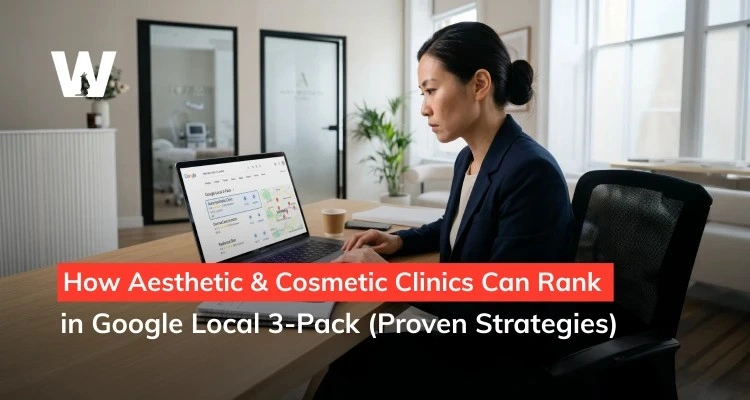
Your competitor down the street has been fully booked for six months. They do not run expensive ads. They do not have better doctors than you. But every time someone nearby searches "Botox near me" or "laser hair removal clinic," their name shows up first - in that coveted little map box at the top of Google's results page.
That box is the Google Local 3-Pack. And for aesthetic and cosmetic clinics, it is arguably the single most powerful piece of digital real estate available. It appears before organic website listings, before paid search results in many layouts, and it dominates the screen on mobile - where the overwhelming majority of local clinic searches happen.
We've worked with clinics that were invisible on Google Maps despite excellent reputations offline. Once we restructured their Local SEO approach, the difference was measurable within months - not years. One of those clinics, a premier medical aesthetics centre, achieved a 127% surge in local search impressions and a 67% increase in calls directly from their Google Business Profile.
The 3-Pack is not a lottery. There is a clear framework behind which clinics appear in those three spots, and which don't. This guide breaks down the proven strategies - grounded in how Google's local algorithm works - that aesthetic and cosmetic clinics can use to earn and hold a position in the top three local listings.
The Google Local 3-Pack is the group of three business listings - with a map preview - that appears at the top of Google search results for local queries. For aesthetic clinics, it is triggered by searches like "Botox clinic near me," "dermal fillers [city]," or "laser skin treatment." These three listings sit above organic website results, capturing the highest-intent segment of patient searches before a single website link is clicked.
According to BrightLocal's 2026 research, the Local Pack appears for 93% of local searches and occupies approximately 33% of visible screen space on mobile devices. For clinic discovery searches, this means nearly a third of what a potential patient sees when they open Google is these three listings.
Position within the 3-Pack matters significantly. A Moz local CTR study found that Position 1 in the Local Pack receives 24.4% of clicks, Position 2 earns 13.3%, and Position 3 gets 8.6%. Being outside those three listings means minimal visibility in a mobile-first patient journey - and in aesthetic medicine, invisible means unbooked.
Google has officially documented three factors that determine which businesses appear in the Local 3-Pack: relevance, distance, and prominence. Understanding how each applies to aesthetic medicine is where most clinics begin to gain ground.
Relevance measures how closely your Google Business Profile matches a patient's search. Google evaluates this through your primary category, secondary categories, service listings, business description, and the keywords that appear naturally across your profile and reviews. A clinic optimized for "Medical Spa," "Skin Care Clinic," and "Laser Hair Removal Service" simultaneously will appear for a far wider range of patient searches than one with a single generic category.
Distance is Google's measure of how close your clinic is to the person searching or the location they specified. This is largely outside your control. But clinics can offset distance disadvantages through stronger prominence and relevance signals - and in many competitive markets, well-optimized clinics further from the search center outrank closer competitors who have neglected the other two pillars.
Prominence reflects how well-known and trusted Google believes your clinic to be. It draws from dozens of signals: review quantity, review sentiment, backlinks from reputable sites, branded search volume, directory citations, and website SEO performance. According to Google's own documentation, "your position in web results is also a factor" in your local ranking - meaning your clinic's website health feeds directly into your Local Pack position.
You cannot change your clinic's location, but you can substantially strengthen relevance and prominence. Those two pillars are where the ranking battle is won or lost.
Your Google Business Profile is the most direct lever you have on your Local 3-Pack ranking. According to the 2026 Local Search Ranking Factors Survey, primary GBP category is the single most influential ranking factor - above even physical proximity. This is encouraging news for clinics in competitive areas, because category selection is entirely within your control.
The most common mistake aesthetic clinics make is selecting a broad category like "Beauty Salon" or simply "Clinic." Your primary category should directly match your core service. A cosmetic injections specialist should select "Medical Spa" or "Cosmetic Surgeon" - not "Day Spa." Add secondary categories for each service line: "Skin Care Clinic," "Laser Hair Removal Service," "Hair Transplantation Centre." This layered approach ensures your profile surfaces for the full range of treatment-specific patient queries in your area.
Every treatment you offer should appear in your GBP service menu with a clear, keyword-aligned name and a brief description. If your clinic offers Botox but does not list it explicitly, Google has no reason to rank you for "Botox near me." The business description (750 characters) is another opportunity to weave in your core treatments and location naturally. Avoid copy-pasting your website homepage - write specifically for the GBP audience who is seconds away from making a booking decision.
This is where many clinics leave ranking potential untouched. According to SOCi's 2026 research, businesses with customer photos receive 42% more direction requests, and the average business in the Local Pack has 11 or more photos - significantly above the 6-photo average of non-ranking competitors. Upload exterior shots, treatment rooms, team photos, equipment, and before-and-after results (with patient consent). Weekly photo updates signal to Google that your profile is active and evolving.
We've consistently seen that clinics who commit to a regular photo cadence outperform those who upload a batch and leave it untouched for months. The GBP algorithm rewards activity, not just volume.
Reviews are among the most cited Local Pack ranking factors - and among the most mismanaged by clinic owners. Most think of reviews as reputation management. They are that, but they are also an active algorithmic signal that determines whether you rank and whether patients choose you once they see your listing.
A BrightLocal study shows that clinics with 50 or more reviews rank significantly higher than those with under 10. But total count is only part of the story. Review velocity - how recently and consistently new reviews arrive - weighs heavily in the algorithm. A clinic with 40 reviews from two years ago will often underperform a competitor with 20 reviews gathered in the last six months. Google interprets fresh reviews as evidence of an actively serving business.
When a patient writes "I came to [Clinic Name] for laser hair removal and the results were outstanding," that treatment mention acts as a direct relevance signal. Google's algorithm reads review text and uses it to match your profile to relevant searches. You cannot dictate what patients write, but you can frame your review request: "Would you mind sharing which treatment you had and what your experience was like?" That simple framing shift can meaningfully change the quality of the reviews you receive.
According to BrightLocal's consumer research, 71% of patients would not consider using a clinic with an average rating below 3 stars. But how you respond to reviews - including negative ones - also functions as a trust signal. Unanswered reviews suggest an absent owner. Thoughtful, professional responses signal that your clinic takes patient feedback seriously, which influences both conversions and Google's assessment of your engagement level.
| Factor | Weak Review Profile | Strong Review Profile |
|---|---|---|
| Total reviews | Under 10 | 50 or more |
| Review recency | Most over 12 months old | New reviews every 2-4 weeks |
| Review content | Generic star ratings only | Mentions specific treatments |
| Owner responses | None or generic | Personalized, timely |
| Average star rating | Below 4.0 | 4.5 or above |
| Ranking impact | Suppressed Local Pack visibility | Active ranking and conversion boost |
Source: BrightLocal Local Consumer Review Survey; Whitespark Local Search Ranking Factors 2026.
Reviews are not passive feedback - they are an active ranking and conversion mechanism. A structured review acquisition system is one of the highest-ROI investments in Local SEO for aesthetic clinics.
Many clinic owners focus entirely on their GBP and neglect the website signals that amplify it. Google's local algorithm uses your website's organic authority as a component of "prominence" - meaning a stronger, better-structured site directly supports your Local Pack position. This connection is explicit in Google's own guidance and confirmed consistently by Local SEO practitioners.
Your Name, Address, and Phone number (NAP) must appear identically across your website, GBP, social profiles, and every directory where your clinic is listed. According to Whitespark, clinics with consistently accurate NAP data across all platforms rank 28% higher in the Local Pack than those with inconsistencies. A small discrepancy - "St." versus "Street," or a missing suite number - can fracture your entity trust with Google in ways that are disproportionate to how minor the error appears.
Schema markup is structured code added to your website that helps Google understand your clinic as a verified local business entity. LocalBusiness schema allows you to specify your clinic type, address, phone number, opening hours, geo-coordinates, and service areas in a format Google can read directly. Despite being a proven ranking support tool, schema remains underused among aesthetic clinics - making it a clear competitive advantage for those who implement it correctly. As part of any Local SEO engagement, our team at Wolfable builds this into every client's website foundation.
Each major treatment your clinic offers should have its own dedicated page - not a bullet point in a services list. A page titled "Lip Filler [City Name]" with treatment information, patient FAQs, before-and-after imagery, and testimonials acts as a content signal that reinforces your GBP relevance for that specific query. This approach is central to how we helped an aesthetic clinic in our portfolio achieve significant improvements in both organic and local pack visibility. You can learn more about this methodology in our SEO strategy guide for aesthetic clinics.
In 2026, Google's local algorithm gives meaningful weight to what users do after seeing your listing. High engagement from your GBP - clicks, calls, direction requests - tells Google that real patients find your listing relevant and trustworthy. Low engagement, even from a technically optimized profile, can suppress your ranking over time.
If your GBP listing generates impressions but few clicks, Google interprets this as a signal that your profile is not compelling relative to competitors. A strong hero photo, high star rating, clear category labelling, and active posts all increase your click-through rate. The listing with consistently higher engagement tends to climb in ranking over time - it is a self-reinforcing cycle that rewards clinics who treat their GBP as a living conversion asset, not a static form.
Direction requests are among the strongest local behavioural signals. When a user asks Google Maps to navigate to your clinic, it sends a definitive signal of booking intent. Clinics can encourage this organically by embedding "Get Directions" links on their website footer, in appointment confirmation emails, and in SMS reminders. Every direction request from a non-patient is also a data point Google uses to assess how relevant your clinic is to the community around it.
According to SOCi's 2026 research, businesses that post weekly on their GBP see 28% more website clicks and 42% more direction requests compared to those that post monthly. GBP posts can feature seasonal treatment offers, new services, patient education content, or clinic events. Each post is a fresh engagement signal that tells Google your profile is active - and it gives prospective patients a reason to click.
| GBP Activity Area | Passive GBP | Active GBP |
|---|---|---|
| Photo uploads | One-time batch upload | Fresh uploads weekly |
| GBP posts | Rarely or never | Every 7-10 days |
| Q&A section | Empty or unanswered | Pre-populated with treatment FAQs |
| Review responses | Ignored or generic | Personalized within 48 hours |
| Business hours | Set once, never updated | Updated for holidays and events |
| Engagement signals | Low CTR, few calls | High CTR, calls, and direction requests |
| Local Pack visibility | Inconsistent or absent | Consistent, improving over time |
Source: SOCi 2026 Research; BrightLocal Local Pack Behavior Analysis.
Clinics that treat their GBP as a managed, living platform consistently outperform those that optimize once and walk away.
We have worked with 183+ clients across healthcare, manufacturing, and B2B verticals, but aesthetic clinics occupy a unique position in our practice. The combination of YMYL scrutiny from Google, high patient trust requirements, and fierce local competition makes this one of the most technically demanding Local SEO environments we operate in.
One of the clearest examples is Musk Clinic, a premier medical aesthetics and hair transplant centre. When they came to us, their GBP was under optimized, NAP data was inconsistent across directories, and recent reviews were sparse. Within months of restructuring their full local presence - GBP categories, review acquisition system, citation cleanup, and on-site local signals - they achieved a 127% increase in local search impressions, a 119% rise in profile appearances in search results, and a 67% jump in calls directly from their Google Business Profile. Website clicks from the GBP climbed 104%.
Our 28 in-house specialists - strategists, SEO experts, content writers, prompt engineers, and developers - handle every aspect of Local SEO under one roof. There is no outsourcing and no templated approach. Each clinic's strategy is built from a competitive audit of their specific city, their primary treatment focus, and their existing digital footprint. If you are also interested in how content strategy supports local visibility long-term, our article on how 'near me' searches drive patient bookings is a useful companion read.
The Google Local 3-Pack is not reserved for the biggest clinics or the ones with the most ad spend. It rewards the most strategically optimized local presence - and that is entirely achievable with the right approach and consistent execution.
The clinics that hold 3-Pack positions in competitive markets share a common pattern: a fully built-out, active Google Business Profile; a steady stream of keyword-rich patient reviews; a technically sound website with local schema and treatment-specific pages; and a consistent flow of behavioural signals that tell Google their listing is genuinely useful to local patients.
The difference between ranking and not ranking is rarely dramatic. It is the cumulative effect of well-executed fundamentals. And in aesthetic medicine, where a single new patient represents significant lifetime value, the return on that investment is hard to match through any other channel. For further reading on managing the reputation signals that feed into your Local Pack position, our guide on
online reputation management for aesthetic clinics at wolfable.com covers the full review and trust-building framework in detail.