Digital Marketing
Wraps up in 10 Minutes
SEO Strategy for Fundraising & VC-Focused Valuation Firms

Published On February 10, 2026
Wraps up in 10 Minutes
Published On February 10, 2026
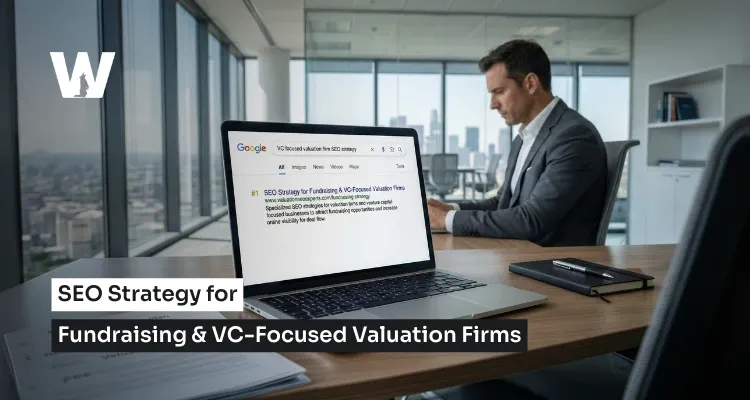
Imagine a Partner at a London Venture Capital firm. They have just received a pitch deck from a promising FinTech startup. The valuation looks ambitious. Before they call you for an independent opinion, they do one thing: they search for your firm online.
What do they find? Do they see a thought leader dominating the search results for "SaaS valuation methodologies"? Or do they find a digital ghost town?
In the high-stakes world of fundraising and valuation, your digital presence is your first round of due diligence. If you are invisible on Google, you are often invisible to the deal flow.
At Wolfable, we understand that marketing for financial services is not about shouting the loudest. It is about appearing with quiet, absolute authority when it matters most.
We do not believe in "factory-style" SEO packages. We operate as Growth Artisans, crafting bespoke strategies that align with the regulatory rigour and professional prestige of the UK financial sector.
This guide outlines how valuation firms can utilise advanced SEO to not just rank, but to build the trust required to close six-figure mandates.
In digital marketing, trust is an algorithmic requirement. Google classifies financial valuation topics under "Your Money or Your Life" (YMYL). This means that if your content advises on money or financial stability, Google holds it to the highest possible standard of accuracy.
For a valuation firm, this means your SEO strategy must be built on Experience, Expertise, Authoritativeness, and Trustworthiness (E-E-A-T). You cannot simply write generic content.
Your content must be authored by named experts. It must cite regulations (like IFRS or HMRC guidelines). It must demonstrate a depth of knowledge that a generic copywriter cannot fake.
If your website lacks these signals, Google will actively suppress your rankings to protect users from "bad advice."
We specialise in helping firms structure their digital footprint to signal this authority. We ensure that every bio, every white paper, and every technical page reinforces your standing as a leader in the field.
A common mistake we see is firms optimising for high-volume, low-intent keywords. Ranking #1 for "business valuation" might bring you 5,000 visitors, but 4,900 of them might be students or small shop owners looking for a free calculator.
That is vanity traffic. It does not pay the bills.
For a VC-focused firm, the gold lies in "long-tail" keywords that indicate high-level intent. These are the queries typed by CFOs and Investment Directors who have a specific, urgent problem.
These search terms have lower volume, but the conversion value is astronomical. A single lead from these keywords can result in a long-term advisory relationship.
At Wolfable, we conduct forensic keyword research. We identify the exact phraseology used by your target clients—whether they are manufacturing owners in the Midlands or tech founders in Shoreditch—and position you as the solution.
In the financial sector, perception is reality. If your website takes five seconds to load, a prospective client subconsciously assumes your internal processes are equally sluggish.
Your website is your 24/7 storefront. It must be as sharp, responsive, and professional as your best analyst.
We have seen firsthand how technical infrastructure impacts growth. For one of our clients, a Business Valuation Firm in Bangalore, the barrier to growth was purely technical.
Their site was a "digital speed bump." It suffered from bloated code and legacy hosting that repelled users and confused search engines.
Wolfable intervened with a pure technical overhaul. We migrated the firm to high-performance cloud hosting and refactored the code to strip out unused scripts.
The results were immediate and drastic. The firm saw a 1,032% increase in organic traffic.
Furthermore, the bounce rate dropped significantly. This proves that for professional services, speed is a feature. By fixing the technical foundation, we allowed the firm’s expertise to finally be seen by the market.
Read the full Case Study on Improved Website Performance here.
This case illustrates that you cannot build a marketing palace on a swamp. Technical SEO is the bedrock of your digital strategy.
Content marketing for valuation firms is not about blogging for the sake of it. It is about Thought Leadership.
Your audience reads the Financial Times and specialist industry reports. Your content must match that intellectual level.
We recommend a "Hub and Spoke" model. You create comprehensive "Hub" pages for your core services (e.g., "Fundraising Support"). Then, you create supporting "Spoke" content that answers specific questions.
This content does two things. First, it ranks for specific queries. Second, it acts as a sales asset. When a lead comes in, your team can send them a link to a relevant article, proving expertise before the first meeting.
Wolfable has extensive experience in curating this high-level corporate voice. We helped Cabrillo Advisors, a financial advisory firm, establish a robust brand communication strategy.
For Cabrillo Advisors, we moved beyond simple updates. We curated the voice of the firm’s leadership, publishing content that engaged with industry discourse.
We developed "Executive Spotlights" and highlighted complex services like "ASC 820 Fair Value" and "M&A Advisory." This strategy did not just fill a feed; it built a digital reputation that mirrored their offline prestige.
Explore the Brand Communication Case Study here.
| Feature | Generalist SEO Agency | Wolfable Growth Artisan |
|---|---|---|
| Primary Metric | Vanity Traffic (Clicks/Hits) | Commercial Outcomes (SQLs/Revenue) |
| Content Strategy | Generic, AI-generated filler | Expert-led, Regulation-aware content |
| Targeting | Broad keywords ("Business") | High-intent financial terms ("409A") |
| Speed/Tech | Standard shared hosting | High-performance cloud architecture |
| Approach | "Set and Forget" automation | Bespoke, consultative partnership |
Even if you serve clients globally, you must dominate your local backyard. If a startup in Shoreditch or a manufacturer in Manchester searches for "valuation firm near me," you must appear in the Google Map Pack.
This is often overlooked by B2B firms who assume Local SEO is only for restaurants. That is a mistake.
Google uses location data to serve results. A strong Google Business Profile, optimised with accurate categories and client reviews, signals legitimacy.
It tells the algorithm: "This is a real firm, with a real office, serving real clients in this city."
Actionable Tip: Ensure your Google Business Profile explicitly lists your specific services (e.g., "Business Management Consultant" or "Appraiser"). Upload photos of your office interior to build subconscious trust with prospective clients who may visit.
The way investors search is changing. They are beginning to use AI tools like ChatGPT, Gemini, and Perplexity to find answers.
Instead of searching "valuation firm London," they might ask: "Who are the top-rated valuation firms for Series A SaaS companies in the UK?"
To win in this new environment, your content must be structured for AEO. This means providing concise, factual answers to direct questions within your content.
Wolfable is at the forefront of this shift. We structure data using advanced Schema markup, making it easy for AI models to "read" your site and cite you as the source of truth.
If you ignore this shift, you risk becoming invisible to the next generation of founders and investors.
Your valuation firm helps clients understand the worth of their assets. It is time to apply that same rigorous valuation to your own digital presence.
A weak SEO strategy is a liability. It leaves money on the table and allows less qualified competitors to capture market share.
A robust, bespoke SEO strategy is an asset. It works while you sleep, filtering through the noise to bring you clients who value expertise over price.
At Wolfable, we do not just sell services. We partner with you to build a digital infrastructure that supports your growth for the next decade.
Stop competing on visibility. Start dominating on authority.