Aesthetic Clinic
Wraps up in 8 Minutes
What Patients Search Before Booking an Aesthetic Treatment

Published On January 3, 2026
Wraps up in 8 Minutes
Published On January 3, 2026
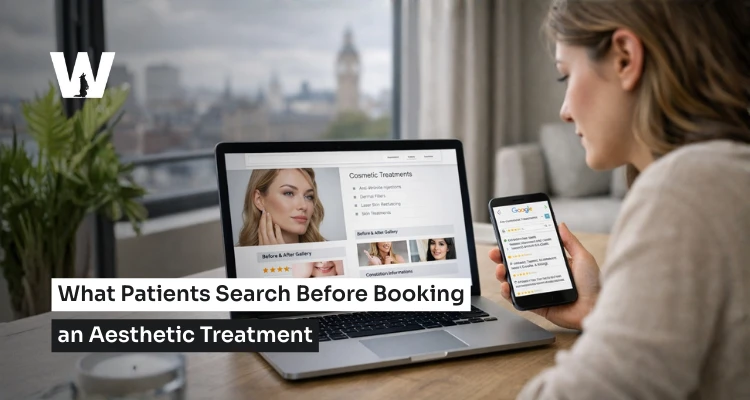
In the modern aesthetic landscape, patients no longer simply search for treatments; they search for safety, validation, and scientific outcomes. Before a patient ever contacts a clinic, they traverse a complex "Silent Funnel"—a digital journey where 70% of their decision-making occurs without human interaction. To capture this audience in the UK market, clinics must move beyond basic keywords like "Botox London" and optimise for "Answer Engine Optimisation" (AEO).
Success lies in providing "Atomic Answers"—concise, factual responses that satisfy AI algorithms and build immediate human trust. The old methods of generic marketing fail here because they treat the patient as a transaction rather than a human being seeking a transformation.
The days of linear marketing funnels are over. Today’s aesthetic patient is a sophisticated researcher, often operating in what we at Wolfable term the "Trust Economy". In high-stakes industries like aesthetics—classified by Google as "Your Money Your Life" (YMYL)—authority is the only currency that matters.
For a clinic in Harley Street or a medispa in Manchester, understanding what a patient searches for are less important than understanding why they are searching. They are not just looking for a service; they are looking to mitigate risk.
The Wolfable "Growth Artisan" philosophy recognises that generic marketing fails because it ignores this nuance. When we analyse search data, we see a distinct shift towards deep-dive content that respects the patient's intelligence.
They are using AI tools like ChatGPT and Google’s SGE (Search Generative Experience) to aggregate data before they ever click a website link. If your digital presence does not answer their specific, complex questions, you are simply invisible.
The journey rarely begins with a solution; it begins with a symptom. At this stage, the patient may not even know the name of the treatment they need. They are searching for the cause of their insecurity, not yet a clinic.
Common searches in this phase include specific queries like "Why do I look tired even when I sleep?" or "How to get rid of deep acne scarring on cheeks.". If your clinic only optimises for "Dermal Fillers," you miss the patient completely at the start of their journey.
Wolfable’s content strategy employs the "Inverted Pyramid" structure to capture these queries effectively. We create educational content that states the conclusion first, followed by the evidence, and finally the context.
For example, a blog titled "Types of Acne Scars" does not just list treatments; it validates the patient's problem. By ranking for these informational queries, a clinic establishes itself as an educator rather than a salesperson.
Once the patient understands their problem, they move to the consideration phase. Here, the search intent becomes comparative as they weigh their options. They are often pitting one technology against another to find the best fit.
Typical searches include battle-style queries like "Morpheus8 vs. Profhilo for neck tightening" or "Is CoolSculpting worth the money in 2026?". This is where "Generative Engine Optimisation" (GEO) becomes important for your visibility.
To appear in the AI-generated answers for these comparisons, your website must use "Atomic Answer Blocks". These are concise 40–60 word definitions that directly answer the comparison question clearly.
At Wolfable, we advise our partners to be radically transparent about these comparisons. If a treatment has a 5-day downtime, state it clearly rather than hiding it.
| Feature | Generic "Factory" Agency | The Wolfable "Growth Artisan" |
|---|---|---|
| SEO Strategy | Keyword stuffing & vanity metrics | AEO & GEO focused on “Answers” |
| Content Style | 500-word generic blogs | Deep-dive White Papers |
| Reporting | Automated reports on “Likes” | Strategic consultancy on ROAS |
| UK Nuance | Generic US-centric advice | Deep knowledge of CQC & ASA |
The "Artisan" voice is "dependable and transparent," rejecting the "generic" agency approach of hiding potential downsides. By offering honest comparison tables and clear "Recovery Timelines," you build the trust required to close the deal.
This is the most critical phase for UK clinics. The patient has chosen the treatment but has not chosen the provider. In the UK, where the aesthetic industry is under intense scrutiny, the search shifts to safety.
Patients are increasingly aware of regulatory gaps and actively search for "Is [Clinic Name] CQC registered?" or "Dr [Name] GMC number.". Your digital footprint must proactively answer these questions to reassure them.
We utilise Schema Markup (specifically MedicalBusiness and Physician schema) to ensure AI bots identify your accreditations immediately. This allows search engines to verify your legitimacy instantly when a user asks.
The final step is often a local query: "Best Botox clinic near me" or "Lip fillers London reviews.". Winning the Google "Map Pack" is non-negotiable here for capturing local traffic.
However, generic reviews are no longer enough to trigger semantic relevance in Google Maps. A review saying "Dr Smith explained the downtime for my Morpheus8 treatment clearly" is far more powerful than just "Great service".
We are entering the "Zero-Click" era, where search engines provide answers directly on the results page. Platforms like Google SGE and Perplexity often answer the user without sending traffic to your website.
This sounds like a threat, but for the "Growth Artisan," it is a massive opportunity. If a patient asks Siri, "What is the cost of a hair transplant in London?" your clinic must be the source.
Wolfable achieves this by structuring content with "Entity-Based SEO," focusing on relationships between the clinic and the treatment. We move beyond simple keywords to build "Knowledge Graphs" for your brand.
By publishing deep, authoritative content rather than thin blogs, we position our clients as the primary source of truth. This "Future-First" stance ensures that as search behaviour evolves toward 2026, your clinic remains the authority.
In aesthetics, the text is only half the story; the visual experience is paramount. The "Artisan" brand rejects stock photography entirely, as it fails to build trust.
Patients search for "Visual Proof" to bridge the gap between the digital and physical (Phygital) worlds. They want to see "Real patient before and after photos" or a "Video tour of [Clinic Name].".
However, in the UK, this must be handled with extreme care regarding ASA (Advertising Standards Authority) guidelines. Misleading filters or exaggerated claims can lead to severe reputational damage and legal issues.
Wolfable’s creative teams craft "bespoke solutions" using high-definition video backgrounds and authentic clinical photography. We advocate for "Unified Design Systems" that signal luxury and medical excellence instantly to the user.
The theory of the "Silent Funnel" is proven in practice with real results. Consider our work with a Hair & Skin Clinic facing high Cost Per Lead (CPL) and low visibility.
The clinic was relying on broad keywords like "Hair Loss," competing with global information sites. We shifted the focus to high intent "Decision" phase keywords like "Hair Transplant Cost".
We optimised their "Google Business Profile" to capture the local "Map Pack" immediately. We also created "Atomic Answer" content around specific pricing and recovery questions to target AI snippets.
The Result:
By aligning the content strategy with the specific search behaviours of the patient, we achieved massive growth. We turned a struggling digital presence into a dominant market leader by moving from anxiety to appointment.
The patient who searches for "Cheap Botox" is rarely your ideal client in the premium sector. The patient who searches for "safest aesthetic clinic in London" is the one you want to capture.
Wolfable’s mandate is to help you stop competing on price and start competing on brand value. By understanding the nuance of the patient’s search journey, you position your clinic as a trusted partner.
The digital landscape of 2026 will be dominated by those who answer questions with precision and authority. It is time to reject the generic and craft a digital presence that reflects your clinical excellence.