Healthcare
Wraps up in 9 Minutes
Marketing to Medical Tourism Patients – The International Patient Acquisition Guide

Published On February 1, 2026
Wraps up in 9 Minutes
Published On February 1, 2026
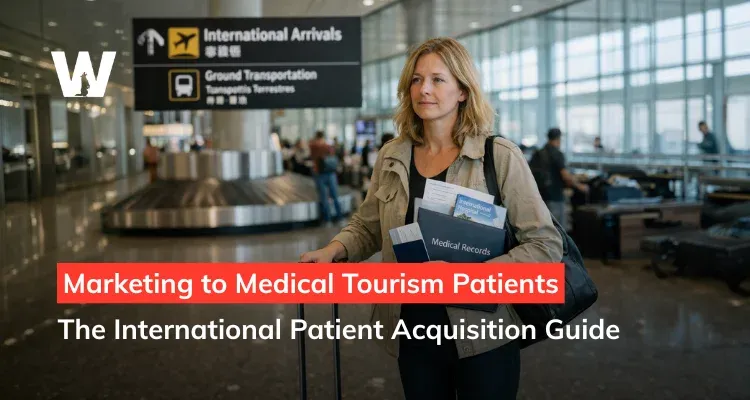
Imagine, for a moment, the mindset of your prospective patient.
They are sitting in a living room in London, Lagos, or New York. They are in pain, or perhaps they are longing for a change they see in the mirror. But the local solution is out of reach—either financially crippling or buried behind a year-long waiting list. They look at a screen, their only window to a solution that lies thousands of miles away.
They aren't just looking for a doctor. They are looking for a reason to trust a stranger with their life.
This is the high-stakes reality of medical tourism. It is an industry where trust is the only currency that matters. You aren't selling a product; you are selling certainty in an uncertain world.
For a hospital in India, a cosmetic clinic in Turkey, or a wellness retreat in Thailand, the world is indeed the waiting room. But the bridge between "browsing" and "booking a flight" is built on sophisticated, empathetic, and precision-engineered marketing.
At Wolfable, we understand this bridge better than most. We don't just see ourselves as marketers; we are artisans of growth. We believe there is an art to taking a local clinic and transforming it into a global brand. Having nurtured over 183 businesses and helped healthcare giants like Musk Clinic and Mission Health dominate their digital space, we have seen firsthand that attracting international patients requires more than just ads—it requires a digital ecosystem that breathes reliability.
This guide is your blueprint. It is an extensive, strategic deep dive into the mechanics of global patient acquisition. We will explore how to dismantle fear, build digital authority, and create a marketing engine that works while you sleep.
Before we discuss tactics, we must understand people.
Marketing to a medical tourist is fundamentally different from marketing to a local patient. A local patient has a safety net; if they don't like the doctor, they go home. An international patient burns the safety net the moment they board the plane.
Every piece of marketing collateral you create must address one of three core anxieties:
Successful marketing doesn't ignore these fears; it validates and answers them before they are even asked.
The decision to travel for surgery is not impulsive. It is a slow burn.
Wolfable Insight: In our work with healthcare clients, we’ve found that the "Doubt" phase is where most clinics lose leads. If your digital footprint has gaps—like a lack of video testimonials or a slow website—you are disqualified silently.
You cannot run ads on a shaky foundation. Before you spend a dollar on Google Ads, you must ensure your "Trust Architecture" is solid. This is the bedrock of your brand identity.
In the international market, logos speak louder than words. If you have JCI (Joint Commission International), NABH, or ISO certifications, they shouldn't be hidden in the footer. They should be your headline.
For a patient in the UK or US, these acronyms act as a translation layer. They might not know your hospital's name, but they know what "JCI Accredited" means. It means safety. It means standardization. It effectively says, "We operate at the same level as the hospitals back home."
People trust people. In medical tourism, the surgeon is the product. Your marketing must elevate your doctors into "Thought Leaders"—a core pillar of the Wolfable approach.
The "Black Box" era of medicine is over. You must show everything.
Your website is likely the only part of your hospital an international patient will see before they commit thousands of dollars. It cannot just be a brochure; it must be a high-performance conversion engine.
At Wolfable, we emphasize that technical performance is marketing. A slow website tells a user that your technology is outdated. If your site takes 10 seconds to load, the patient subconsciously assumes your medical equipment is equally sluggish.
Do not make international patients hunt for information. Create a dedicated section in your main navigation menu titled "International Patients."
This section should house:
SEO for medical tourism is not about ranking for "Best Hospital." It is about ranking for specific solutions in specific locations. This requires a granular, data-driven strategy.
You must identify where your patients are coming from and tailor your content to them.
Generic keywords are too competitive and often low intent. We focus on capturing the user at the moment of specific need.
Wolfable Case Study Insight: When we worked with Musk Clinic, a premier medical aesthetics center, we didn't just target generic terms. We implemented a comprehensive SEO strategy focusing on high-intent local and regional keywords. By optimizing their Google Business Profile and creating detailed, keyword-rich service pages, we achieved a 429% increase in organic website traffic and a 119% increase in search appearances. This proves that specific, intent-based targeting works.
Patients are increasingly using voice search and AI tools (like ChatGPT or Siri) to ask questions. "Hey Siri, which is the safest country for dental implants?"
To rank here, your content must be structured as Answers.
If a picture is worth a thousand words, a video is worth a thousand bookings. In medical tourism, video is the closest thing you have to a physical handshake.
You need to dissolve the mystery of your location. A high definition professionally produced "Virtual Tour" video that walks a patient from the hospital entrance, through the lobby, into the patient suite, and finally into the Operation Theatre is invaluable. It answers the silent question: "Is it clean? Is it modern?"
Patients are intimidated by medical jargon. Have your lead surgeons record simple, 2-minute videos explaining procedures.
This does two things: it educates the patient (value), and it makes the doctor feel familiar (trust).
A prospective patient from Nigeria wants to see a success story from another Nigerian patient. A patient from Australia wants to hear an Australian accent.
Curate your video testimonials by region. When a prospect sees someone "like them" having a successful outcome, the psychological barrier to travel drops significantly.
Wolfable Case Study Insight: For Mission Health, a chain of physiotherapy centers, we integrated video ads showcasing their advanced technology and facilities. This wasn't just branding; it was a conversion tool. The result? A 177% increase in leads and a massive 98% decrease in Cost Per Lead (CPL). Video builds the trust that static text simply cannot.
Organic growth is sustainable, but paid media is fast. However, in medical tourism, you can burn your budget overnight if you aren't careful.
In countries with socialized medicine (like the UK or Canada), wait times for orthopedic and elective surgeries can be months or years.
In countries with expensive private healthcare (like the USA), patients are often uninsured or underinsured.
Medical decisions take time. A user might visit your site and leave. You must use retargeting ads (on Facebook, Instagram, or Google Display) to stay top-of-mind. Show them success stories, facility photos, or "Meet the Doctor" content to bring them back.
Your blog is not just a place for updates; it is an education engine. It should serve as a library of answers for every possible concern a medical tourist might have.
Don't just market the hospital; market the destination. Is your city safe? Is it tourist-friendly?
Be bold. Create direct comparison charts.
Wolfable Case Study Insight: For Musk Clinic, we developed a content strategy that spanned the entire funnel—from "Top of Funnel" awareness to "Bottom of Funnel" decision-making. We created detailed blogs answering patient questions and addressing pain points. This content engine helped drive a 987% increase in website impressions, proving that when you educate the market, you own the market.
You cannot separate the reputation from Local SEO. Google looks at how many reviews you have and how often you get them to decide where to rank you on the map.
International leads are fragile. If a patient inquires from a different time zone, they expect a quick acknowledgment.
The "Medical" part is only 50% of the experience. The "Tourism" part is the rest.
These small "concierge" details are often the tipping point for conversion because they remove the logistical headache of travel.
In the digital age, your reputation arrives before you do.
Actively solicit reviews from happy international patients. A 5-star rating on Google Business Profile is your most valuable asset.
But what about negative reviews?
For cosmetic and wellness sectors, patient influencers are powerful. If a patient with a decent social following documents their journey (honestly), it acts as a massive endorsement.
| Feature | Domestic Patient | International Patient |
|---|---|---|
| Primary Concern | Convenience & Cost | Trust & Capability |
| Research Time | Days | Weeks/Months |
| Key Decision Factor | Referral / Insurance | Reviews / Video / Accreditation |
| Communication | Phone Call | WhatsApp / Video Consult |
| Post-Op Needs | Home Recovery | Hotel/Guest House Recovery |
The medical tourism industry is evolving. It is moving away from "cheap surgery" and towards "value-based excellence." The hospitals and clinics that will win in the next decade are not necessarily the ones with the lowest prices, but the ones with the highest trust.
Building this trust requires a shift in mindset. It requires you to stop thinking like a local provider and start thinking like a global host. It requires a digital ecosystem that is open, transparent, and deeply empathetic to the fears of a patient traveling across the world.
This is not a quick fix. It is a journey of brand building.
At Wolfable, we specialize in this journey. We are not just a digital marketing agency; we are partners who help you nurture your business from a local entity to a global contender. Whether it is crafting a high-performance website, producing documentary-style patient stories, or engineering a precision SEO strategy, we bring the "artisanal" touch to medical marketing.
We have helped clinics like Musk Clinic and Mission Health transform their digital presence and achieve triple-digit growth. We are ready to do the same for you.
The world is waiting. Are you ready to welcome them?