Digital Marketing
Wraps up in 14 Minutes
Hair Transplant Clinic Marketing – The Complete Patient Acquisition Guide

Published On January 5, 2026
Wraps up in 14 Minutes
Published On January 5, 2026
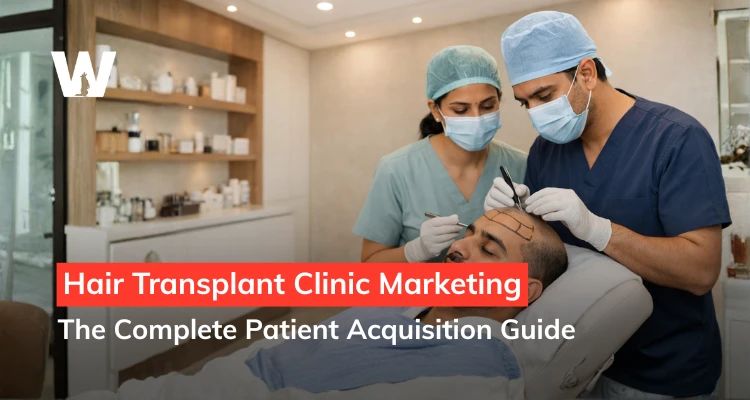
The global hair restoration market is exploding. By 2026, the industry is projected to see unprecedented growth, driven by destigmatization, celebrity transparency, and technological leaps like robotic FUE and AI-assisted diagnostics.
But here is the hard truth that keeps many clinic directors awake at night: Being the best surgeon in town is no longer enough.
You might have the steadiest hands in the industry, the highest graft survival rates, and the most advanced Artas robotic system. But if your local market doesn't know you exist—or worse, if they trust a slicker, less qualified competitor with a better Instagram feed—your chair sits empty.
Marketing a hair transplant clinic is unlike marketing any other medical service. You aren't just selling a procedure; you are selling confidence, youth, and identity. You are asking patients to trust you with their appearance, often at a price point of $5,000 to $15,000+. The sales cycle is long, skepticism is high, and the competition—from local rivals to medical tourism hubs in Turkey—is fierce.
At Wolfable, we understand that "generic" digital marketing fails in this niche. You need a strategy that navigates strict Google Ad policies, combats the "cheaper abroad" narrative, and builds deep, unshakeable trust. We are artisans of growth, believing that just as there is an art to a natural hairline, there is an art to acquire the right patient.
This is your complete blueprint to dominate the hair restoration market.
| Strategy Component | The "Old Way" (Declining) | The "Wolfable Way" (Growth Focused) |
|---|---|---|
| Patient Acquisition | Relying on “Word of Mouth” & Billboards | Multi-Channel Digital Ecosystems (SEO + PPC + Video) |
| Content Style | Generic medical articles | Patient-Centric Storytelling & “Journey” Videos |
| Lead Handling | Calling leads back “whenever free” | 5-Minute Speed-to-Lead with AI Automation |
| Brand Identity | Clinical, cold, and transactional | Empathetic, Authoritative, & Premium |
| Results Timeline | Unpredictable | Data-Driven & Scalable |
Before we discuss SEO or PPC, we must understand who we are talking to. The hair loss patient—whether a 30-year-old tech professional noticing a receding hairline or a 50-year-old executive with a bald spot—is often anxious, embarrassed, and overwhelmed.
They spend months, sometimes years, in the "Research Phase" before they ever contact a clinic. They are lurking on Reddit forums like r/HairTransplants, zooming in on before-and-after photos, and terrified of "botched" results.
If your marketing strategy is purely transactional—screaming "$2/Graft!"—you will fail to connect. You must position your clinic as an empathetic authority. You are not selling grafts; you are guiding them through a life-changing transformation. Successful clinics don't just market the surgery; they market the lifestyle that comes after it: the confidence to date again, the edge in the boardroom, and the freedom from wearing hats.
If you try to compete solely on price, you are entering a losing war against clinics in Istanbul or Mexico. You cannot win on margins. You must win on value. This requires building a Premium Brand.
What makes your clinic the "safe" choice?
Your logo, color palette, and clinic interior photos must scream "Medical Excellence," not "Budget Spa." Avoid cartoonish hair follicles in your logo. Embrace clean, clinical, and sophisticated typography that communicates precision and care.
People trust people. The biggest mistake clinics make is hiding the surgeon. Your marketing materials should feature the doctor prominently speaking, consulting, and operating. This humanizes the brand and builds immediate authority.
At Wolfable, our Branding Strategy services are designed to extract these unique narratives. We help you move beyond being a service provider to become an "iconic brand" that patients aspire to visit.
Your website is the single most important asset in your marketing ecosystem. It is your 24/7 consultant. If it loads slowly, looks outdated, or lacks clear information, you have lost the patient before you even knew they were there.
Most patients research hair loss privately on their phones—often late at night. Your site must be blazing fast (under 3 seconds) and perfectly responsive. A slow site equals a "cheap" clinic in the user's mind. We emphasize technical robustness and Core Web Vitals in every site we build.
This is the most visited page on every hair transplant website.
You don't have to list an exact price, but you must give a range. "Contact for Price" frustrates users. A section explaining "Factors that influence cost" (e.g., graft count, technique, shaving vs. non-shaving) builds trust.
Does your current website convey this level of professionalism? Our Web Development team specializes in creating SEO-optimized, marketing-ready platforms that turn visitors into booked consultations.
Search Engine Optimization (SEO) for hair restoration is a battle for two types of keywords: Commercial Intent (ready to buy) and Informational Intent (researching).
When someone searches "Hair transplant [City]," the "Map Pack" is the first thing they see.
You need dedicated pages for every specific service. Don't lump everything onto the homepage.
Google needs to understand your site's medical authority. We use Schema Markup (specifically MedicalWebPage and Physician schema) to tell search engines exactly who you are, your accepted insurance (if any), and your medical credentials. This is crucial for E-E-A-T (Experience, Expertise, Authoritativeness, Trustworthiness).
Theory is good, but the results are better. At Wolfable, we applied these exact strategies—focusing technical SEO and high-intent content—for a Hair Transplantation and Skin Clinic.
💡 Case Study Spotlight: The 429% Growth Benchmark
The result? A 429% increase in website traffic and a significant boost in qualified leads.
How did we do it? * Local SEO Domination: We optimized for "near me" searches to capture immediate intent.
This isn't magic; it's the "Wolfable Artisan" approach to growth.
Content is how you combat the "Medical Tourism" threat. If a patient is considering flying to Turkey for a $2,000 transplant, your blog needs to explain the risks (lack of aftercare, legal recourse, over-harvesting) without sounding petty.
Create a central "Ultimate Guide to Hair Transplants" (the Hub) and link it to smaller, specific articles (Spokes).
Our Content Marketing team handles this entire process—from researching the questions your patients are asking to write meticulous, plagiarism-free articles that establish your clinic's authority.
Hair transplantation is a visual medium. Text on a screen is not enough. YouTube is the second largest search engine in the world, and it is critical for this industry.
Document a real patient's journey from the initial consultation to the 12-month result. Show the nervousness, the procedure (blurring blood for ad compliance), the awkward growing phase, and the final reveal. This builds immense empathy and trust.
Sit your doctor down in front of a camera. Have them answer the "embarrassing" questions patients are afraid to ask.
While YouTube is for education, TikTok and Instagram Reels are for awareness. Fast-paced, catchy transitions showing "Day 1 vs Day 365" can go viral and attract a younger demographic (25-35) worried about early hair loss.
Wolfable's Video Marketing services manage this entire lifecycle, from concept to promotion, helping you tell captivating stories that resonate with patients.
Google and Meta (Facebook) have strict policies regarding medical procedures. "Before and After" images showing too much skin or blood can get your ad account banned. Retargeting people based on health conditions is often restricted.
Never send paid traffic to your homepage. Send them to a dedicated Landing Page optimized for one goal: Booking a Consultation.
Our Performance Marketing team specializes in these acquisition, engagement, and conversion campaigns, often working on a pay-for-performance model to align our success with yours.
A patient might fill out a form and then get cold feet. If you don't follow up, you lose them. >/p>
You must contact a lead within 5 minutes. Use automation to send an instant WhatsApp or text message: "Hi [Name], thanks for inquiring about hair restoration at [Clinic Name]. Would you like to schedule a quick 5-min call with our patient coordinator?"
Create a 6-month automated email sequence.
You need a Customer Relationship Management (CRM) system to track where every lead is in the funnel. Are they "New," "Contacted," "Consultation Booked," or "Thinking About It"?
By integrating our AI Solutions, we can help you scale these processes, ensuring no patient inquiry slips through the cracks.
One bad review claiming "botched surgery" can destroy a clinic.
Deciding between doing it yourself, hiring a freelancer, or partnering with an agency? Here is the breakdown.
| Feature | DIY (In-House) | Freelancer | Wolfable (Full-Service Agency) |
|---|---|---|---|
| Cost | Low (Time-Intensive) | Moderate | Moderate/High (High ROI) |
| Expertise | Limited to your knowledge | Specialized in one area (e.g., just SEO) | Complete Team (SEO, PPC, Design, Dev, Strategy) |
| Scalability | Low | Low | High (Can scale ad spend & content instantly) |
| Tools | Basic (Free versions) | Limited | Enterprise Grade (SEMrush, Ahrefs, heatmaps, AI tools) |
| Medical Compliance | Risky (Easy to violate ad policies) | Variable | Expert (We know healthcare ad policies inside out) |
| Time to Results | Slow | Medium | Fast (Proven systems ready to deploy) |
Marketing a hair transplant clinic is complex. You are dealing with medical regulations, high patient anxiety, and aggressive competition. But the reward is massive. A single loyal patient can generate thousands in revenue and become a lifelong ambassador for your brand.
You don't need to be a marketing expert—that's our job. You need to be the expert surgeon that patients can trust.
At Wolfable, we view ourselves as skilled artisans of growth. Just as you carefully craft a hairline to suit a patient's face, we craft bespoke marketing strategies that fit the unique contours of your business. We don't believe in templates; we believe in "artistry applied to growth."
From compliance-safe ad strategies to "No-Shave" SEO domination, we have the playbook.
Are you ready to stop chasing leads and start welcoming patients?