Marketing Agency
Wraps up in 9 Minutes
Why Digital PR Is Becoming Critical for GEO and AI Search

Published On October 4, 2026
Wraps up in 9 Minutes
Published On October 4, 2026
For years, Digital PR and SEO had a fairly straightforward relationship. PR helped brands earn media coverage, mentions and backlinks, while SEO teams used that authority to strengthen organic rankings and drive qualified traffic. The two disciplines often worked alongside each other, but they were still treated as separate marketing activities.
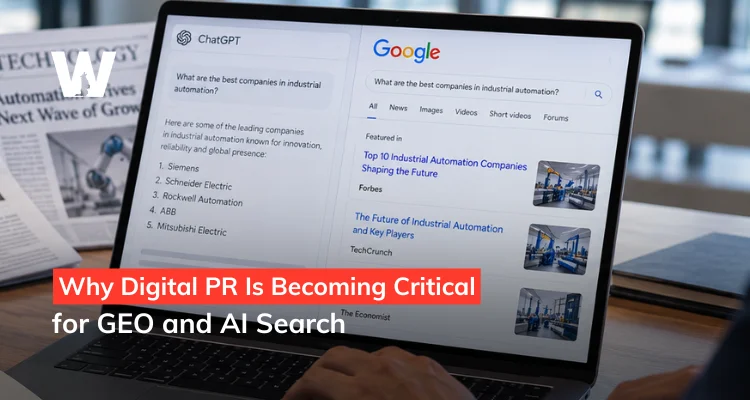
Generative AI is starting to change that relationship. Visibility today is no longer limited to where your website appears on Google. A potential customer might ask ChatGPT to recommend companies in a particular category, use Gemini to research suppliers, encounter a Google AI generated response while researching a problem, or use Perplexity to compare different solutions before visiting any company website.
This creates an important question for marketing teams: What information exists across the wider web that gives AI systems enough confidence to understand, cite or mention your brand? This is where Digital PR is becoming an increasingly important part of Generative Engine Optimization (GEO).
Digital PR for GEO is the practice of building credible third party references, expert mentions, media coverage and industry authority that strengthen the information ecosystem surrounding a brand. Traditional Digital PR has often been measured through media placements, referral traffic and backlinks. Those outcomes remain valuable, but GEO introduces another consideration: whether independent sources across the web consistently associate your organisation with the topics, expertise and markets for which you want to be known.
This means marketers need to think beyond simply asking whether a publication will provide a backlink. They also need to consider who is mentioning the company, what they are saying about it, whether the source is relevant to the industry, what topics are associated with the brand and whether respected third parties support the expertise presented on the company's own website.
AI search makes this particularly important because generative systems can synthesise information from multiple sources before constructing an answer. Instead of displaying ten blue links and leaving the user to evaluate them, an AI generated response may summarise the subject, compare alternatives and mention only a handful of companies or sources. Building authority beyond your own website therefore becomes increasingly important.
Every business can make claims about itself. A manufacturer can describe itself as a leader in precision engineering, a healthcare organisation can claim exceptional clinical expertise, and a financial services company can position itself as a trusted adviser. These statements may be completely legitimate, but they remain first party claims published by the organisation itself.
There is an important difference between a company saying something about itself and independent sources repeatedly validating that expertise. Consider a precision manufacturing company specialising in highly engineered components. Its website might contain detailed pages explaining its CNC machining capabilities, materials, tolerances, certifications, quality processes and industries served. That content provides an essential SEO and GEO foundation, but it represents only one part of the company's wider digital footprint.
Now imagine that the same manufacturer is regularly referenced by engineering publications, listed in respected industry directories, quoted in articles discussing precision manufacturing challenges and invited to contribute technical commentary. Perhaps its engineering team also publishes original research that other industry publications reference. Instead of relying on one website claiming expertise, multiple independent sources now connect the company with the same technical subject.
Research from Muck Rack illustrates why this broader information environment deserves attention. Its analysis of more than 25 million links cited across major generative AI platforms found that earned media represented a significant proportion of AI citations. This does not mean publishing a press release will automatically make a company appear in ChatGPT. What it does suggest is that credible third party information is becoming an important part of the environment from which AI systems retrieve and synthesise information.
SEO has traditionally placed significant emphasis on backlinks. When reputable websites link to another website, those links can contribute to the authority and discoverability of the destination. Backlinks remain important, and businesses should not abandon established SEO principles simply because AI search is growing.
However, GEO introduces a broader idea: brand evidence. A third party article might mention a company without linking to it. From a traditional link building perspective, that placement might appear less valuable than a followed backlink. From an AI visibility perspective, however, the mention still contributes information about the company, its expertise and the context in which the brand operates.
If credible independent sources repeatedly associate a company with a specific capability, market or area of expertise, they create a richer information environment around that brand. Research examining AI visibility has started identifying correlations between branded web mentions and how frequently brands appear in AI generated answers. Correlation does not prove that additional mentions directly cause additional AI citations, but the relationship is important enough that marketing teams should pay attention to it.
This leads to an important shift in thinking. In AI search, what the wider web says about your brand may become increasingly important alongside what your own website says about it. For Digital PR teams, this expands the objective from acquiring backlinks to creating credible evidence around the organisation's expertise.
GEO should not be treated as a replacement for SEO. A strong AI search strategy still depends on technically accessible websites, useful content, logical information architecture, structured data where appropriate, strong internal linking and pages that genuinely answer the questions potential customers are asking.
Digital PR adds an external authority layer to this foundation. Your website establishes owned authority by explaining what the organisation does and demonstrating its expertise. Technical SEO helps search engines discover and understand that information, while strong content builds topical depth. Digital PR then extends that authority beyond the website through relevant publications, expert commentary, research, media coverage and other credible third party sources.
The strongest approach therefore combines owned authority and earned authority. A company that publishes excellent content but has almost no external recognition may have an authority gap. Similarly, a company receiving substantial media coverage without a strong website and content foundation may struggle to turn that visibility into sustained search performance.

This is why Digital PR should increasingly be considered part of search strategy rather than a completely separate marketing function.
One mistake businesses can make is assuming that GEO focused Digital PR means getting mentioned by the largest publication possible. For many organisations, particularly those operating in technical B2B markets, industry relevance may be considerably more valuable than general reach.
A precision engineering company, for example, does not necessarily need coverage in a large consumer publication. A detailed article in a respected manufacturing or engineering publication discussing the company's technology, engineering process or technical expertise may create much stronger contextual relevance. The publication's audience, subject matter and relationship to the company's market should therefore be considered alongside traditional authority metrics.
The same principle applies across other industries. Healthcare organisations may benefit from credible medical publications, recognised practitioners, relevant professional platforms and trusted local sources. Financial services companies may focus on reputable finance publications, professional associations, original research and expert commentary. Digital PR strategy should therefore move beyond asking only, “How authoritative is this website?” and start asking, “Is this a source that our buyers and AI systems are likely to encounter when researching this subject?”
Consider a precision components manufacturer supplying engineered parts to automotive and industrial equipment companies. The company wants greater visibility for searches and AI queries around precision machined components, custom CNC components, high tolerance machining and precision manufacturing for automotive applications.
Traditional SEO would begin by building strong capability pages, detailed technical information, case studies, certifications, FAQs and educational content. This remains essential because AI visibility without a strong owned content foundation is difficult to sustain. However, a GEO focused strategy would also consider what information exists about the manufacturer outside its own website.
The company's engineering director could contribute expert commentary to manufacturing publications about maintaining tolerances during high volume production. The business could publish original data analysing common quality issues in precision machining, while a detailed case study could demonstrate how an engineering change reduced material waste, production time or component failure. Relevant industry publications could then reference that research, while the company maintains accurate profiles across respected industrial directories and associations.
The objective is to create a consistent connection between the company and its expertise across multiple credible sources. If an engineering buyer later asks an AI system, “What should I look for when selecting a precision machining supplier for high tolerance automotive components?”, there is now a wider body of information connecting the manufacturer with precision machining, automotive production and engineering expertise.
This does not guarantee that an AI platform will recommend the company. What it does is create a stronger and more credible digital footprint from which search and generative systems can potentially understand the brand.
The growing relationship between PR and AI visibility also creates the risk of low quality tactics. Publishing dozens of generic press releases across syndication websites should not be confused with building meaningful authority. Similarly, chasing irrelevant backlinks simply because a website has an attractive domain metric may contribute very little to how a brand is understood within its actual market.
Effective Digital PR for GEO should create genuinely useful information. Original research gives journalists and industry publications something worth referencing. Expert commentary connects recognised individuals with specific subjects. Technical case studies provide evidence of expertise rather than simply making marketing claims, while industry surveys can generate proprietary statistics that other publishers may cite.
Trade publication coverage, technical interviews, expert roundups, podcasts and thoughtful executive commentary can also contribute to the wider information environment around a company. The objective should therefore not be to generate more PR, but to generate more relevant, credible and useful third party evidence around the subjects strategically important to the business.
One of the biggest opportunities for established companies is turning internal knowledge into external evidence. Many organisations are sitting on years of industry experience, customer questions, operational data and technical knowledge that could be transformed into valuable research.
A manufacturer could analyse production trends, common component failures, material utilisation or procurement challenges. A healthcare organisation could examine anonymised patient questions or treatment trends where legally and ethically appropriate. A financial services firm could publish research around business owners' tax planning concerns, succession planning or financial preparedness.
Instead of publishing another opinion article on a topic that has already been covered hundreds of times, the company creates something original that other people have a reason to reference. This can produce a powerful chain: internal expertise becomes original research, research generates media coverage, media coverage generates industry references, and those references create brand mentions, links and citations.
The same asset can therefore support SEO, Digital PR, thought leadership and AI visibility simultaneously. This is where Digital PR moves beyond traditional link acquisition and starts becoming a mechanism for building authority.
Generative AI has dramatically lowered the cost of producing generic content. Almost any organisation can now publish large volumes of articles explaining subjects that have already been covered extensively across the web. As content volume increases, simply publishing more information is unlikely to create sustainable differentiation.
Expertise becomes far more valuable in this environment. Instead of producing another generic article about CNC machining, a manufacturing company could interview its production director about why certain components fail tolerance inspection. A financial valuation firm could ask an experienced valuation professional to explain the mistakes founders commonly make before a transaction. A healthcare organisation could use clinicians to answer complex questions patients regularly ask.
Digital PR can then distribute those insights beyond the company's website through expert commentary, interviews, industry publications and research based stories. This creates something generic content cannot easily replicate: genuine first hand experience supported by people who actually work within the field.
One of the most significant organisational changes created by GEO may be the need for SEO, content and PR teams to work much more closely. Traditionally, an SEO team might identify keywords and create content while the PR team independently pursued media opportunities. That separation becomes increasingly inefficient when both disciplines are ultimately trying to establish authority around similar subjects.
Imagine SEO research identifies robotic material separation systems as a strategically important topic for an industrial manufacturer. The content team can create a comprehensive technical resource, while a subject matter expert contributes engineering insights. The PR team can then identify journalists and publications covering recycling technology, waste management and manufacturing automation.
Original data or a technical case study could provide the PR hook, while earned coverage strengthens the external authority surrounding the same subject. One strategically selected topic can therefore generate organic search content, expert thought leadership, third party coverage, brand mentions, backlinks and additional evidence that may contribute to AI visibility.
This is a much more integrated way to approach modern search marketing.
The starting point should not be sending more press releases. Businesses should first understand the questions and topics they want their brand to be associated with across traditional and AI search. This means analysing what potential customers are asking Google, ChatGPT, Gemini and Perplexity and identifying which companies currently appear within those conversations.
The next step is understanding which external sources influence those answers. If competitors repeatedly appear in influential trade publications, comparison articles, directories, professional associations or expert discussions while your organisation is largely absent, the issue may no longer be simply a PR gap. It could also represent an AI visibility and authority gap.
Companies can then identify areas where they have genuine expertise and develop PR worthy assets around those subjects. Proprietary research, industry surveys, technical case studies, executive perspectives, expert commentary, benchmarks and original data can all provide journalists and industry publications with something valuable to reference.
The final step is connecting earned authority back to a strong owned content ecosystem. Digital PR should amplify expertise that already exists within the organisation rather than attempting to manufacture authority around topics where the company has little genuine experience.
PR measurement also needs to evolve. Media placements, referral traffic and backlinks remain useful indicators, but they do not provide a complete picture of how a company's authority is developing across AI powered discovery environments.
Marketing teams should increasingly monitor whether their brand appears across relevant AI generated answers and which sources are being cited alongside those mentions. AI brand mentions, citations, share of voice, competitor visibility, source visibility and referral traffic from AI platforms can all contribute to a broader measurement framework.
The sources themselves can provide valuable intelligence. If a particular industry publication repeatedly appears in AI generated responses to commercially important questions, that publication becomes strategically interesting for Digital PR. Similarly, if competitors are frequently recommended alongside a consistent group of external sources, analysing those sources can reveal gaps in your own authority footprint.
This creates an ongoing feedback loop. Brands can monitor AI answers, identify influential sources, strengthen their authority within those ecosystems, measure how visibility changes and continually refine the strategy. GEO therefore becomes less about trying to manipulate an algorithm and more about understanding and improving the information ecosystem surrounding the brand.
No Digital PR campaign can guarantee that a company will appear in ChatGPT, Gemini, Perplexity or Google's AI generated experiences. Generative systems are dynamic, and responses can vary depending on the query, model, location, available sources, freshness of information and other factors.
Businesses should therefore be cautious about treating Digital PR as an AI ranking hack. The objective is not to acquire a certain number of media placements and expect a corresponding number of ChatGPT recommendations. The objective is to increase the amount of credible, relevant and independently validated information available about the organisation and its expertise.
Digital PR can strengthen the conditions that support search and AI visibility, but it should be considered part of a broader authority building strategy rather than a guaranteed route to an individual AI citation.
Backlinks transformed search marketing because search engines needed ways to understand which pages and websites other websites considered authoritative. Generative search introduces a broader challenge because AI systems need to understand organisations, experts, products, relationships and claims across information gathered from different parts of the web.
This makes corroboration increasingly important. If a company's website says it specialises in a particular field and relevant publications, industry directories, experts, customers and independent sources consistently reinforce the same association, the organisation becomes easier to understand within that context.
Digital PR can help create this external layer of evidence. It does not replace technical SEO, high quality websites, useful content, backlinks, structured information or topical authority. Instead, it complements them by extending the company's authority beyond its own domain.
For marketers, this creates two increasingly important questions: What do we say about ourselves, and what does the rest of the web say about us? SEO and content have traditionally focused heavily on the first. Digital PR can help strengthen the second. GEO increasingly requires businesses to think about both.
Generative Engine Optimization is still evolving, and there is no fixed formula that can guarantee an AI platform will recommend a particular company. However, one principle is becoming increasingly difficult to ignore: AI visibility cannot be built entirely within the boundaries of your own website.
At Wolfable, we believe the next phase of search will require brands to think beyond rankings and traffic alone. Strong technical SEO and content remain fundamental, but they increasingly need to work alongside Digital PR, subject matter expertise, thought leadership and credible third party validation. The brands that connect these elements effectively will be better positioned to build authority across both traditional and AI driven search.
This is particularly important for businesses operating in complex B2B industries, where buyers already rely on multiple sources before making high value decisions. AI search is making that research journey even more fragmented, which means building a credible presence across the sources that influence those decisions can strengthen both human trust and digital visibility.
For us, the objective of GEO is therefore not simply to make another webpage rank. It is to build enough expertise, evidence and authority across the wider digital ecosystem that when buyers, search engines and AI systems investigate your category, your brand deserves to be part of the answer.