Healthcare
Wraps up in 5 Minutes
Medical Tourism Marketing: How to Attract International Patients in 2026

Published On February 1, 2026
Wraps up in 5 Minutes
Published On February 1, 2026
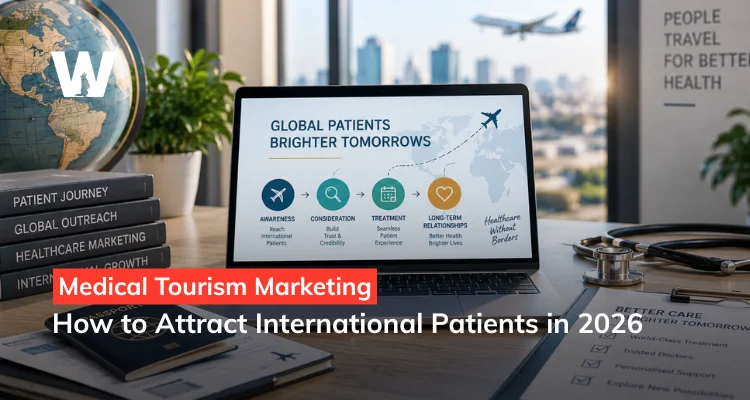
A patient in London searching for hair restoration in India, someone in the United States comparing dental treatment abroad, or a family in the Middle East researching specialist surgery overseas will usually begin their journey in the same place: online.
Before contacting a hospital or clinic, international patients may compare doctors, treatment costs, destinations, accreditations, patient reviews, travel requirements, recovery timelines and available support. Unlike a local healthcare decision, choosing treatment abroad involves trusting not only a doctor, but also an unfamiliar healthcare provider, destination and patient journey.
This is why medical tourism marketing is about much more than generating website traffic. It is the process of positioning and promoting hospitals, clinics, doctors and healthcare providers to patients considering medical treatment outside their home country. A successful strategy brings together SEO, AEO, GEO, content marketing, paid advertising, social media, video, reputation management, localization and patient lead nurturing.
Ultimately, the objective should be to create a measurable international patient journey:
Search → Trust → Enquiry → Consultation → Travel → Treatment → Advocacy
In this guide, we explore how healthcare providers can build that journey and use digital marketing to attract, educate and convert international patients.
Medical tourism marketing focuses on attracting patients who are willing to travel domestically or internationally to access medical treatment. Depending on the provider, this could include elective procedures, dental care, fertility treatment, orthopedic surgery, cosmetic procedures, hair restoration, cardiac care or other specialist medical services.
Unlike traditional healthcare marketing, the prospective patient is not simply choosing a doctor. They may simultaneously be choosing a treatment, healthcare provider, country, travel experience, recovery environment and financial commitment. That makes the decision significantly more complex.
An international patient may want to know whether the doctor is qualified, whether the hospital is safe, how much treatment will cost, how long they need to stay, what happens if complications arise, whether somebody can assist with travel and accommodation, and how follow-up care will work after they return home.
Effective digital marketing for medical tourism answers many of these questions before the patient ever speaks with the provider.
International patient acquisition increasingly begins long before a patient speaks with an international patient coordinator. The research journey can involve Google searches, YouTube videos, social media, patient reviews, hospital websites, online communities and increasingly AI-powered search platforms.
Consider someone researching knee replacement abroad. Their first search might be “best countries for knee replacement surgery.” Later, they may search “knee replacement cost in India,” followed by “best orthopedic hospitals in India for international patients,” and eventually the name of a particular surgeon or hospital.
Each search represents a different stage of intent. The job of medical tourism digital marketing is therefore not simply to rank for one high-volume keyword. It is to establish visibility, relevance and trust throughout the patient's entire research and decision-making journey.
One of the biggest mistakes healthcare organizations make is treating international patients in the same way as local patients. International patients typically have a longer decision cycle, more questions and significantly more perceived risk.
Understanding this journey allows hospitals and clinics to create the right content and marketing experience at each stage.
At the discovery stage, the patient is beginning to consider travelling for treatment. They may search for topics such as “best countries for IVF treatment,” “affordable dental implants abroad,” or “best destinations for medical tourism.”
The objective at this stage is education and visibility. Rather than aggressively promoting a hospital or clinic, content should help the patient understand their options, costs, destinations and important considerations.
Once patients understand their options, they start comparing destinations, hospitals and specialists. Searches become more specific, such as “India vs Turkey for hair transplant,” “knee replacement cost India vs USA,” or “best IVF clinics in India for international patients.”
At this stage, content should demonstrate expertise and differentiation. Detailed treatment pages, cost guides, destination comparisons, doctor profiles and patient stories can help prospective patients evaluate whether your organization belongs on their shortlist.
Once a patient has created a shortlist, the question changes from “What are my options?” to “Can I trust this provider?”
Patients may investigate doctor credentials, hospital accreditations, patient reviews, before and after results where appropriate, treatment outcomes, facility videos, YouTube interviews and social media activity. They may also search the doctor's or hospital's name independently to see what other sources say.
This makes your wider digital reputation an important part of medical tourism marketing. What patients find outside your website can influence what they believe about the information on your website.
When sufficient trust has been established, the patient is ready to communicate with the provider. At this point, the next step should be extremely clear.
Depending on the healthcare organization, conversion options might include requesting a treatment plan, speaking with an international patient coordinator, booking a virtual consultation or starting a WhatsApp conversation.
The goal is to reduce friction between research and human interaction.
Once an enquiry has been generated, marketing and patient operations begin to overlap. Prospective patients may need treatment estimates, medical visa assistance, virtual consultations, accommodation information, airport transfers, expected length of stay, recovery guidance and payment information.
Marketing may bring the patient to your door, but the quality and speed of the patient experience can determine whether they walk through it.
Trying to market a healthcare provider globally from day one usually spreads resources too thin. A stronger strategy starts by identifying the countries where there is genuine demand for your treatments and a realistic opportunity to compete.
Healthcare providers can evaluate potential source markets based on treatment demand, affordability gaps, travel accessibility, competition, patient value and existing patient data. A hospital in India, for example, may discover very different opportunities across the Middle East, Africa, Bangladesh, the UK or the United States depending on its specialties.
Once priority markets have been identified, campaigns can be built around specific country + treatment combinations. Instead of a generic “international patients” campaign, a provider could develop dedicated strategies around cardiac surgery in India for African patients, orthopedic treatment in India for UK patients, or hair restoration in India for UAE patients.
This makes the marketing experience much more relevant to the person conducting the search.
SEO for medical tourism should go beyond trying to rank for broad terms such as “best hospital in India.” Some of the strongest commercial opportunities appear deeper in the patient journey, where searches become more specific.
A patient may begin with a treatment keyword such as “robotic knee replacement” and later search “robotic knee replacement cost in India.” Others may use international patient searches such as “best surgeon in India for overseas patients” or comparison searches such as “knee replacement cost India vs USA.”
This means an effective medical tourism SEO strategy should cover multiple keyword groups, including:
Rather than publishing isolated blogs, healthcare providers should also develop treatment specific content clusters. For example, a main page about knee replacement in India could be supported by articles about treatment costs, recovery timelines, robotic versus traditional surgery, travelling after surgery and questions international patients should ask before choosing an orthopedic surgeon.
This creates deeper topical authority while helping patients find relevant information at different stages of their journey.
The international patient journey is no longer limited to traditional Google searches. Patients can now ask AI platforms questions such as “Which countries offer affordable knee replacement surgery?”, “What should I check before choosing a hair transplant clinic abroad?” or “Compare medical tourism in India, Turkey and Thailand.”
This creates a new visibility opportunity for healthcare organizations. Traditional SEO remains the foundation, but medical tourism providers should increasingly consider Answer Engine Optimization (AEO) and Generative Engine Optimization (GEO) as extensions of their search strategy.
Improving AI search visibility starts with producing content that clearly answers genuine patient questions. Treatment pages should use descriptive headings, physician profiles should clearly communicate qualifications and expertise, and educational content should demonstrate appropriate medical review and authority.
Structured data, strong entity information, credible external mentions, citations and consistent information across trusted digital properties can also make it easier for search engines and AI systems to understand the relationship between your doctors, treatments, locations and healthcare organization.
AI visibility is not about adding “AI keywords” throughout your website. It is about making your healthcare expertise easier for both people and machines to understand, verify and reference.
International visitors should not have to search across ten different pages to understand how treatment with your organization works. A dedicated international patient section can bring the most important information into one clear journey.
This section should explain available treatments, doctor expertise, hospital accreditations, estimated treatment costs where appropriate, virtual consultations, medical visa support, airport pickup, accommodation, language assistance, expected length of stay, recovery, follow up care and payment processes.
For important source markets, dedicated country pages can also be valuable. A hospital could create separate experiences for patients travelling from the UAE, UK, Nigeria or other priority markets.
However, localization should go beyond changing the country name in a template. Each page should reflect the questions, terminology, travel considerations and healthcare concerns of that particular audience.
For many international patients, the doctor is one of the strongest trust signals in the entire decision.
A basic profile containing a photograph, qualification and job title is rarely enough. Strong physician pages can communicate qualifications, years of experience, areas of specialization, professional memberships, international training, research, publications, languages spoken and the technologies or techniques used.
Video can make these profiles even stronger. A short introduction allows a prospective patient thousands of miles away to see and hear the doctor before deciding whether to book a consultation.
Doctors should also contribute to educational content. Instead of publishing only a generic article titled “Everything You Need to Know About Robotic Knee Replacement,” a hospital could publish “Dr. [Name] Explains Who Is a Candidate for Robotic Knee Replacement.”
This turns clinical expertise into visible digital authority.
An international patient cannot easily visit your hospital or clinic before making a decision. Video provides one of the closest digital alternatives.
Doctor introductions can help patients understand who will treat them, while procedure explainers can answer common questions in patient friendly language. Hospital tours can demonstrate facilities and technology, and patient journey videos can show what the overall treatment experience looks like.
Patient testimonials can be particularly powerful when handled ethically and with appropriate consent. Rather than presenting all testimonials together, consider organizing them by treatment and source market so prospective patients can find experiences that feel relevant to their own situation.
Video should not simply be treated as social media content. It can support treatment pages, physician profiles, YouTube visibility, paid campaigns, retargeting and the conversion journey.
Medical tourism involves a high trust decision, and patients rarely rely entirely on what a hospital says about itself. They want independent signals that other patients have had positive experiences.
Healthcare organizations should therefore develop a systematic and ethical process for collecting authentic patient feedback across appropriate platforms. Relevant testimonials and reviews can then be incorporated into treatment pages, physician pages, international patient pages and conversion focused landing pages.
Social proof should appear close to the point where the patient is making a decision rather than being hidden on a standalone testimonial page.
Online reputation management is equally important. Negative feedback should not automatically be ignored. Where appropriate and compliant with privacy requirements, a thoughtful and professional response can demonstrate that the organization takes patient experience seriously.
SEO can create sustainable long term visibility, but paid advertising allows healthcare providers to reach high intent patients much faster.
Google Ads can be particularly valuable when targeting searches that demonstrate treatment and commercial intent. A query such as “knee replacement surgery India cost” may indicate much stronger patient intent than a broad informational query such as “what is knee replacement?”
Campaigns should therefore be structured around specific treatments, markets and intent levels. Sending every visitor to the homepage wastes much of the relevance created by the ad. Dedicated landing pages can provide a much stronger experience.
Meta platforms can support patient stories, physician awareness, educational video campaigns and retargeting. Since medical treatment decisions often involve a long consideration period, retargeting can help providers remain visible while the patient continues researching.
Rather than repeatedly showing the same promotional message, retargeting can expose prospective patients to doctor videos, patient stories, FAQs, hospital tours and virtual consultation opportunities.
Social media for medical tourism should not become a gallery of generic health tips, festival posts and promotional graphics. For an international patient researching your organization, it should function as a digital trust library.
A balanced healthcare social media strategy can include doctor expertise, patient education, patient experiences, facility and technology content, and information specifically designed for international patients.
For example, doctors can answer common treatment questions through short videos, while international patient coordinators can explain what happens after someone submits their medical reports. Hospital teams can show facilities, technology and behind the scenes patient support.
The goal is for someone researching your organization to leave your social channels with a better understanding of your people, expertise and patient experience.
Generating an international patient enquiry is not the end of the marketing funnel. In many cases, it is where the most important part begins.
International enquiries may arrive from different countries, languages and time zones. Hospitals therefore need a defined process for acknowledging enquiries, collecting medical reports, coordinating doctor reviews, arranging virtual consultations, sharing treatment estimates and following up appropriately.
A typical journey might move from website enquiry to international patient coordinator, medical report collection, doctor review, virtual consultation, treatment estimate and finally travel confirmation.
WhatsApp may play an important communication role in many markets, while email and CRM workflows can support longer decision cycles. Whatever technology is used, the communication should feel like healthcare coordination rather than an aggressive sales process.
Speed matters, but the quality of the response matters just as much.
Website traffic and keyword rankings are useful indicators, but they do not tell you whether your medical tourism marketing is actually generating patients.
At the visibility level, healthcare organizations can monitor organic search visibility, target keyword rankings, AI search visibility, source market traffic and video reach. Engagement metrics can include treatment page interaction, doctor profile views, video engagement and return visits.
The next level should measure actual patient intent. This includes international enquiries, WhatsApp conversations, phone calls, forms, virtual consultation requests and cost per enquiry.
Ultimately, reporting should connect marketing to business outcomes. The most valuable metrics are qualified international enquiries, consultations booked, confirmed patients, patient acquisition cost, revenue by source market and revenue by treatment.
This allows healthcare organizations to answer a much more important question than “How much traffic did we generate?”
Which treatments, markets and marketing channels are actually generating patients?
A healthcare organization can achieve excellent search rankings and still struggle to convert international patients if its digital presence does not create enough confidence.
Prospective patients should be able to understand who will treat them, what qualifications the doctor has, what facility they will visit, what the treatment involves, what the potential risks and recovery expectations are, and what support is available throughout their journey.
Pricing transparency can also play an important role where appropriate. Exact treatment costs may not always be possible before clinical assessment, but explaining what influences pricing can still reduce uncertainty.
International patients should also understand whether they can speak with the medical team before travelling, how travel support works and what happens after they return home.
In medical tourism marketing, transparency is often more persuasive than exaggerated claims.
A strong medical tourism content strategy should reflect the actual questions patients ask at different stages rather than publishing topics simply because they have search volume.
For an orthopedic provider, an awareness stage article could cover “Best Countries for Knee Replacement Surgery.” A consideration stage guide might focus on “Knee Replacement in India: Cost, Procedure and Recovery,” while a comparison article could explore “Knee Replacement in India vs UK: What International Patients Should Know.”
As the patient moves closer to making a decision, content can become more specific. Topics such as “How to Choose an Orthopedic Surgeon Abroad” or “What International Patients Can Expect When Travelling to India for Knee Replacement” can help build trust.
Finally, conversion focused content can encourage an appropriate next step such as booking a virtual consultation or submitting medical reports for review.
This approach turns content into part of the international patient acquisition journey rather than simply a way to generate website traffic.
Many hospitals and clinics have excellent clinical capabilities but weak digital positioning. One common mistake is trying to target every country simultaneously without understanding where the strongest opportunities actually exist.
Another is sending international traffic to a generic homepage that does not address travel, costs, doctors, international support or patient concerns. Generic AI generated healthcare content can create a similar problem because it adds volume without building meaningful authority or trust.
Healthcare organizations can also become too dependent on paid advertising while neglecting organic search, physician authority and reputation. Others generate enquiries but fail to track whether those leads eventually become consultations and patients.
A better strategy starts with a focused combination of treatments and source markets, builds the right digital foundation, measures actual patient acquisition and then expands based on what works.
At Wolfable, we look at medical tourism growth across five connected layers rather than treating SEO, advertising, content and social media as separate activities.
1. Market Intelligence: Identify target countries, priority treatments, competitors, patient questions and search opportunities.
2. Digital Foundation: Strengthen the website experience, treatment pages, doctor authority, international patient content, technical SEO and conversion pathways.
3. Demand Generation: Build visibility through SEO, AEO, GEO, content, Google Ads, social media, video and other relevant channels.
4. Trust and Conversion: Connect physician expertise, patient stories, reviews, transparent information, virtual consultations and strong enquiry experiences.
5. Measurement and Scale: Track enquiries, qualified opportunities, consultations, confirmed patients, acquisition costs and revenue by market and treatment.
When these layers work together, digital marketing becomes more than a collection of campaigns. It becomes an international patient acquisition engine.
Medical tourism marketing requires more than running Google Ads or publishing healthcare blogs. Your website, search visibility, physician authority, patient experience, content, advertising and conversion journey need to support one another.
At Wolfable, we help hospitals, clinics and healthcare organizations build connected digital marketing strategies across medical tourism marketing, healthcare SEO, international SEO, AEO and GEO, website strategy, treatment content, Google and Meta advertising, social media, video marketing and analytics.
Our experience working with healthcare organizations has reinforced one important principle: healthcare marketing does not begin with promotion. It begins with trust.
For international patients, much of that trust has to be established digitally before they ever walk through your doors.
If your hospital, clinic or healthcare organization is looking to expand its international patient reach, Wolfable can help identify priority markets, strengthen your digital foundation and develop a measurable patient acquisition strategy.