Digital Marketing
Wraps up in 8 Minutes
How to Build a Digital Marketing Strategy for a Manufacturing Company

Published On September 14, 2026
Wraps up in 8 Minutes
Published On September 14, 2026
Many manufacturing companies grow successfully for years through referrals, distributors, existing customer relationships, trade shows and the reputation they have built within their industry. There is nothing wrong with that model. In fact, strong word of mouth is usually a sign that the company has a good product and has earned trust in the market.
The challenge often appears when the ambition becomes bigger than the existing network. A manufacturer may want to enter the UK or US, increase exports, introduce a new product range, reach larger companies or simply create a more predictable flow of sales opportunities. At that point, relying primarily on relationships and referrals can make growth difficult to scale.
This is where digital marketing for manufacturers becomes commercially relevant.
A good manufacturing digital marketing strategy is not about posting every day on LinkedIn, chasing website traffic or running Google Ads because competitors are doing it. It is about making your company visible and credible at the moments when engineers, procurement teams, distributors, plant managers and business leaders are researching products, evaluating suppliers and comparing potential partners.
The strategy should ultimately connect five things:
The right market → The right buyer → The right message → The right digital channels → A measurable sales opportunity
In this guide, we will look at how manufacturing companies can build that system and connect digital marketing more closely with business development.
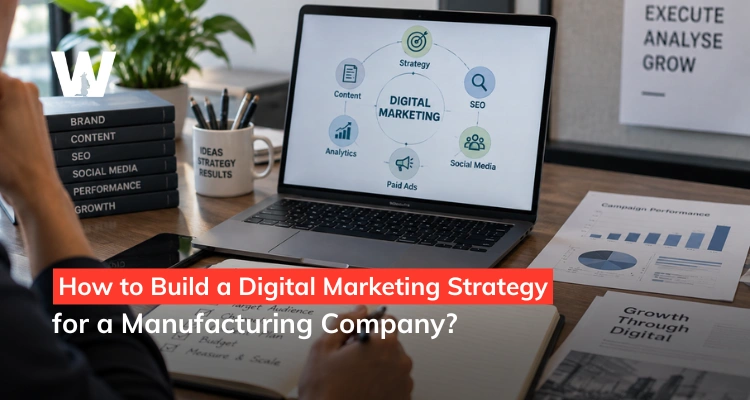
A digital marketing strategy for a manufacturing company is a structured plan for using online channels to reach, educate and convert potential B2B buyers. Depending on the business and market, that could involve SEO, Google Ads, LinkedIn, technical content, email marketing, video, industry-specific landing pages, website optimisation and increasingly, visibility across AI-powered search experiences.
The important part is the objective behind those activities.
For most manufacturers, generating more website traffic should not be the final goal. Neither should impressions, followers or the number of keywords appearing on Google. The real objective is to create more opportunities with companies that could realistically become customers.
This distinction is particularly important in manufacturing. Ten relevant enquiries from procurement teams, distributors or technical buyers may have substantially more commercial value than 10,000 website visitors with no purchasing intent.
Manufacturing purchases are rarely impulsive. A buyer may spend weeks or months evaluating specifications, applications, certifications, manufacturing capabilities, pricing, delivery requirements and supplier reliability before a purchase decision is made.
There are also usually multiple people involved.
An engineer may want to know whether the product meets a particular technical requirement. A procurement manager may be evaluating supplier capability, pricing and delivery. A plant manager may care more about reliability, maintenance and operational performance. Senior management may be looking at commercial value, scalability and long-term supplier stability.
This means manufacturing marketing has to do more than attract attention. Your digital presence needs to help different stakeholders understand your capabilities and progressively become confident that your company deserves to be considered.
That is why applying a standard consumer marketing playbook to an industrial business often produces disappointing results.
One of the most common mistakes we see is a company beginning its marketing discussion with questions such as, “Should we start SEO?”, “Should we run Google Ads?” or “Should we become more active on LinkedIn?”
Those are important questions, but they come too early.
The first question should be: What commercial outcome are we trying to create?
For one manufacturer, the objective might be entering the UK and US markets. Another may want to increase export enquiries from the Middle East. A third might want to grow a particular product category, reach pharmaceutical manufacturers or develop distributors in new territories.
Each of those goals requires a different manufacturing marketing strategy.
For example, a manufacturer entering a new export market may need market-specific landing pages, international SEO, paid search and strong digital credibility. A company launching a new industrial product may need application-focused content, technical videos and Google campaigns targeting existing search demand.
When the commercial objective is clear, choosing marketing channels becomes considerably easier.
Saying “we sell to manufacturing companies” is not enough to build an effective B2B marketing strategy.
Manufacturers should define both the type of organisation they want to reach and the people involved in making the purchasing decision. Start with industries, company size, geography, applications and the characteristics that make an opportunity commercially attractive.
Then look inside those organisations.
Depending on what you manufacture, the buying committee could include procurement managers, purchase heads, engineers, plant managers, project managers, technical directors, operations leaders, business owners, distributors and consultants.
These people do not necessarily search for the same information.
An engineer might search using a technical specification or application. A procurement manager may search directly for manufacturers and suppliers. A business owner entering a new project might begin by researching solutions before they even know which product they require.
A strong manufacturing marketing strategy recognises these differences and builds content for multiple stages of the buying process.
Search behaviour in manufacturing is one of the biggest opportunities for digital marketing.
Industrial keywords often show lower search volumes than consumer terms, but that does not mean they lack commercial value. Someone searching for a very specific product, specification or manufacturer may be much closer to making a purchasing decision than someone conducting a broad informational search.
Consider searches such as “industrial valve manufacturer India”, “filter press pump manufacturer”, “magnetic separator for recycling plant” or “stainless steel round bar supplier”. These searches may never generate enormous traffic volumes, but each relevant visitor could represent a meaningful B2B opportunity.
This is why SEO for manufacturing companies should focus on search intent rather than search volume alone.
A practical keyword strategy should cover several layers.
Product and category keywords capture people who already know what they need. These could include terms such as industrial valve manufacturer, centrifugal pump supplier or stainless steel round bar manufacturer.
Specification keywords are particularly important for technical buyers. Materials, grades, standards, dimensions, capacities and performance characteristics can all form part of the search journey.
Application keywords capture buyers searching for a solution rather than a specific product. A prospect might search for a pump for a filter press application, a magnetic separator for recycling or a valve suitable for chemical processing.
Industry keywords allow manufacturers to demonstrate relevance within particular sectors, while problem-based keywords help reach buyers earlier in the research process.
Rather than only asking, “What products do we want to rank for?”, manufacturers should also ask, “What does our customer search before they know which supplier to contact?”
That question often reveals much stronger content opportunities.
A manufacturing website should not simply be a digital version of the company brochure.
When a potential buyer arrives, the website should quickly help them understand whether you manufacture what they need, whether you can meet their technical requirements, whether your company appears credible and what they should do next.
That requires more depth than a Home, About, Products and Contact structure.
Depending on the complexity of the business, a strong manufacturing website may include individual product pages, product categories, applications, industries served, manufacturing capabilities, infrastructure, quality and certifications, export markets, case studies, technical resources, FAQs and clear enquiry or RFQ pathways.
Product pages deserve particular attention. Where relevant, they should explain specifications, materials, grades, standards, dimensions, applications and manufacturing capabilities. Technical brochures and data sheets can support the page, but they should not replace useful information within the website itself.
The objective is to make technical evaluation easier.
A potential buyer should not need to contact your sales team simply to understand what your company actually manufactures.
SEO for manufacturers should not be judged only by how many keywords have reached page one.
The better question is: Are we becoming visible for searches that could realistically create business?
A manufacturing website could rank for hundreds of broad informational keywords and still generate very little pipeline. Another manufacturer might rank for a much smaller group of highly specific product, supplier, application and technical searches and generate valuable RFQs.
A strong manufacturing SEO strategy therefore needs a mix of commercial product pages, application pages, industry-specific content, technical educational resources and geographic pages where there is a genuine market reason for creating them.
Authority matters as well. Useful technical resources, industry publications, associations, credible PR and relevant backlinks can help strengthen the overall digital footprint of a manufacturing brand.
Ultimately, SEO becomes valuable when it reflects the way your buyers actually research and purchase.
Manufacturing content does not need to go viral. It needs to demonstrate that your company understands the product, application and customer's problem.
Instead of repeatedly publishing broad articles such as “5 Trends Transforming Manufacturing”, look at the questions your prospects already ask during sales calls, quotation discussions, exhibitions and technical meetings.
A valve manufacturer, for example, could explain how to select the right valve for a particular application, how different materials perform under specific operating conditions or what procurement teams should evaluate when comparing suppliers. An industrial equipment manufacturer might explain maintenance requirements, common causes of failure or how to choose between two technologies.
This is where manufacturers have an advantage that is often overlooked.
Your engineers, founders, production teams and salespeople already possess years of specialist knowledge. Much of it exists inside emails, quotations, WhatsApp conversations, technical meetings and people's heads.
Turning that expertise into useful, searchable content can support SEO, sales conversations and increasingly AI search visibility at the same time.
SEO is valuable, but it takes time. Google Ads can help manufacturers reach potential buyers who are already searching for a product, supplier or solution.
The objective should not be to maximise clicks. It should be to capture commercially relevant demand.
Campaigns can prioritise high-intent searches containing terms such as manufacturer, supplier, exporter, custom, industrial, specification and application. Visitors should then be directed to the most relevant product or application page rather than automatically being sent to the homepage.
Lead quality also needs to be measured properly.
A form submission from a student, job seeker or vendor should not carry the same value as an RFQ from a procurement manager. Manufacturers should categorise enquiries into relevant RFQs, potential distributors, existing customers, recruitment enquiries, vendors and irrelevant leads.
That gives management a much clearer understanding of whether paid marketing is actually influencing the sales pipeline.
LinkedIn can be an effective channel for manufacturing companies, particularly where the buying process involves senior leaders, technical specialists or niche industries.
However, being active is not the same as being effective.
A feed consisting primarily of festival graphics, factory photographs and generic company announcements is unlikely to build meaningful market authority.
Instead, LinkedIn should demonstrate what the company knows. Technical teams can explain applications and engineering decisions. Leadership can share perspectives on industry changes, exports, manufacturing challenges and customer expectations. Factory content can demonstrate capabilities and processes. Case studies can provide evidence of real outcomes.
The company page establishes brand presence, but the people behind the company often build trust.
Manufacturers should use both.
The way buyers discover information is changing.
Traditional Google search remains extremely important, but potential customers can also use AI-powered search experiences and conversational platforms to research suppliers, compare technologies, understand technical concepts and create initial vendor shortlists.
This does not mean manufacturers need an entirely separate “AI SEO strategy”.
The fundamentals remain closely connected to good SEO: clear website architecture, technically accessible pages, useful original information, strong internal linking and content that accurately explains what the company does.
What becomes increasingly important is specificity.
Statements such as “We are a leading manufacturer providing world-class innovative solutions” communicate very little to a search engine, an AI system or a potential customer.
Instead, clearly explain what you manufacture, the industries and applications you serve, relevant specifications and standards, your manufacturing capabilities, markets served and the expertise behind the business.
Manufacturers should also build content around genuine questions buyers ask. Clear headings, concise answers, detailed supporting information and accurate structured data can make that information easier to understand and retrieve.
Most importantly, bring first-hand expertise into the website.
Your technical team knows things about your products and applications that cannot be replicated by publishing another generic AI-generated article. That knowledge can become an increasingly valuable digital asset.
For many industrial businesses, exhibitions and trade shows remain valuable sources of relationships and sales opportunities.
The mistake is treating exhibitions and digital marketing as separate activities.
Before an exhibition, manufacturers can create relevant product and event content, reach target accounts, build search visibility and communicate their participation. During the event, the team can capture product demonstrations, customer questions, technical discussions and useful video content.
After the exhibition, those assets can support email follow-ups, LinkedIn content, website articles, remarketing, case studies and sales material.
A three-day exhibition can potentially create months of useful marketing material.
The same principle applies to referrals and distributors. Digital marketing does not necessarily need to replace the channels that already work. It should make those channels stronger and expand the number of potential buyers your company can reach.
Generating an enquiry is not the end goal.
This is especially important in manufacturing, where sales cycles can be long and a significant gap may exist between an initial website visit and a confirmed order.
Marketing and sales teams should be able to understand where an opportunity originated, which product attracted the buyer, whether the enquiry was qualified, whether it progressed to quotation and eventually whether it became revenue.
This changes the way marketing performance is evaluated.
Instead of reporting only impressions, website sessions and clicks, manufacturers can begin measuring qualified enquiries, RFQs, cost per qualified opportunity, quotation value, export enquiries, sales pipeline influenced and ultimately revenue.
That is the point where digital marketing becomes a business growth function rather than simply a promotional activity.
There is no single channel that works best for every manufacturing company. The right mix depends on the product, target geography, competition, buying process and commercial objective.
SEO can capture long-term search demand, while Google Ads can reach buyers who are already demonstrating immediate intent. Technical content helps establish expertise and supports buyers during evaluation. LinkedIn can build visibility among decision makers, while email helps nurture relationships across longer sales cycles. Video is particularly useful for demonstrating products, processes, machinery and technical expertise.
AI search visibility is becoming another consideration, but it should complement rather than replace these channels.
The strongest manufacturing marketing strategies connect these activities rather than running each one independently.
There is no universal timeline for manufacturing digital marketing.
Paid campaigns can start generating useful data relatively quickly, while SEO, content authority and organic visibility generally require sustained effort. More importantly, the manufacturer's own sales cycle needs to be considered.
A potential buyer may discover your business today, review your capabilities, return several weeks later, involve an engineer or procurement colleague and only then submit an RFQ. In some industries, the journey from first interaction to order can be considerably longer.
This is why manufacturers should evaluate digital marketing as a growth system rather than expecting every activity to produce an immediate lead.
Consistency, measurement and ongoing improvement matter more than short bursts of marketing activity.
Word of mouth is not a weakness. For many successful manufacturers, it is evidence of years spent building reliable products, customer relationships and industry credibility.
The limitation appears when the company's growth ambition becomes larger than the network it has already built.
Entering new markets, increasing exports, launching new products or reaching buyers outside existing relationships requires the business to become discoverable by people who may never have heard its name before.
That is where digital marketing should fit.
It should not replace relationships, distributors, exhibitions or traditional sales. It should expand the number of relevant relationships your sales team has an opportunity to build.
At Wolfable, we help manufacturing companies connect their website, SEO, content, paid media and digital strategy with real commercial objectives. The focus is not simply on generating more digital activity, but on building stronger visibility and creating qualified business opportunities.
If your manufacturing company has grown through referrals, relationships or traditional sales and you are now looking to build a more structured digital growth engine, let's discuss where the strongest opportunities could be.