Aesthetic Clinic
Wraps up in 10 Minutes
How to Build a High-Converting Referral Program for Aesthetic Clinics

Published On May 15, 2026
Wraps up in 10 Minutes
Published On May 15, 2026
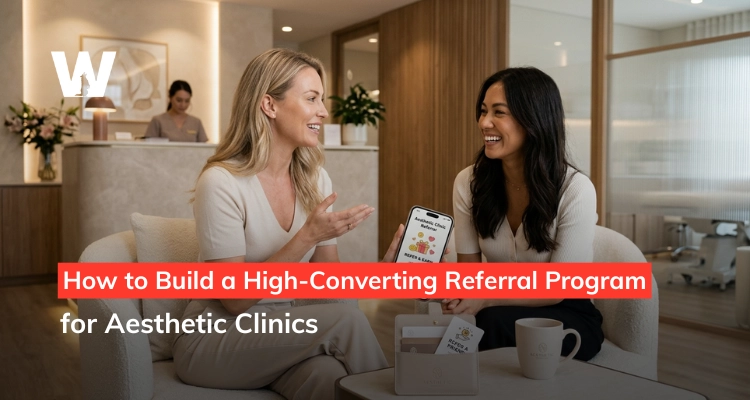
Think about how your best patients found you. Not your highest-volume months or your biggest Instagram post - your best patients. The ones who arrive already trusting you, who show up for follow-ups, who mention you to friends unprompted. Chances are, most of them came through a recommendation.
That's not a coincidence. According to research from the Wharton School of Business, referred customers have a 16% higher lifetime value and a 37% higher retention rate compared to patients acquired through other channels. For aesthetic clinics specifically, where trust is everything and treatment decisions are deeply personal, referrals are not just one growth channel among many. They're the highest-quality one.
Here's the gap most clinics sit in 83% of satisfied patients are willing to refer - but only 29% do. Not because they don't want to. Because nobody gave them a reason, a nudge, or a simple way to do it. That gap - between willingness and action - is exactly what a well-built referral program closes.
This guide walks you through how to build one that works in the aesthetic space. Not a generic "refer a friend" email blast. A proper, structured system that turns your happiest patients into a consistent source of high-intent bookings.
Let's be honest - most aesthetic clinics are leaving significant revenue on the table. Not from bad marketing. From absent marketing. Specifically, there is no system for turning the satisfied patients they already have into a growth engine.
The numbers are striking. Healthcare referral marketing achieves a 7.2% conversion rate - nearly three times the 2.6% average for paid digital channels. Referred patients also arrive with something no ad can manufacture pre-existing trust. They've heard about your clinic from someone whose opinion they value. That first consultation is an entirely different conversation when the patient already believes you're good.
We've seen this consistently across the clinics we work with. When a structured referral system is in place, consultation-to-booking conversion rates are noticeably higher than for patients arriving through Google Ads or social. The lead quality is simply better - because the source of the recommendation is a real patient with a real result, not an ad impression.
The average healthcare practice already gets 38% of new patients from word-of-mouth - and most of those referrals are entirely unstructured and untracked. A referral program doesn't create something new. It puts a proper system around something that's already happening.
There's a version of "referral marketing" that most clinics already do: the front desk occasionally mentions it; a post-treatment email vaguely hints at it, and some patients refer on their own. That's not a program - that's wishful thinking. Here's what a proper program actually looks like by comparison.
| Factor | Organic Word-of-Mouth | Structured Referral Program |
|---|---|---|
| Volume | Unpredictable - happens only when a patient remembers to mention it | Consistent - the system prompts, tracks, and follows up on every referral opportunity |
| Timing | Random - no control over when referrals occur | Controlled - triggered at the peak satisfaction moment after treatment |
| Tracking | None - you rarely know which patient sent the new booking | Full - every referral linked to a patient, a date, and a reward |
| Incentive | None - the patient refers purely from goodwill | Dual-sided reward - both the referrer and the new patient benefit |
| Scalability | Low - growth is limited by individual memory and motivation | High - compounds with every new satisfied patient added to your base |
| ROI Visibility | Invisible - no data, no attribution, no optimization possible | Clear - cost per referred patient, conversion rate, and LTV all trackable |
Note: A structured referral program does not replace organic word-of-mouth - it amplifies it by creating a consistent, rewarded mechanism around what already happens naturally.
Bottom Line: The gap between willingness and action is the entire opportunity. A referral program closes that gap with a system, not wishful thinking.
The first decision in any referral program is structure: do you reward only the patient who refers, or do you reward both the referrer and the person they send your way?
The data makes a clear case for double-sided programs. Over 78% of high-performing referral programs reward both parties, because it changes the psychology of the referral. When the friend being referred also gets something - a discount on their first consultation, a complimentary skin assessment - the referral stops feeling like the existing patient is doing a favour for the clinic and starts feeling like they're doing a favour for their friend. That distinction matters enormously in the aesthetic space, where patients are protective of who they recommend.
Single-sided programs work fine when your patient base is highly loyal, and your treatments generate frequent repeat visits. But for most aesthetic clinics - where booking frequency is lower and the consultation is a significant trust commitment for new patients - a double-sided structure is the better starting point.
This is where a lot of clinic referral programs go wrong. They offer a cash discount and wonder why the program feels transactional - or worse, why patients feel slightly uncomfortable referring. In aesthetic medicine, the wrong incentive can inadvertently make the clinic feel like a product rather than a practice.
Treatment credits work better than cash discounts for most aesthetic clinics. Offering the referring patient with a credit toward their next treatment (say, a complimentary skin booster or a top-up session valued at a specific amount) keeps the reward tied to the clinical experience rather than a price reduction. It also keeps the patient in your chair - which is exactly where you want them.
Exclusive access is another option that works especially well for premium clinics. Early access to new treatments, an invitation to a clinic event, or a complimentary consultation with a senior practitioner are all rewards that feel elevated without costing the clinic at a significant margin. They also reinforce the sense of belonging that high-value patients respond to.
What does not work is an incentive that's too small to notice or so large it feels suspicious. A tiny discount signals that the referral is an afterthought. An over-the-top cash reward raises questions about why the clinic is paying so much for a patient. Calibrate the reward to what feels genuinely generous within the context of your treatment pricing.
Here's a truth that most referral programs ignore people who don't fail to refer because they don't want to. They fail because the process is a bit annoying; the link is buried in an email, or they simply forget by the time they're home. Friction is the enemy.
The referral journey needs to be frictionless end-to-end. After a successful treatment, the patient gets a short, warm follow-up message (SMS works better than email for this) with a personalized referral link or a QR code they can screenshot and share. That link takes the referred friend directly to a booking page with the incentive already applied - no codes, no forms to fill out, no hoops.
Timing matters here. Send the referral prompt 3 to 7 days post-treatment - when the patient is noticing and appreciating their results, but the experience is still fresh. That is the peak satisfaction window. Too soon and it feels pushy. Too late and the moment has passed.
And don't rely on one touchpoint. A reminder at the 2-week mark, a mention during the next in-clinic visit, and a note on your social media content that subtly reinforces the program all work together. The best referral programs feel omnipresent without being annoying - patients encounter them at natural moments rather than through repeated hard sells.
The word "referral program" can make some clinic owners cringe a little - and understandably. In healthcare and aesthetics, you're building a relationship based on clinical trust, not a loyalty card scheme at a coffee shop. The way you communicate the program needs to match that environment.
Frame it around the friend, not the reward. "Know someone who's been thinking about a skin treatment? We'd love to meet them" lands very differently to "Earn credit when you refer!" One is generous and warm. The other sounds like a telecom company.
In-clinic promotion works best when it's subtle and personal. A small card at the reception desk. A quiet mention by the practitioner at the end of a consultation. A tasteful note in your post-visit follow-up. The goal is for patients to feel like they're being let in on something - not marketed at. Clinics that nail this tone find that patients actively enjoy telling their friends, because it positions the patient as someone with access to something good rather than someone forwarding a coupon.
Online, keep it simple. A dedicated page on your website, a periodic mention in your email newsletter, and a story or post on social media every few weeks is enough. You're not building a loyalty program app. You're creating awareness of a consistent, quietly running system.
A referral program you're not measuring is just hope dressed up as a strategy. The good news is you only need four metrics to know exactly how well your program is performing - and what to adjust when it's not.
Use the table below as your quarterly tracking dashboard. If any metric is significantly below its target range, that tells you exactly where in the referral journey something is breaking - whether it's the incentive, the sharing process, the landing page, or the follow-up.
| Metric | What It Measures | Target Range for Aesthetic Clinics |
|---|---|---|
| Referral Rate | Percentage of active patients who refer someone within a 90-day window | 5-10% is a healthy baseline; 15%+ indicates exceptional incentive design |
| Referral Conversion Rate | Percentage of referred prospects who book and attend a consultation | 7-15% is realistic for aesthetics, with strong programs exceeding 15% |
| Time-to-Book | Days between the referral share and the first appointment | Under 14 days for warm referrals; above 21 days signals friction in the booking path |
| Referred Patient LTV | Average revenue per referred patient over 12 months | Target 16-25% higher than your non-referred patient average (Wharton benchmark) |
| Reward Redemption Rate | Percentage of earned rewards that are used by patients | Above 60% signals a well-designed incentive; below 40% suggests the reward is not motivating enough |
| Program ROI | Revenue generated from referred patients vs. total cost of the program including rewards | Healthcare referral programs average 3-6x ROI; aim for 4x minimum in the first year |
Note: Benchmarks sourced from Wharton School of Business, Accenture Health, and GrowSurf healthcare referral data. Adjust targets based on your clinic's treatment mix and patient acquisition cost.
Bottom Line: Review these numbers every quarter. A referral program that isn't being optimized is a referral program that's slowly underperforming.
We're going to be direct here. A referral program is not complicated to understand - but it is easy to build badly. The wrong incentive kills participation. A clunky sharing process kills conversions. Inconsistent promotion means the program dies quietly in the background after six weeks.
We've built growth systems for aesthetic and healthcare clinics across India, the UK, the USA, and Canada. Our team of in-house specialists - including strategists, designers, content writers, and CRM-focused marketers - designs referral programs that are tailored to the specific patient profile, treatment mix, and brand positioning of each clinic.
The proof is in the numbers. The aesthetic clinic clients we support through our full-service aesthetic clinic marketing programme consistently see patient acquisition costs fall and lifetime patient value rise as referral systems mature. One clinic saw a 127% increase in GBP visibility and a 67% increase in direct calls - from a combined strategy that included referral activation alongside local SEO and social. These things compound when they're designed to work together.
We don't just hand you a playbook and wish you luck. We build the system, set up the tracking, run the promotions, and optimize quarterly. If you want a referral program that generates consistent bookings - not one that sits in a deck and never gets implemented - this is where that conversation starts.
The best referral programs for aesthetic clinics are not the most complex ones. They're the ones that make it genuinely easy for a happy patient to share something good with someone they care about - and that reward both people fairly when they do.
Get the structure right, choose an incentive that feels like a clinic reward rather than a discount code, build a frictionless sharing journey, promote it warmly, and measure the four metrics that tell you whether it's working. Do that consistently and you're building one of the most cost-effective patient acquisition channels available to an aesthetic clinic.
If you want a referral program designed, built, and managed for your clinic - not a template, but an actual system tailored to how your patients think and behave - talk to the team at Wolfable. We know this space, and we know what works in it.
Go deeper on growing your aesthetic clinic's patient base with these Wolfable resources: