Healthcare
Wraps up in 14 Minutes
How Cosmetic Clinics Can Manage Online Reviews Across Platforms

Published On May 8, 2026
Wraps up in 14 Minutes
Published On May 8, 2026
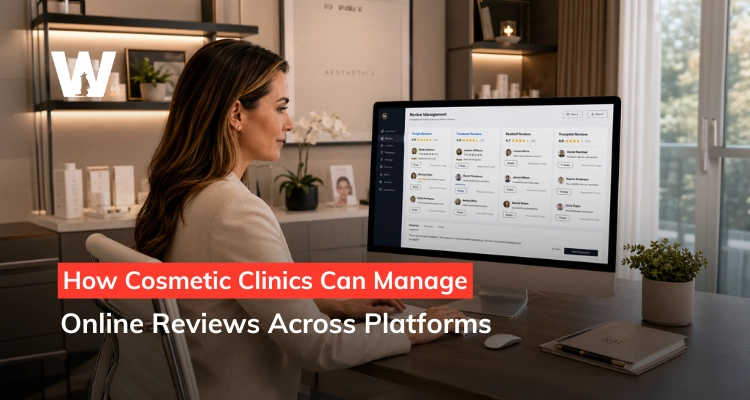
Before a patient ever calls your clinic, they have already read your reviews. Your star rating on Google, your profile on Practo, your RealSelf thread, your Trustpilot page - these are the waiting room that exists before the waiting room. And for cosmetic clinics, where patient decisions are deeply personal and high stakes, that digital waiting room matters enormously.
According to BrightLocal's 2026 Local Consumer Review Survey, 98% of consumers read online reviews for local businesses. In the same report, nearly a third of consumers in 2026 said they would only use a business with a rating of 4.5 stars or higher - almost double the figure from the previous year. For cosmetic clinics, where trust and clinical credibility are the primary purchase drivers, the bar is higher still.
The challenge is not just collecting reviews. It is managing them intelligently across multiple platforms that each behave differently, attract different patient demographics, and carry different weight with search engines and prospective patients. Most clinic owners know they should be "doing something" with reviews - but few have a system for it.
This guide gives you that system. We cover which platforms actually matter, how to generate reviews consistently, how to respond to every type of feedback - positive or negative - and how to turn your review profile into a patient acquisition asset.
Most clinic owners view reviews as a reflection of past performance. The more useful frame is to see them as a live sales channel - one that operates around the clock and speaks directly to every prospective patient who searches for your name or your treatment category online.
Reviews influence your clinic's performance in two distinct ways. First, they shape patient perception - a prospective patient reading twelve detailed reviews about your team's bedside manner and treatment results is already building trust before they have spoken to a single person at your clinic. Second, they directly affect your local search visibility. Review quantity, recency, and response rate are all considered as part of Google's local ranking algorithm for aesthetic clinics - clinics that actively manage their review profile consistently achieve better Map Pack positioning.
Research from healthcare review management studies shows that it takes approximately 40 positive reviews to offset the reputational impact of a single negative one. That math underscores why review generation needs to be an ongoing, systematic process - not a reactive push after a complaint surfaces.
In our experience working with aesthetic clinics across India and the UK, clinics that treat review management as a structured weekly operation see measurably higher consultation request rates than those managing it informally. The system is not complicated - but it does require consistency.
Not all review platforms carry equal weight. The platforms that matter depend on your geography, your patient demographics, and your treatment mix. Here is a clear breakdown of where cosmetic clinics need to have an active, managed presence in 2026.
| Platform | Primary Geography | Patient Profile | Why It Matters for Clinics | Response Capability |
|---|---|---|---|---|
| Google Business Profile | Global | All patient types searching locally | Direct local SEO ranking factor, Map Pack visibility, highest traffic volume | Full - reply to every review from GBP dashboard |
| Practo | India, Southeast Asia | Urban Indian patients booking aesthetic and wellness treatments | Dominant booking platform in India - critical for metropolitan clinic visibility | Full - respond via Practo Pro dashboard |
| RealSelf | USA, UK, Canada, Australia | High-research patients evaluating specific procedures | Reviews rank in Google searches for procedure names - high impact for surgical and injectable specialties | Full - respond to reviews via provider account |
| Trustpilot | UK, Europe, Global | Consumers seeking institutional credibility signals | Strong trust signal for UK-based clinics and internationally marketed services | Full - verified business account required |
| Yelp | USA | US-based discovery patients searching via Yelp or Apple Maps | Secondary trust layer in US market - avoid directly soliciting reviews per platform rules | Full - but direct review requests are against Yelp guidelines |
Note: Platform priority should reflect your clinic's primary market. Indian clinics should weight Practo and Google equally. UK and US clinics should prioritise Google and RealSelf.
Bottom Line: Google Business Profile is non-negotiable for every cosmetic clinic globally. Every other platform is a layer of trust on top of that foundation.
The single biggest mistake cosmetic clinics make with reviews is waiting for them to appear organically. Happy patients leave reviews when they are prompted. Disappointed patients leave reviews without prompting. That asymmetry means a passive approach will always underperform.
A functional review acquisition system has three components: the right timing, the right channel, and the right ask. On timing, BrightLocal's research shows that 40% of healthcare patients prefer to be asked for a review within three days to a week of their appointment - enough time to notice and appreciate the results, but close enough to the experience to write something meaningful.
The right channel depends on your patient mix. SMS has a higher open rate than email and works well for post-visit follow-ups. Email works better for patients who engage with you through a digital booking journey. A short, personalized message with a direct link to your preferred review platform removes every barrier between a happy patient and a posted review.
The right ask is warm, specific, and never incentivized. "We hope you're happy with your results - if you have a moment, it would mean a great deal if you could share your experience on Google" performs far better than a generic template. And it keeps you compliant with platform guidelines that prohibit review gating or offering rewards in exchange for feedback.
Response rate is one of the most visible and most neglected elements of clinic reputation management. According to BrightLocal's 2024 consumer research, 88% of consumers prefer businesses that respond to both positive and negative reviews - compared to just 47% who would consider a business that does not respond to any. For cosmetic clinics, where trust is everything, that gap is significant.
The goal of every response is not to win an argument or to thank someone for their praise. The goal is to demonstrate to the next ten prospective patients reading that review that your clinic is attentive, professional, and genuinely invested in patient experience.
Positive reviews deserve more than a generic "Thank you for your kind words." Personalize every response - reference the treatment or the aspect of the experience they mentioned. Keep it warm, specific, and brief. This signals to future patients that there are real people behind the clinic profile, not a scheduled template.
Negative reviews require a professional, empathetic response - always. Never get defensive, never argue publicly, and never disclose clinical details in the response. A strong response acknowledges the experience, expresses genuine regret that it did not meet expectations, and invites the patient to contact the clinic directly to resolve the matter.
This approach does two things simultaneously: it gives the dissatisfied patient a path forward, and it shows every future patient that your clinic takes feedback seriously. Research consistently shows that a personalized response to a negative review can win back 51% of dissatisfied patients - making your response strategy one of the highest-ROI reputation activities available to a clinic.
Fake reviews are a documented and growing problem across all platforms. Google has the highest proportion of potentially fraudulent reviews at 10.7%, followed by Yelp at 7.1% and Facebook at 4.9%. For cosmetic clinics - which can attract competitor sabotage or reviews from people who are never patient - knowing how to respond to fake content is not optional.
The first step is recognition. Fake reviews often share identifiable characteristics: they lack specific treatment or appointment details, the reviewer's profile shows no other review history, the language is unusually generic or emotionally extreme, and the timing clusters around specific dates or competitor activity.
Once identified, the process is: flag it through the platform's official reporting system, respond publicly with a calm, factual statement (never accusatory - state simply that you cannot find a record of this patient in your system and invite them to contact the clinic directly), and document everything in writing in case escalation is needed. Do not attempt to have a review removed through unofficial channels - platforms detect this, and it can damage your standing.
In 2026, BrightLocal reports that 97% of consumers believe businesses should face consequences for using fake reviews - and platforms are responding with more active detection. The clinics best protected are those with a high volume of genuine, recent reviews that make any fraudulent outlier statistically obvious.
The most underused function of review management is the operational intelligence that patient feedback contains. When three separate reviews in a quarter mentioned long waiting times, that is a scheduling problem. When five reviews praise the consultation process, but none mention the front-desk team, that is a gap in patient experience. Reviews, read systematically, are a low-cost patient experience audit.
Set a monthly review of all feedback across platforms. Look for repeated themes - both positive and negative. Feed those themes into team briefings. When you fix something that patients complained about in reviews, the improvement shows in future reviews - and the trajectory itself becomes part of your clinic's public story. Patients notice when a clinic improves and acknowledges it.
The table below contrasts how common review scenarios are typically mishandled versus how they should be addressed by a well-run clinic:
| Review Scenario | What NOT to Do | What to Do Instead |
|---|---|---|
| Negative experience - results concern | Get defensive, dispute the patient's perception publicly, mention clinical details | Acknowledge the concern with empathy, invite the patient to contact the clinic directly to discuss - no clinical disclosure |
| Low star rating, no written explanation | Leave it unanswered or respond with a generic message | Respond warmly, ask if they would be willing to share what could have been better, provide a direct contact |
| Suspected fake or competitor review | Ignore it, respond angrily, or attempt to get it removed through unofficial means | Respond professionally noting you have no record of this patient, flag via platform tools, document the incident |
| Positive 5-star review | Respond with a templated "Thank you for your lovely review!" message every time | Personalise the response - reference the specific treatment or experience detail mentioned - keep it warm and genuine |
| Repeated complaint about same issue | Respond individually but take no internal action | Flag the pattern at the next team meeting, make the operational fix, acknowledge the improvement in a subsequent public response |
Note: All review responses for healthcare providers should avoid disclosing any identifiable patient information or clinical details, in line with data protection obligations applicable in your jurisdiction.
Bottom Line: Review responses are not just for the reviewer - they are read by every future patient considering your clinic. Write for the audience, not just the individual.
Managing reviews across five or six platforms, responding within 24 hours, spotting fake content, and turning feedback into operational intelligence - this is a full system. For most clinic owners and practice managers, it is also a system that gets deprioritized when clinical work intensifies. That's exactly where we come in.
Wolfable works exclusively with clinics, manufacturers, and B2B businesses across India, the UK, the USA, and Canada. Our in-house specialists - including dedicated reputation management and local SEO strategists - treat your review profile with the same rigour your clinical team applies to treatment protocols.
We have built reputation management systems for aesthetic clinics from the ground up. For one of our cosmetic clinic clients, a structured local SEO and reputation programme delivered a 127% increase in Google Business Profile views, a 104% increase in website clicks from search, and a 67% increase in direct calls from GBP - within a few months of implementing a consistent, platform-wide review strategy. The reviews were not the only factor - but they were critical pillars.
Your review profile is not a passive record of past appointments. It is an active, living part of your clinic's marketing - one that influences local search rankings, patient decision-making, and your ability to compete against newer or more prominent clinics in your area.
Managing it well means knowing which platforms to prioritize, building a review acquisition system that runs consistently, responding to every piece of feedback with care and professionalism, and reading review patterns as a window into your patient experience. None of this requires a large team - but it does require a structured approach.
If you want a review management system built and run for your clinic - one that generates consistent patient feedback, protects your rating, and feeds your local SEO rankings - the team at Wolfable has the playbook ready.
Explore these Wolfable resources to build on what you've learned here: