Aesthetic Clinic
Wraps up in 6 Minutes
SEO for Aesthetic Clinics: Ranking for High-Intent Treatment Keywords

Published On December 9, 2025
Wraps up in 6 Minutes
Published On December 9, 2025
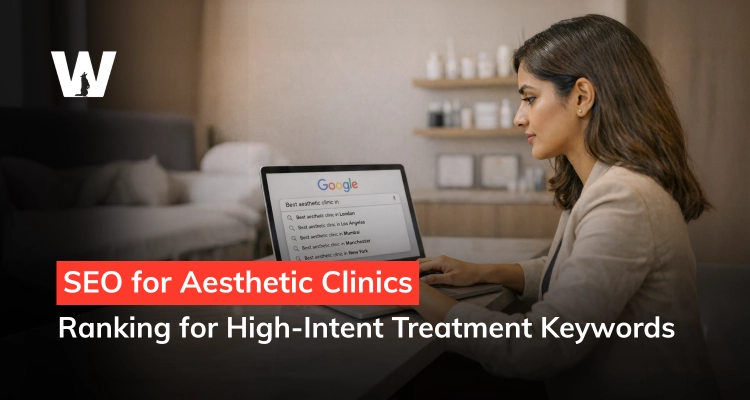
You have the advanced lasers. You have the skilled injectors. You have the stunning clinic interior. But do you have the patients?
In the aesthetic industry, "build it and they will come" is a myth. If your potential patients can’t find you when they type "best lip filler near me" or "CoolSculpting cost" into Google, you simply don’t exist to them.
The aesthetic market is saturated. To win, you don't just need traffic; you need high-intent traffic. You need the person who has their credit card ready, not the one just browsing for DIY skincare tips.
At Wolfable, we don’t believe in cookie-cutter marketing. We believe in an "artisanal" approach—crafting strategies that fit your specific clinic’s brand and goals. This guide isn't just about getting clicks; it’s about filling your appointment slots with the right patients.
Most generalist agencies treat a medical clinic the same way they treat a t-shirt shop. This is a fatal mistake.
Aesthetic medicine falls under Google’s YMYL (Your Money or Your Life) category. This means Google holds your website to a much higher standard of accuracy and safety than a lifestyle blog. If your content is vague, unverified, or purely sales-driven without educational value, Google’s algorithms will suppress it to protect users.
Standard SEO chases volume. Aesthetic SEO chases trust.
When a patient looks for a cosmetic treatment, they are making a decision about their body and their health. They are anxious. They are researching safety, downtime, and results. Your SEO strategy must bridge the gap between their anxiety and your expertise.
Wolfable Insight: We helped a Hair & Skin Clinic achieve a 429% increase in website traffic not by posting generic articles, but by creating deep, medically accurate content that answered specific patient fears.
Not all keywords are created equal. In the world of aesthetics, there is a massive difference between "informational" intent and "transactional" intent.
1. Low Intent (Informational): "How to get rid of wrinkles"
User Mindset: Just browsing. Might buy a cream at a pharmacy.
2. Medium Intent (Commercial Investigation): "Botox vs. Dysport reviews"
User Mindset: Comparing options. Interested but not committed.
3. High Intent (Transactional): "Best Botox clinic in [City Name]" or "Under eye filler price"
User Mindset: Ready to book. Looking for a provider.
User Mindset: Ready to book. Looking for a provider.
Your SEO strategy must prioritize tier 3. Ranking #1 for "wrinkles" might bring 10,000 visitors, but ranking #1 for "wrinkle treatment clinic [City]" will bring 100 visitors who pay.
Start by mapping your highest-margin treatments. If you make the most profit on laser hair removal packages, your keyword research shouldn't focus on "shaving tips." It should focus on:
Stop guessing what your patients type. Let’s find the data together.
At Wolfable, we often say we are "artisans" of growth. In the context of aesthetic SEO, this means hand-crafting content that proves you are the expert.
Google’s E-E-A-T guidelines are the most critical factor for ranking aesthetic websites.
You cannot use generic, AI-generated fluff for treatment pages. A potential patient can tell if a page was written by a robot or a medical professional.
Authority comes from external validation.
For aesthetic clinics, Local SEO is arguably more important than organic search. When a user searches "Dermatologist near me," Google displays the "Map Pack" (the top 3 map results) before the traditional website links.
Your Name, Address, and Phone number must be identical across the web. If your Google Profile says, "Elite Aesthetics" but your Yelp page says, "Elite Aesthetics & Spa," Google gets confused and lowers your ranking.
Reviews are a direct ranking factor. But you need more than just stars; you need keywords in the reviews.
Don't just pick "Medical Spa." Utilize secondary categories like "Skin Care Clinic," "Laser Hair Removal Service," and "Dermatologist" to cast a wider net.
Struggling to get into the top 3 map results?
Your homepage is your lobby, but your service pages are your consult rooms. This is where the conversion happens.
Many clinics make the mistake of having one page called "Services" with a bulleted list. This is SEO suicide. You need a dedicated, long-form page for every single treatment you offer.
Wolfable Tip: We use Schema Markup (structured code) on these pages to tell Google explicitly: "This is a Medical Procedure," "This is the Price Range," and "This is the Location." This helps your snippets stand out in search results.
The aesthetic industry is visual. Patients want to see the transformation.
A 60-second video of the doctor explaining a procedure builds more trust than 2,000 words of text.
Did You Know? Wolfable produced a video strategy for a manufacturing client that garnered 1 million+ views on YouTube. We apply that same "storytelling" capability to our healthcare clients to demystify complex treatments.
Search is changing. Users are now asking AI tools like ChatGPT or Google’s Gemini for recommendations. This is called Answer Engine Optimization (AEO).
AI models prefer content that is structured, factual, and direct.
Start your paragraphs with the answer.
Structure your blogs with questions as headers (H2s and H3s). This mimics the natural language users type into chat bots.
AI loves structured data. Use tables to compare treatments (e.g., "Botox vs. Dermal Fillers") to increase the chances of being cited as the source.
| Feature | General SEO Agency | Wolfable’s "Artisan" Approach |
|---|---|---|
| Keyword Strategy | Chases high volume (e.g., "Beauty tips") | Chases high intent (e.g., "Under eye filler cost") |
| Content Quality | Generic, often AI-generated | Medically accurate, E-E-A-T focused, Doctor-reviewed |
| Local Focus | Basic directory listings | Comprehensive Map Pack optimization & Review strategy |
| User Experience | Focuses only on desktop | Mobile-first design (since 80% of patients search on phone) |
| Reporting | "Traffic" and "Rankings" | "Leads," "Bookings," and "Revenue" |
You wouldn’t perform surgery in a dirty room. Don’t run your marketing on a messy website.
If your site is hard to navigate on an iPhone, you are losing 80% of your aesthetic clientele. Your "Book Now" button must be a "sticky" element that is always visible on the screen.
Google measures "Core Web Vitals"—speed, responsiveness, and visual stability.
Users are submitting personal health information. If your site isn't secure (showing the padlock icon), Google will warn users away, and your trust will evaporate.
Is your website technically healthy?
SEO gets them to the door; content gets them to stay.
A blog isn't just for ranking; it's for nurturing. A patient might find you for "lip fillers" but then read your article on "The benefits of medical-grade facials" and book a second treatment.
Content Clusters for Clinics:
Create "hub" pages for main categories (e.g., Anti-Aging) and link them to "spoke" pages (e.g., Botox, RF Microneedling, Chemical Peels). This internal linking strategy tells Google you are an authority on the entire topic of Anti-Aging.
Wolfable’s Approach: We don't just write blogs; we create "knowledge centers." For our clients, we produce patient guides, recovery checklists, and myth-busting articles that position the clinic as a thought leader.
The aesthetic market is evolving rapidly. Algorithms are changing, AI is rising, and patient expectations are higher than ever. Relying on outdated tactics or generic agencies is a recipe for stagnation.
At Wolfable, we understand the "art" of growth. We know that behind every keyword search is a person looking for confidence. We nurture your digital presence with the same care you treat your patients. Whether you need to dominate the local Map Pack or completely overhaul your digital strategy, we are your partner on the journey from now to what’s next.
Ready to fill your appointment book with high-value patients?